Crypto Payment Penalty Calculator
Calculate Your Potential Penalty
Based on Russia's 2025 laws, using cryptocurrency for domestic transactions carries significant legal risks. This calculator shows potential fines for violations.
Potential Penalty Range
Important: Fines are just one consequence. Your crypto assets may be seized permanently, and tax violations carry additional penalties up to prison time.
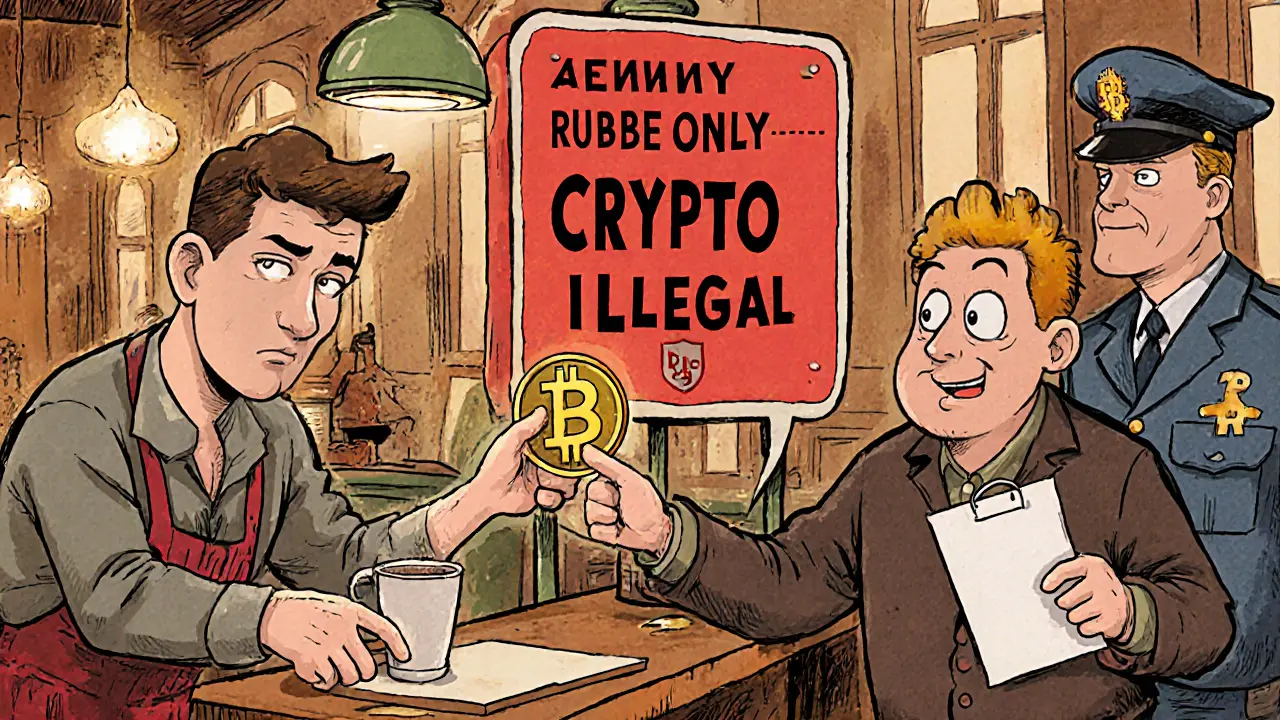
Can you use Bitcoin or Ethereum to buy coffee in Moscow? The short answer is no - and if you try, you could face serious fines. As of 2025, Russia has made it crystal clear: cryptocurrency payments are illegal for any domestic transaction. You can own crypto. You can trade it. You can even mine it. But you cannot use it to pay for groceries, rent, or services inside Russia. The law doesn’t just discourage it - it actively punishes it.
What’s Actually Illegal?
The Russian government doesn’t ban owning cryptocurrency. That’s allowed. But using it as money? That’s where the line is drawn. The Central Bank of Russia has been pushing for a total ban on crypto payments since 2021, and by 2025, the rules are fully enforced. If you’re a Russian citizen or business and you accept Bitcoin for a product sold in St. Petersburg, you’re breaking the law. Same goes for paying your contractor in Ethereum. Even if both parties agree, it’s still illegal. The law treats crypto like gold or foreign currency - something you can hold, but not spend. The ruble is the only legal tender. This isn’t about distrust in the technology. It’s about control. The government wants to keep the ruble dominant, especially after Western sanctions hit Russian banks and payment systems like SWIFT. Crypto, in their view, threatens that control.There’s One Big Exception: International Trade
Here’s where things get complicated. While you can’t pay for a Russian-made phone with Dogecoin inside Russia, you can use crypto to pay a company in Turkey or India for goods they ship to you. That’s thanks to the Experimental Legal Regime (ELR), a narrow loophole created in 2022. The ELR allows Russian businesses to conduct cross-border transactions in cryptocurrency - but only if they’re dealing with foreign partners. This wasn’t designed to help tech startups. It was a sanctions workaround. When banks cut off access to dollars and euros, Russian exporters needed a way to get paid. Crypto filled that gap. In 2025, crypto-facilitated international trade reached 1 trillion rubles ($11 billion USD). That’s real money. And it’s growing. The ELR also lets a small group of "highly qualified" investors trade crypto derivatives. But regular people? No access. No wallets for payments. No apps for peer-to-peer transfers. Just a legal gray zone for big companies and foreign deals.What Happens If You Get Caught?
Starting in 2026, the penalties get much worse. Right now, enforcement is uneven. But new draft laws will make violations expensive - and risky. If you’re caught using crypto to pay for something in Russia, you could be fined between 100,000 and 200,000 rubles (about $1,100-$2,200 USD). For businesses? That jumps to 700,000-1 million rubles ($7,700-$11,000 USD). But fines aren’t the worst part. The crypto you used? It gets seized. Permanently. Authorities can freeze your wallet, trace the transaction, and take the coins. No appeal. No refund. And if you’re doing this repeatedly, or on a large scale, you could face criminal charges. The tax code adds another layer. Every time you sell, trade, mine, or earn crypto - even from staking or airdrops - you owe income tax. You must report it by April 30 and pay by July 15. The tax is calculated in rubles, using official exchange rates. Failing to report? That’s a fine of 50,000 rubles ($550 USD) plus 40% of unpaid taxes. If you hid over 45 million rubles ($500,000 USD) in crypto over two years? You could be looking at forced labor or prison time.
How Are They Tracking You?
You might think you can hide crypto transactions. You’d be wrong. Russian tax authorities have built automated systems that scan blockchain data, exchange records, and even foreign wallet addresses linked to Russian IP addresses. They don’t need your permission. They don’t need a warrant. They just need data. If you bought Bitcoin on Binance and later sent it to a Russian-based wallet, that’s visible. If you mined crypto using a server in Kazan, the power usage patterns can be flagged. Even if you use a VPN, your transaction history on exchanges is still tied to your ID if you ever used a Russian phone number or bank account to deposit funds. The system isn’t perfect - but it’s getting better. And it’s designed to catch the biggest players first. But once the fines start in 2026, smaller users won’t be ignored.Why Are People Still Using Crypto?
Despite the risks, over 15 million Russians still hold cryptocurrency - up 15% a year since 2021. Total holdings are estimated at over $40 billion. Why? Because the alternatives are worse. Western sanctions locked Russians out of Visa, Mastercard, PayPal, and most international banking. Many can’t access foreign apps or services without crypto. Some use it to buy digital services - like hosting, software subscriptions, or cloud storage - from companies that won’t accept rubles. Others use it to send money to family abroad. The problem? There are no legal Russian exchanges. You can’t open a crypto account with Sberbank. You can’t trade on a local platform approved by the Central Bank. So people rely on foreign exchanges - Binance, Bybit, KuCoin - and risk getting blocked or frozen. It’s a patchwork of workarounds, all operating in legal shadows.





priyanka subbaraj
November 27, 2025 AT 11:31This is insane. They ban crypto payments but let you mine it? Like, what’s the point? I’m not even surprised anymore - authoritarian regimes always want control, not innovation.
Just wait till they start taxing your emotional energy next.
George Kakosouris
November 28, 2025 AT 23:13Let’s unpack the macroeconomic implications here. The Central Bank’s monetary sovereignty thesis is textbook - they’re weaponizing legal tender laws to circumvent SWIFT isolation. But the ELR loophole? That’s a classic regulatory arbitrage play. Crypto isn’t being adopted - it’s being exploited as a sanctions-resistant settlement layer.
What’s alarming is the tax enforcement infrastructure: blockchain forensics + IP geolocation + KYC linkage = de facto surveillance state. No decentralization here - just centralized control with a blockchain veneer.
Ben Costlee
November 29, 2025 AT 07:42I get why people are still holding crypto - it’s not about speculation, it’s survival. When your bank won’t let you pay for a Zoom subscription or access a cloud server because of sanctions, what else do you do?
It’s heartbreaking, honestly. People aren’t rebels here - they’re just trying to stay connected to the world. The government’s fear isn’t of crypto. It’s of people finding ways to be free without asking permission.
And yes, the fines are brutal. But the real tragedy? The system doesn’t see them as people. Just violations.
Mark Adelmann
November 30, 2025 AT 18:00Man, I used to think crypto was all about freedom - but this? This is like using a secret handshake to buy coffee while the cops are watching.
Still, I’ve got friends in Moscow who swear they pay their dog walker in Dogecoin. They say the cops don’t care unless you’re doing it big. Maybe that’s the new underground economy - tiny, personal, invisible.
Just don’t get caught. And always file your taxes. Seriously. I’ve seen people lose everything over one missed form.
ola frank
December 1, 2025 AT 02:40The structural contradiction here is glaring. The state permits crypto as a store of value and a cross-border settlement mechanism while criminalizing its use as a medium of exchange - effectively creating a dual-tier monetary system where the ruble is the only legal tender, yet crypto functions as a de facto parallel currency for international capital flows.
This is not a ban on crypto - it’s a redefinition of its role to serve state interests. The ELR is not a loophole - it’s a strategic concession. The tax regime, surveillance infrastructure, and asset seizure protocols are not enforcement mechanisms - they’re institutionalized coercion.
The question isn’t whether crypto will survive in Russia - it’s whether the state will survive its own contradictions.
imoleayo adebiyi
December 2, 2025 AT 23:41I just want to say - if you’re in Russia and you’re using crypto to pay for your kid’s online lessons or send money to your sister abroad, you’re not breaking the law to be a rebel. You’re doing it because you love your family and you’re trying to make things work.
That’s not criminal. That’s human. I hope someone sees that before the fines start.