
Merkle Root Calculator
Calculate the Merkle root for blockchain transactions and see how the Merkle tree works. Enter transaction hashes to simulate blockchain verification.
Transaction Input
Merkle Tree Visualization
Enter transaction hashes above to see the Merkle tree construction process
Verification Results
Every blockchain is built on blocks. But what’s inside those blocks? Most people think of transactions - sending Bitcoin, swapping tokens, locking up smart contracts. But the real magic happens in two hidden parts: the block header and the block body. One keeps the chain secure. The other holds the value. Together, they make blockchain work.
What’s in the Block Header?
The block header is tiny - just 80 bytes in Bitcoin. That’s less than a tweet. But it’s the most important part of the whole block. It doesn’t store transactions. It stores proof. Think of it like a seal on a legal document. If the seal is broken, the whole thing is invalid.
Here’s what’s inside:
- Version number - tells nodes which rules to follow when validating the block.
- Previous block hash - the fingerprint of the block before this one. This is how blocks link together. Change one block? The next one’s hash breaks. The chain snaps.
- Merkle root - a single hash that represents every transaction in the block body. It’s like a summary of all the receipts in a folder. If one receipt changes, the summary changes.
- Timestamp - when the block was created. Not exact, but close enough for consensus.
- Difficulty target - how hard it is to mine this block. Adjusts every two weeks in Bitcoin to keep block time around 10 minutes.
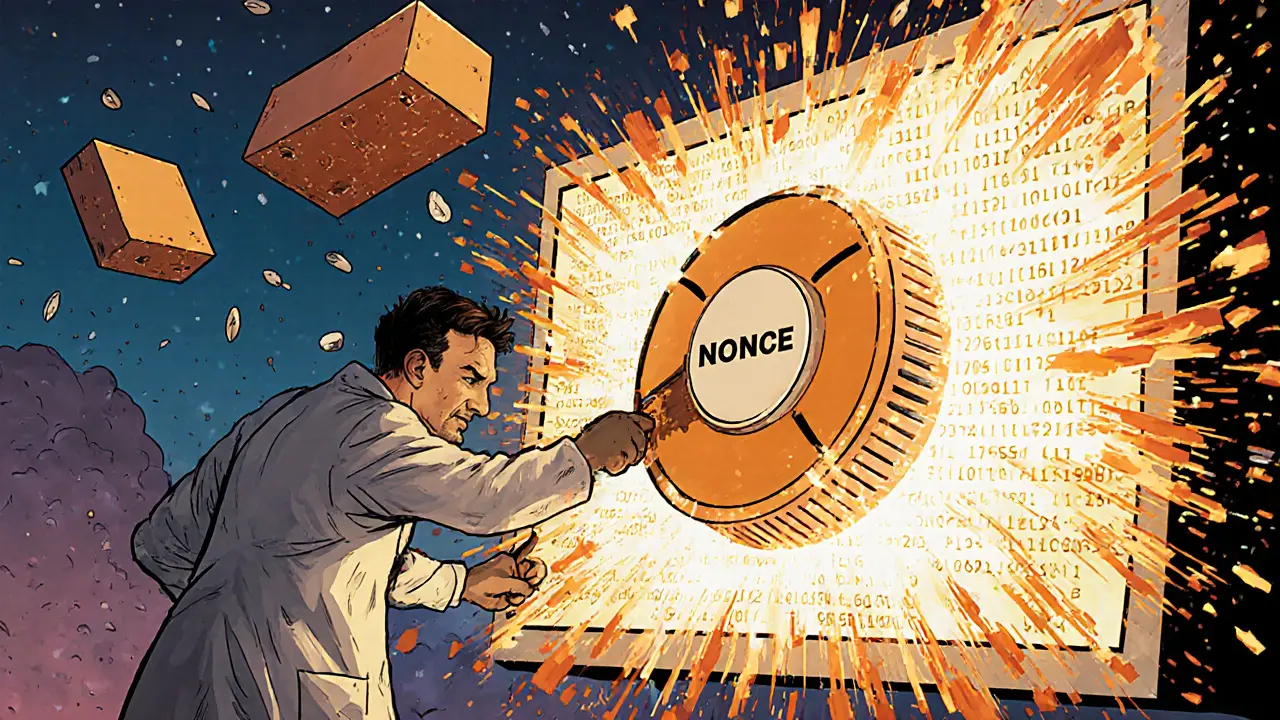
- Nonce - the magic number miners tweak over and over until the header hash starts with enough zeros.
This header is hashed - once - to create the block’s unique ID. That hash becomes the "previous block hash" for the next block. That’s the chain. No transaction data needed. Just this 80-byte fingerprint.
Miners don’t care about the transactions. They only care about the header. That’s why Bitcoin miners do 300 exahashes per second - all of it focused on guessing the right nonce in the header. The body? They just copy it. The header is where the work happens.
What’s in the Block Body?
The block body is where the action is. This is where your Bitcoin transfer lives. Or your NFT mint. Or your DeFi trade. It’s the reason blockchain exists.
In Bitcoin, the body starts with a count of how many transactions are in it (1 to 20,000+), then lists each one. Each transaction has inputs, outputs, signatures, and amounts. The whole thing can be up to 4MB after SegWit. That’s a lot of data.
But here’s the clever part: the Merkle root in the header is built from these transactions. Every transaction gets hashed. Then pairs of hashes are hashed together. Then those pairs get hashed. Repeat until you get one final hash - the Merkle root. That’s the only part of the body that goes into the header.
Why? Efficiency. If you’re a lightweight wallet on your phone, you don’t need to download 2MB of transactions to verify one payment. You just download the block header and a short proof (Merkle branch) showing your transaction is in there. The rest? You don’t need it. That’s what Satoshi Nakamoto meant by "Simplified Payment Verification" - and it works because of this header-body split.
Bitcoin vs Ethereum: Different Heads, Same Body Logic
Bitcoin’s header is clean. Simple. 80 bytes. Ethereum? Not so much.
Ethereum’s header is bigger - around 500 bytes. Why? Because it does more. It doesn’t just link blocks. It tracks the state of the whole network.
- State root - a hash of every account balance, contract code, and storage slot across the entire network.
- Transaction root - same as Bitcoin’s Merkle root, but for Ethereum transactions.
- Receipt root - a hash of all logs and outcomes from transactions (like who paid gas, what events fired).
This means Ethereum’s header isn’t just a chain link. It’s a snapshot of the entire system. That’s why changing a single transaction in the body doesn’t just break the Merkle root - it breaks the state root too. The whole network notices.
And the body? Bitcoin only has transactions. Ethereum has transactions and “ommers” (or uncles) - blocks that were mined but didn’t make it into the main chain. These are included to reward miners who worked hard but got outpaced. It’s a security tweak for faster block times.
Also, Bitcoin uses SHA-256. Ethereum uses Keccak-256. Different hashes. Same job.
Why This Split Matters
This design isn’t accidental. It solves three big problems:
- Security - tampering with a transaction changes the Merkle root, which changes the header hash, which breaks the chain. You’d need to rewrite every block after it - impossible with current computing power.
- Scalability - light wallets and mobile apps can verify transactions without downloading gigabytes of data. That’s how Bitcoin works on phones.
- Efficiency - miners only hash the header. They don’t waste energy processing megabytes of transactions. The body is just cargo. The header is the engine.
But it’s not perfect. Bitcoin’s 4MB limit and 10-minute block time mean slow transactions. Ethereum’s larger headers slow down light clients. Both systems are trying to fix this - but without breaking the header-body model.
What’s Changing? The Future of Headers and Bodies
Blockchain isn’t frozen in time. Changes are coming - but they’re building on this structure, not replacing it.
Ethereum is replacing Merkle trees with Verkle trees. Why? To make light clients even faster. Verkle trees let you prove a transaction is in a block with less data. The header will still exist. It’ll just be smarter.
Bitcoin is exploring MAST (Merkelized Abstract Syntax Trees). This lets smart contracts live in the body without bloating the header. More features. Same small header.
And then there’s Bitcoin Ordinals - people storing images and text directly in Bitcoin transactions. Block bodies are hitting 99% capacity. That’s pressure. But miners still only hash the header. The body keeps growing. The header stays tiny.
Even enterprise blockchains like Hyperledger Fabric keep the split. They just add private data fields to the body. The header still links blocks and proves integrity.

What Happens If You Break the Rules?
Try changing one byte in a transaction. The Merkle root changes. The header hash changes. The next block’s "previous block hash" no longer matches. The chain breaks. Every node rejects it.
Try changing the nonce in a mined block. The hash changes. The proof of work is invalid. Miners won’t build on it.
Try changing the timestamp to be 2 hours in the future? Nodes will reject it. Timestamps have rules.
This system isn’t just secure. It’s self-policing. The header-body split creates a feedback loop: tampering breaks the chain. The chain rejects tampering. No central authority needed.
Why Should You Care?
If you use crypto, you’re relying on this system every time you send a transaction. If you’re a developer, you need to understand it to build on top of it. If you’re just curious, knowing this helps you see why blockchain isn’t magic - it’s math, engineering, and clever design.
Block headers are the guardians. Block bodies are the treasure. One ensures trust. The other delivers value. And together, they’ve powered over $1.2 trillion in market value - without banks, without central servers, without a single point of failure.
That’s the power of a simple split: 80 bytes of code holding the world’s most secure ledger.
Can a block have no transactions in its body?
Yes, technically. A block can have zero transactions. The body would just contain the transaction counter (0) and nothing else. The header still needs to be valid - with a correct previous hash, nonce, and Merkle root (which would be a hash of an empty tree). Bitcoin has seen such blocks, usually mined by pools testing new software or during low-traffic periods. But they’re rare. Miners earn transaction fees, so empty blocks mean lost income. Most blocks include at least a few transactions.
Why is the block header only 80 bytes in Bitcoin?
It’s intentionally small to make mining and verification fast. Since miners hash the header over and over to find a valid proof-of-work, a smaller header means faster computations. It also lets lightweight wallets (SPV clients) download and verify blocks with minimal bandwidth. A 500-byte header like Ethereum’s would slow down mobile apps and increase storage needs. Bitcoin’s 80-byte header was a deliberate trade-off: sacrifice flexibility for speed and efficiency.
Does changing a transaction in the block body affect the header?
Yes, absolutely. Every transaction in the body contributes to the Merkle root. Change even one byte in one transaction - like the amount sent or the signature - and the entire Merkle tree recalculates. The new Merkle root won’t match the one stored in the header. That mismatch makes the block invalid. Nodes will reject it. That’s why the header-body link is so powerful: it makes tampering computationally impossible without rewriting the entire chain.
How do Ethereum’s larger headers impact performance?
Ethereum’s 500-byte headers use 6.25 times more data than Bitcoin’s 80-byte headers for the same verification task. This slows down light clients - wallets and apps that don’t download full blocks. It also increases bandwidth costs for nodes syncing the chain. Developers are working on solutions like Verkle trees to shrink verification proofs, but the header itself will remain larger than Bitcoin’s because it carries state data. The trade-off is more functionality (smart contracts, account balances) at the cost of efficiency.
Are block headers and bodies the same in all blockchains?
No. While nearly all major blockchains use a header-body split, the details vary. Bitcoin’s header is minimal. Ethereum’s includes state and receipts. Cardano’s header adds stake pool data. Solana’s header is over 1280 bytes to include proof-of-history timestamps. Some private blockchains simplify it further. But the core idea - a small, cryptographic header linking blocks and a larger body storing data - remains universal. It’s the most reliable way to build trust in a decentralized system.





Komal Choudhary
November 28, 2025 AT 00:32Bro why are we even talking about headers like they’re some sacred text? I just want my crypto to move fast and cheap. All this math is cool but my wallet app lags because of these 500-byte Ethereum headers. Can we please just optimize for real people?
fanny adam
November 29, 2025 AT 06:49Have you considered that this header-body architecture is not just technical-it’s a control mechanism? The fact that only miners can manipulate the nonce while the rest of us are locked into verifying hashes? This is how centralized power hides behind decentralization. The Merkle root isn’t security-it’s a cryptographic illusion designed to make you trust a system that benefits the few who control the ASICs.
Kristi Malicsi
November 30, 2025 AT 17:41So the header is like the soul of the block and the body is the body... wait no that’s not right. It’s more like the header is the fingerprint and the body is the whole damn person. But why does it matter if we’re just sending money? I mean I get it’s cool tech but I just wanna buy coffee with BTC without reading a whitepaper first
Evelyn Gu
December 2, 2025 AT 00:00I just want to say how deeply moving it is, honestly, to see how such a simple structural decision-splitting the header from the body-created this entire ecosystem of trust without a single human needing to say ‘I believe you’… and yet, every single time I send a transaction, I’m relying on that 80-byte header to hold the universe together, and it never fails, not once, not even when the market crashes or the internet goes down in my neighborhood, it just… keeps going, and I think that’s the most beautiful thing about blockchain, that it’s quiet, it’s steady, it doesn’t shout, it just works, and I’m so grateful for the people who designed it this way, because they thought about the little guy, the phone user, the person in a village with spotty internet, and they made it possible for them to be part of something global without needing a supercomputer… I just… I needed to say that.
Angel RYAN
December 2, 2025 AT 18:23Great breakdown. The header-body split is one of those elegant solutions that seems obvious in hindsight but took real genius to design. The fact that Bitcoin’s header stays tiny while Ethereum adds state roots shows how different priorities shape tech. Both work. Neither is ‘better.’ Just different needs.
stephen bullard
December 4, 2025 AT 10:58It’s wild to think that something as simple as hashing a few fields can create a system that’s tamper-proof and global. Like, we’re not just storing data-we’re storing trust in math. And that’s the real magic. No cops. No banks. Just code and consensus. I’m still amazed it works at all.
SHASHI SHEKHAR
December 6, 2025 AT 01:52OMG YES 🤯 The Merkle root is the MVP of blockchain! You don’t need the whole block to verify your transaction-just a tiny branch! It’s like proving you were at a party by showing your selfie with the DJ… not the whole guest list! 📸 And Verkle trees? That’s like upgrading from a photo to a live video proof! 🚀 Also, Bitcoin empty blocks? Happens when miners are testing new software or just chilling 😎 But yeah, they lose fees so most avoid it. Fun fact: the first ever empty block was mined by Satoshi himself in 2009-purely for testing! 🕵️♂️
Vaibhav Jaiswal
December 7, 2025 AT 20:07Man… I just imagined the block header as this tiny, quiet ninja sitting on top of a massive treasure chest (the body). The ninja doesn’t care what’s inside. Just makes sure the chest hasn’t been tampered with. And if someone tries to swap out a Bitcoin? The ninja whispers ‘nope’ to the whole network and the whole chain goes silent. That’s poetry right there.
Michael Labelle
December 9, 2025 AT 08:04One sentence: The header is the chain’s memory. The body is its life.