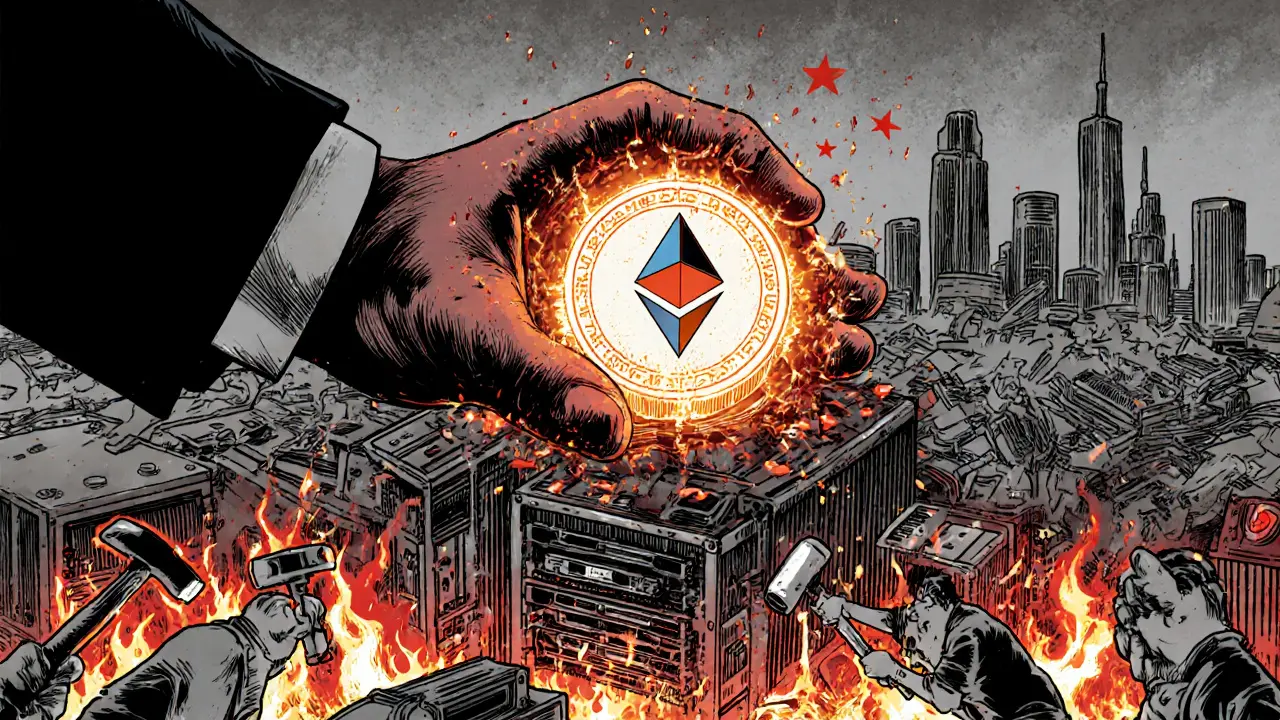
On June 1, 2025, China made it illegal to own, trade, or mine any cryptocurrency - not just Bitcoin or Ethereum, but all digital assets. This wasn’t a surprise. It was the final step in a 16-year campaign to wipe out private cryptocurrency use within its borders. What started as warnings in 2009 became a full-scale financial lockdown by 2025. Today, if you’re in China and you hold Bitcoin, you’re breaking the law. If you use a VPN to access Binance or Coinbase, you’re breaking the law. If you even try to mine Ethereum on a rig in your garage, you’re breaking the law.
How China Got Here: A 16-Year Crackdown
China didn’t wake up one day and decide to ban crypto. It built the ban piece by piece, year after year. In 2009, the government first warned that virtual currencies couldn’t be used to buy real goods. By 2013, banks were banned from handling Bitcoin transactions. In 2014, trading accounts were shut down. In 2017, Initial Coin Offerings (ICOs) were outlawed, and local exchanges like Huobi and OKEx were forced to close. By 2018, mining operations were already being shut down in provinces like Sichuan and Inner Mongolia. In 2021, the government went all-in on mining, shutting down every last mining farm in the country - not because of energy use alone, but because decentralized money threatened state control. The September 2021 ban was the turning point. It declared all crypto trading, mining, and transactions illegal. But there was still a loophole: individuals could still hold crypto privately. That changed on May 30, 2025, when the People’s Bank of China issued a final decree: no private ownership of digital assets under any circumstances. The clock started ticking. On June 1, 2025, it became a criminal offense to hold Bitcoin, Ethereum, or any other coin - even if you bought it before the ban.How the Seizures Work
The government doesn’t just say “no” - it takes action. Authorities now have legal power to seize cryptocurrency wallets, freeze bank accounts linked to crypto activity, and confiscate hardware used for mining. They use financial monitoring systems to track transfers between exchanges and domestic banks. Internet traffic is scanned for connections to foreign crypto platforms. Even using a VPN to access a crypto exchange can trigger an investigation. In October 2025, Chinese authorities coordinated with UK police after a Chinese national was arrested in London for running a $7 billion crypto fraud scheme. Police seized 61,000 Bitcoin from her home - the largest single Bitcoin seizure in history. But here’s the twist: while the UK government wants to use the funds to offset public spending, Chinese officials are demanding the coins be returned to victims - not because they care about justice, but because returning stolen crypto to Chinese citizens helps them maintain the illusion of control. The case shows how China’s enforcement doesn’t stop at its borders.Why China Won’t Back Down
This isn’t about protecting investors. It’s about power. China’s real goal is the digital yuan - its state-controlled Central Bank Digital Currency (CBDC). By eliminating Bitcoin and Ethereum, the government removes competition. No one can bypass the financial system. No one can send money outside China without approval. No one can store wealth outside state control. The digital yuan isn’t just a payment tool - it’s a surveillance tool. Every transaction is tracked. Every balance is visible. Every transfer can be frozen. Experts agree: China’s ban is strategic, not reactionary. It’s part of a larger move to dominate global finance by controlling the flow of digital money. While the U.S. and EU debate regulation, China chose total elimination. They don’t want to regulate crypto - they want to erase it.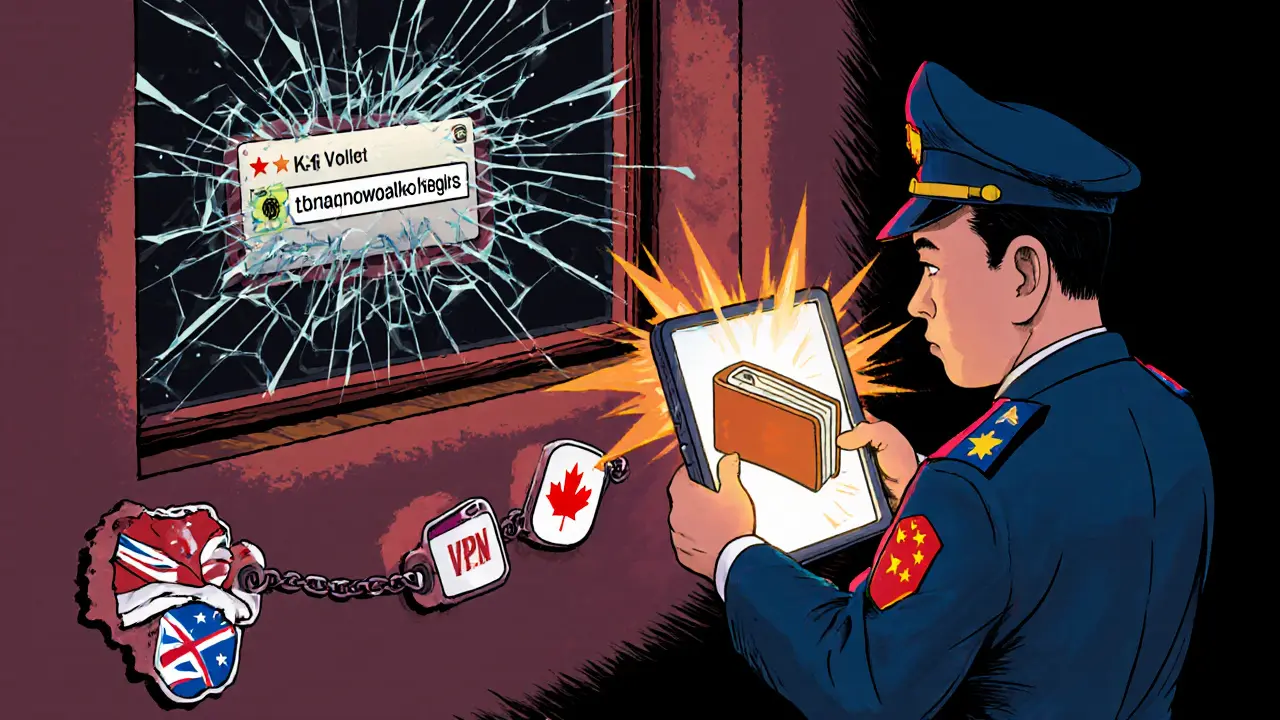
What Happens to People Who Break the Law?
Violations carry serious penalties. First-time offenders face fines up to 10 times the value of the crypto held. Repeat offenders can be jailed for up to five years. Businesses caught facilitating crypto transactions - even by providing internet access or hosting servers - can be shut down permanently. There’s no gray area. If you have a wallet with 0.1 Bitcoin, you’re breaking the law. If you bought it in 2020 and never touched it since, you’re still breaking the law. The government doesn’t care about intent. They care about possession. Some people have tried to hide their crypto in hardware wallets, buried in walls or sent abroad. But China’s enforcement teams now work with international partners. If your wallet is linked to a Chinese ID, even if it’s stored in Canada or Singapore, authorities can trace it. Banks and exchanges abroad are pressured to cooperate. Many do.What About the Global Market?
China used to be the biggest player in crypto. In 2020, over 70% of Bitcoin mining happened in China. Today, that number is zero. Mining rigs were shipped to Kazakhstan, the U.S., and Russia. Trading volume collapsed overnight. The price of Bitcoin dropped 22% in a single week after the 2025 ban announcement. But the global market adapted. Other countries filled the gap. The U.S. became the new mining hub. Singapore and Dubai became crypto-friendly havens. China’s exit didn’t kill crypto - it just moved it. What China did was extreme. No other country has ever banned private ownership of digital assets outright. Even Russia, which restricts crypto, still allows citizens to hold it. China didn’t just regulate - it outlawed.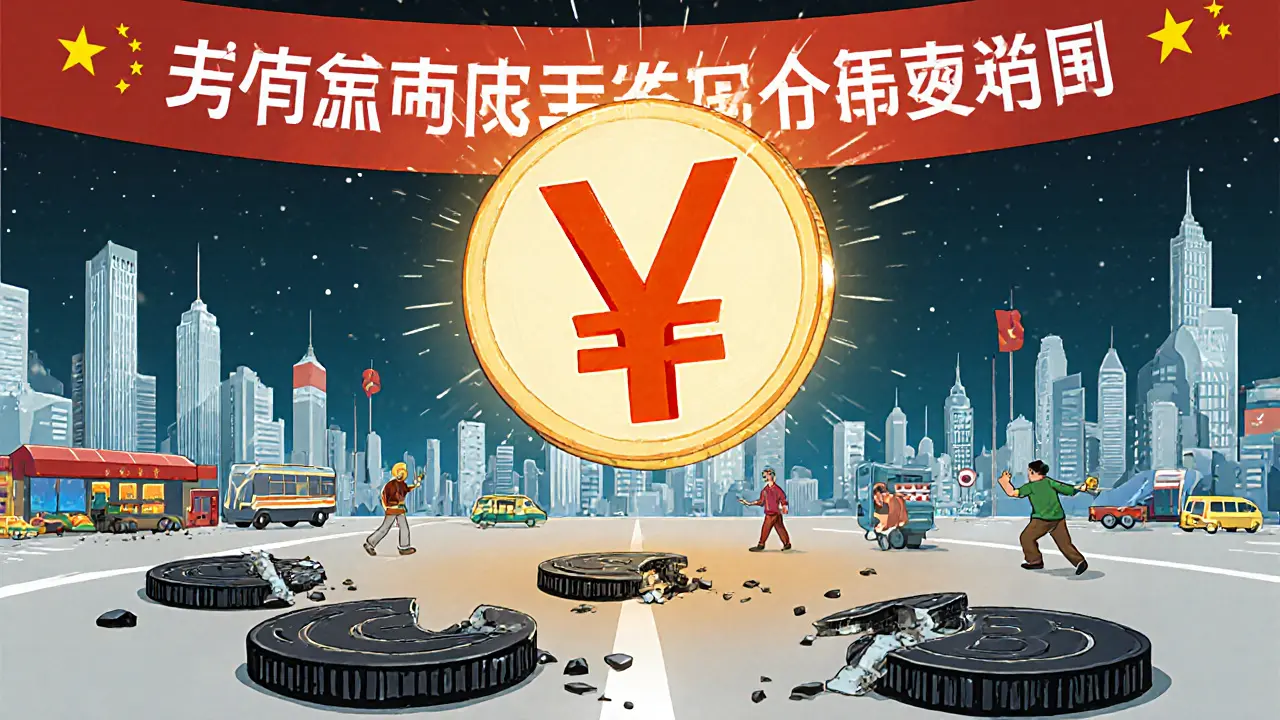
The Digital Yuan Is the Real Winner
The digital yuan is now mandatory for all government payments, taxes, and social benefits. It’s being rolled out in schools, hospitals, and public transport. By 2025, over 600 million people in China use it regularly. The government doesn’t need to advertise it - it just makes everything else illegal. The digital yuan has no anonymity. No decentralization. No volatility. It’s a payment system with built-in control. And that’s exactly what China wanted.Will China Ever Reverse This?
Almost certainly not. There’s no sign of policy reversal. No officials have suggested relaxing the ban. No lawmakers have proposed legalizing crypto. The narrative in state media is clear: private digital currencies are a threat to national security. The digital yuan is the future - and it’s the only future allowed. Even if Bitcoin hits $200,000 or Ethereum becomes the backbone of global finance, China won’t care. They’ve already chosen their side.What This Means for You
If you’re outside China, this ban doesn’t directly affect you. But it changes the global crypto landscape. It shows how much power a single government can wield. It proves that crypto isn’t truly borderless - if a country decides to shut it down, it can. If you’re a Chinese citizen, the choice is simple: comply or risk everything. There’s no middle ground. The Chinese government didn’t just ban crypto. It rewrote the rules of money - and made it clear: control is more important than freedom.Is it still legal to own Bitcoin in China?
No. As of June 1, 2025, it is illegal for any individual or entity in China to own, trade, mine, or transfer any cryptocurrency, including Bitcoin, Ethereum, or any other digital asset. Holding crypto - even if acquired before the ban - is considered a violation of the law.
Can I use a VPN to access crypto exchanges from China?
Using a VPN to access foreign crypto exchanges is illegal under China’s 2025 ban. Authorities actively monitor internet traffic for connections to known crypto platforms. While some users still attempt this, doing so increases the risk of being flagged by financial surveillance systems, leading to account freezes, fines, or criminal investigation.
What happens if I’m caught with cryptocurrency in China?
If authorities find you holding crypto, your digital wallets may be seized, your bank accounts frozen, and your mining hardware confiscated. First-time offenders face fines up to 10 times the value of the assets. Repeat offenders or those involved in large-scale operations can face prison sentences of up to five years.
Why did China ban crypto but promote the digital yuan?
China wants total control over its financial system. Cryptocurrencies like Bitcoin are decentralized and anonymous - making them impossible to track or regulate. The digital yuan, however, is fully controlled by the People’s Bank of China. Every transaction is recorded, every balance monitored, and every transfer can be frozen. By eliminating private crypto, China ensures all digital money flows through its system.
Are Chinese citizens being arrested for crypto possession?
Yes. Since the June 2025 ban, hundreds of individuals have been investigated for crypto possession. While most cases involve fines or asset seizures, multiple arrests have been reported for large holdings or attempts to move crypto abroad. Courts have begun sentencing violators to jail terms, especially when funds are linked to fraud or money laundering.
Can foreign crypto exchanges still serve Chinese users?
Technically, yes - but they risk legal consequences. Many major exchanges like Binance and Kraken have blocked Chinese IP addresses and restricted account access for users identified as residing in China. Some still allow access via VPNs, but they’re under increasing pressure from international regulators to comply with China’s ban. Exchanges that ignore this risk being cut off from global banking partners.
Did China’s crypto ban hurt the global market?
Yes - but temporarily. China was once home to over 70% of global Bitcoin mining. When mining was banned in 2021, prices dropped sharply. The 2025 ownership ban caused another 22% price decline in a week as investors feared broader crackdowns. However, mining quickly shifted to the U.S., Canada, and Kazakhstan. The global market adapted, but China’s exit removed a major source of liquidity and volatility.
Is there any way to legally hold crypto in China now?
No. There are no legal exceptions. Even holding crypto as a personal investment, for educational purposes, or as part of a family inheritance is prohibited. The 2025 ban is absolute and applies to all individuals, regardless of intent, amount, or origin of the assets.
What’s the difference between China’s digital yuan and Bitcoin?
The digital yuan is issued and controlled by the Chinese government. Every transaction is tracked, and the state can freeze or reverse payments. Bitcoin is decentralized - no government or company controls it. Transactions are pseudonymous, irreversible, and not subject to censorship. China chose control over freedom - and eliminated Bitcoin to make sure the digital yuan is the only option.
Will other countries follow China’s lead?
Most countries are moving toward regulation, not prohibition. The U.S., EU, Japan, and Singapore all allow crypto with rules around taxation, licensing, and anti-money laundering. China’s total ban is extreme and unlikely to be copied. Other nations value financial innovation and individual freedom - even if they regulate crypto strictly. China’s model is about control, not innovation.





Ben Costlee
November 26, 2025 AT 07:29This isn't just about crypto-it's about what kind of society China wants to be. They've traded individual financial freedom for total control, and the digital yuan isn't a step forward, it's a step into a panopticon where every transaction is watched, logged, and potentially blocked. I don't care if it's convenient-I'd rather have messy, decentralized freedom than clean, state-approved surveillance.
Mark Adelmann
November 27, 2025 AT 13:08Man, I remember when mining rigs were everywhere in Sichuan. Now they're sitting in warehouses in Texas and Quebec. The market moved, but the human cost? That’s still sitting in those apartments where people got fined for holding 0.2 BTC they bought in 2020. No second chances.
ola frank
November 29, 2025 AT 01:38The structural implications of this policy are profound. By eliminating non-state-controlled monetary instruments, the PBoC has effectively monopolized the transactional layer of the digital economy. This represents a radical departure from Hayekian monetary theory and aligns with Schmittian sovereign exceptionalism-where the state's capacity to suspend economic autonomy becomes the ultimate expression of legitimacy. The digital yuan is not a currency; it is a governance protocol with embedded compliance logic.
imoleayo adebiyi
November 29, 2025 AT 16:54It’s heartbreaking to see how quickly innovation can be crushed under the weight of control. In Nigeria, we struggle with unreliable banks and high fees-crypto gave people a way out, even if imperfect. China’s move shows that power doesn’t fear competition-it fears loss of grip. I hope the world remembers that freedom isn’t just about rights, but about access.
Michael Labelle
November 29, 2025 AT 19:47They banned it, but people still have it. Hidden in hardware wallets, buried in walls, sent to relatives overseas. The law says it’s illegal, but human behavior doesn’t obey paper rules. The government can seize wallets, but they can’t erase memory-or desire.
Brian Bernfeld
November 30, 2025 AT 14:34Let’s be real-this is the most extreme financial authoritarianism the world has ever seen. No other country has gone this far. Russia lets you hold crypto. Iran uses it to bypass sanctions. Even North Korea mines Bitcoin. But China? They didn’t just regulate. They erased. And now the digital yuan is the only game in town-no anonymity, no decentralization, no escape. It’s not a currency. It’s a leash. And the worst part? Most Chinese citizens don’t even realize they’re wearing it.