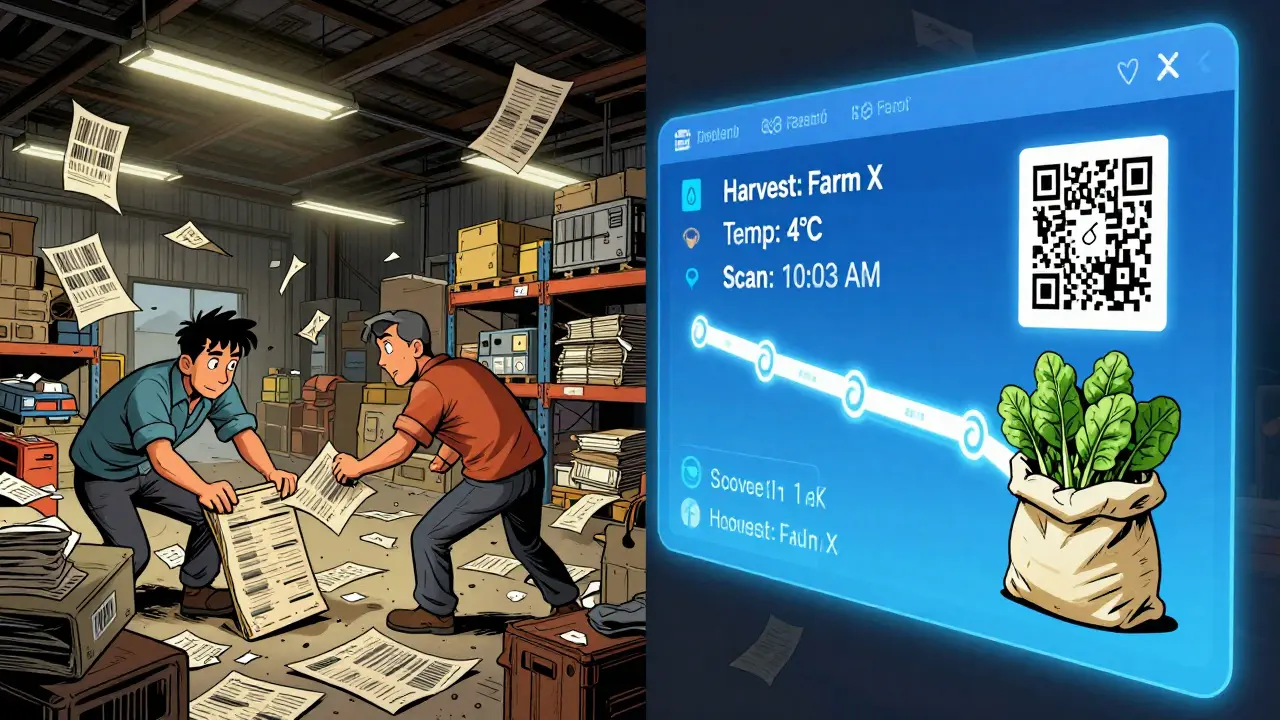
When a bag of spinach makes people sick, how long does it take to find out where it came from? In the old system, it could take weeks. With blockchain, it takes seconds. That’s not science fiction-it’s happening right now in grocery stores, farms, and warehouses across the U.S. and beyond.
Why Traditional Food Tracking Fails
For decades, food safety relied on paper logs, spreadsheets, and barcodes. If a batch of contaminated tomatoes showed up in 10 states, companies had to call each supplier, check handwritten shipping records, and hope no one lost a slip of paper. Even then, they’d often only trace the product back to a distributor, not the actual farm. That’s like trying to find your car in a parking lot using only the color-no license plate, no row number, no timestamp. The result? Outbreaks spread. People got sick. Companies lost millions. And consumers had no idea what was safe to eat. The system wasn’t broken-it was invisible. No one could see the full path of their food from field to fridge.How Blockchain Solves This
Blockchain isn’t just about cryptocurrency. At its core, it’s a shared digital notebook that everyone can see but no one can erase. Every time a food item changes hands-whether it’s picked, washed, packed, shipped, or stocked-a record is added. That record includes details like:- Batch number and GTIN-14 code
- Exact date and time of harvest
- Location of the farm
- Temperature during transport
- Inspection reports
- Who handled it at each step
When a problem pops up, say, a listeria outbreak tied to romaine lettuce, regulators or retailers can scan a QR code on the package and instantly see every stop the lettuce made. Not in days. Not in hours. In under 10 seconds.
The Real-World Proof: Walmart and IBM Food Trust
In 2017, Walmart started testing blockchain with its leafy greens suppliers. Before, tracing a head of lettuce back to its farm took 7 days. After switching to IBM Food Trust, it took 2.2 seconds.They didn’t just test it-they made it mandatory. By 2018, every supplier of leafy greens to Walmart had to join the network. That meant over 25 products-from strawberries to baby food-could now be traced in real time. One test showed they could track a single ingredient in a jar of baby food back to the exact field in California where it was grown.
Other big names followed. Kroger, Dole, Nestlé, Tyson, and Unilever all joined. Albertsons and Carrefour came on board too. Today, the IBM Food Trust network includes more than 100 major companies. It’s not a lab experiment anymore-it’s the new standard for how food moves in the modern world.
How It Actually Works on the Ground
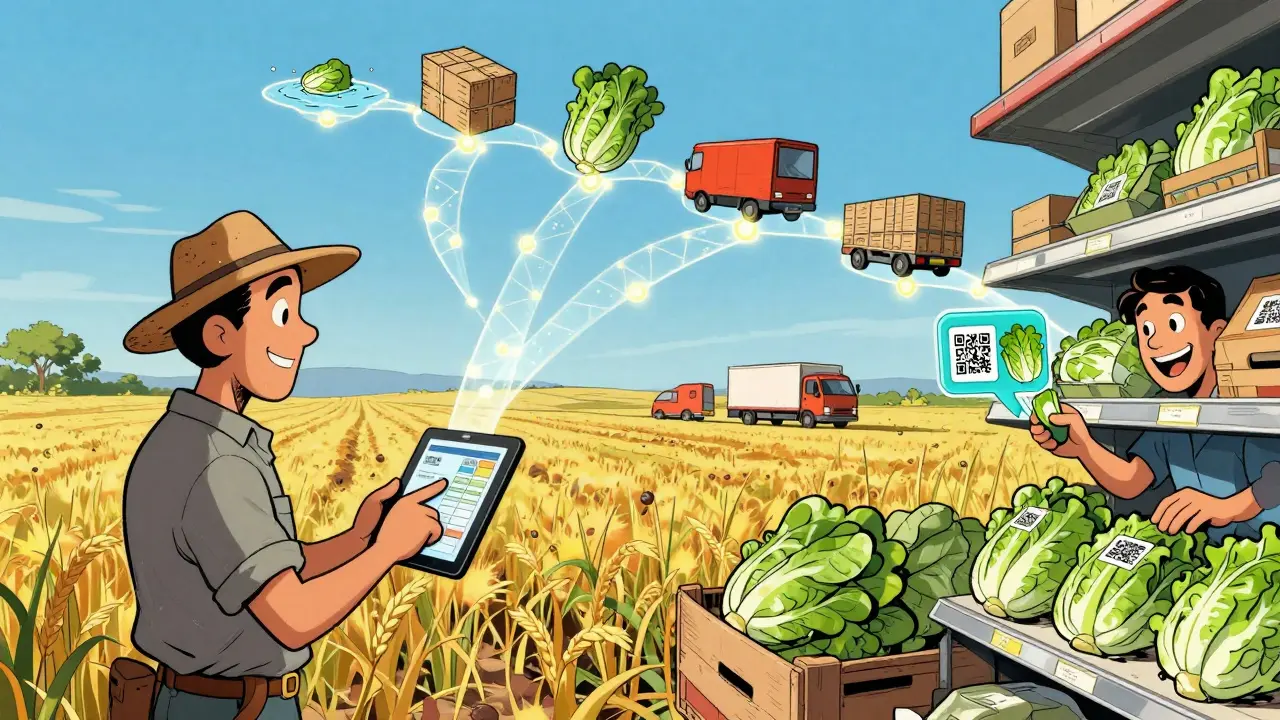
It sounds high-tech, but the setup is simple. A farmer uses a tablet or smartphone to log harvest data. A warehouse scans a QR code when the product is loaded onto a truck. A distribution center logs temperature changes. Each step is recorded automatically.The system uses GS1 standards-global codes for products, locations, and shipments. That means a farm in Mexico can communicate with a retailer in Germany because they’re speaking the same digital language. No more mismatched codes, lost paperwork, or manual data entry errors.
Suppliers don’t need to be tech experts. They just need to use the right tools: a barcode scanner, a mobile app, and access to the blockchain network. Training takes a few days. The payoff? Fewer recalls, faster responses, and less wasted food.
Why This Isn’t Just About Safety
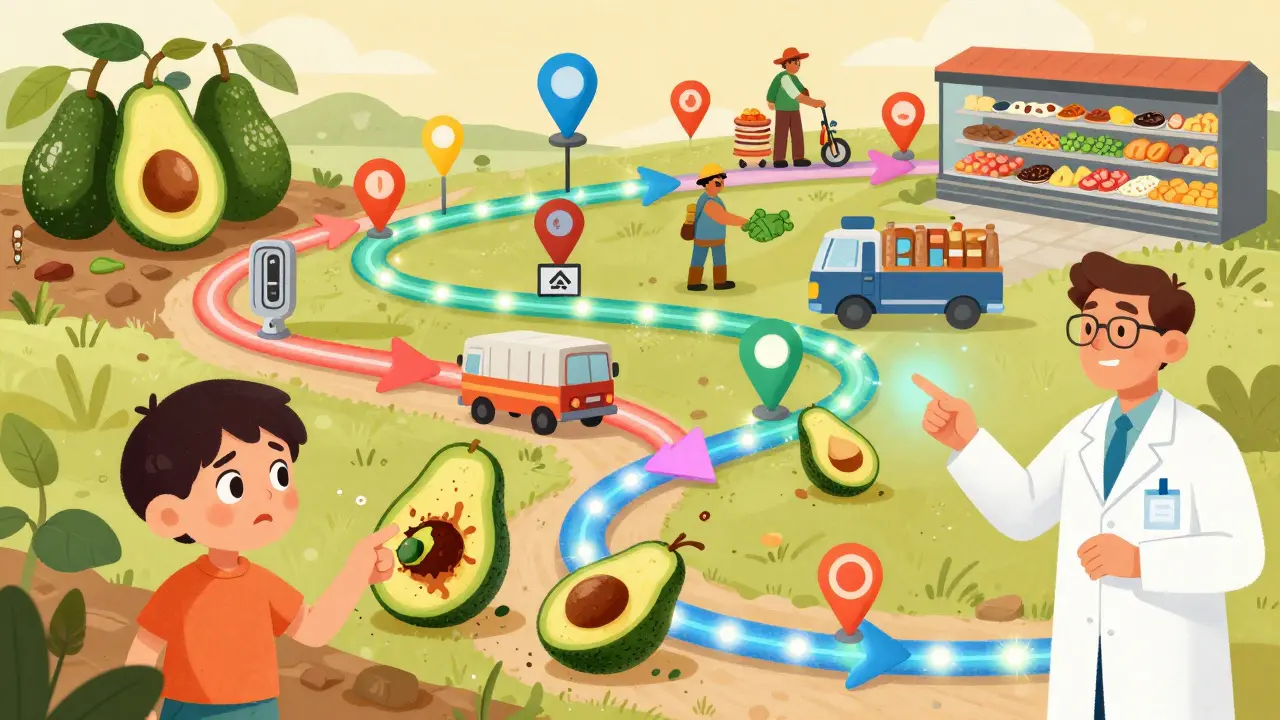
You might think this is only about preventing illness. But it’s bigger than that.When a shipment of avocados spoils because it sat too long in a hot warehouse, blockchain shows exactly where the temperature spiked. That means the logistics company gets held accountable-not the farmer. No more blame games.
Small farms benefit too. If a grower in Florida can prove their organic tomatoes were never exposed to pesticides, they can get paid more. Buyers trust the data. Consumers trust the label.
And it helps the planet. By cutting down on food waste-because we know exactly when and where things go bad-we reduce greenhouse gas emissions from rotting produce in landfills.
What’s Holding Back Wider Adoption?
Not everyone’s on board yet. Smaller suppliers say the cost of sensors, scanners, and training is too high. Some worry about sharing data with competitors. Others just don’t know how to start.But the tide is turning. Governments are starting to require digital traceability. The FDA now pushes for “electronic, interoperable systems” in food tracking. The EU has similar rules coming. And consumers? They’re asking more questions. “Where did this come from?” “Was it tested?” “Can I see the records?”
Companies that don’t adapt won’t just lose trust-they’ll lose shelf space. Retailers like Walmart and Kroger now require blockchain compliance. If you’re a supplier and you can’t prove your food’s journey, you’re out.
The Future Is Already Here
By 2026, blockchain traceability won’t be optional. It’ll be the baseline. Every apple, every egg, every bag of rice will have a digital trail. And it won’t just be for safety-it’ll be for fairness, sustainability, and accountability.Imagine scanning your yogurt and seeing not just the farm, but the bees that pollinated the wildflowers the cows ate. Or checking your salmon and knowing it was caught using sustainable methods, not illegal nets. That’s the next step. And it’s coming fast.
This isn’t about blockchain as a buzzword. It’s about food that’s safer, cleaner, and more honest than ever before. And for the first time in history, we can actually see where it’s been.
Can blockchain prevent all foodborne illnesses?
No, blockchain can’t stop contamination at the source. If a farm has dirty water or poor hygiene, the problem still happens. But blockchain makes it possible to find the source in seconds, not weeks. That means faster recalls, fewer people exposed, and less spread. It doesn’t prevent every case-but it saves lives by acting fast.
Do I need to install special software to use blockchain traceability?
No, if you’re a consumer. You just scan a QR code on the package with your phone. If you’re a supplier or retailer, you’ll use apps provided by the blockchain network-like IBM Food Trust or TradeLens. These are designed to be simple: no coding needed. Think of it like using a GPS app-you don’t need to know how satellites work to get directions.
Is blockchain traceability only for big companies?
No. While big retailers like Walmart pushed adoption, smaller farms and distributors can join too. Many blockchain networks offer low-cost or free entry for small suppliers. The key is using standardized systems like GS1 codes and simple mobile apps. Some cooperatives even share the cost of equipment among members.
What happens if someone hacks the blockchain?
Blockchain isn’t hacked like a website. It’s distributed-thousands of computers hold copies of the same data. To change one record, you’d need to alter every copy at once, which is impossible with current technology. The system is designed so that tampering is obvious. If someone tries, the network rejects it. That’s why it’s called tamper-proof.
How is blockchain different from a regular database?
A regular database is controlled by one company or person. They can edit, delete, or hide entries. Blockchain has no single owner. Everyone in the network sees the same data, and no one can change it without everyone else knowing. It’s like a public ledger everyone can read but only one person can write to-and even then, their entry gets locked in forever.