
Georgia Crypto Business License Checker
Is Your Crypto Business Compliant?
Use this tool to determine if your cryptocurrency business needs a Georgia money transmitter license based on transaction types and business model.
Result
Georgia doesn’t ban cryptocurrency. But if you’re running a crypto business or even operating a Bitcoin ATM there, you’d better have the right paperwork-because the rules are strict, and enforcement is real.
It’s Legal to Own Crypto in Georgia, But Not to Move It Without a License
You can buy, hold, and trade Bitcoin, Ethereum, or any other cryptocurrency in Georgia without breaking the law. The government doesn’t treat it as legal tender, but it doesn’t outlaw it either. That’s the first thing to understand. The restriction isn’t on ownership-it’s on transmission.
Under O.C.G.A. § 7-1-681(b), anyone who moves money or monetary value-including virtual currency-must be licensed as a money transmitter. This includes crypto exchanges, wallet providers, and yes, even Bitcoin ATM operators. If you’re letting someone deposit cash into a machine that sends crypto to a third-party wallet, you’re transmitting value. And that triggers the license requirement.
It’s not a gray area. In January 2025, the Georgia Department of Banking and Finance issued cease and desist orders against two companies: Bullet Blockchain, Inc. and Blockchain Technology Machines, Inc. (doing business as RocketBTM). Both were running Bitcoin ATMs without licenses. The orders took effect immediately. No warnings. No grace period. Just shut down.
What’s the VASP License, and Why Does It Matter?
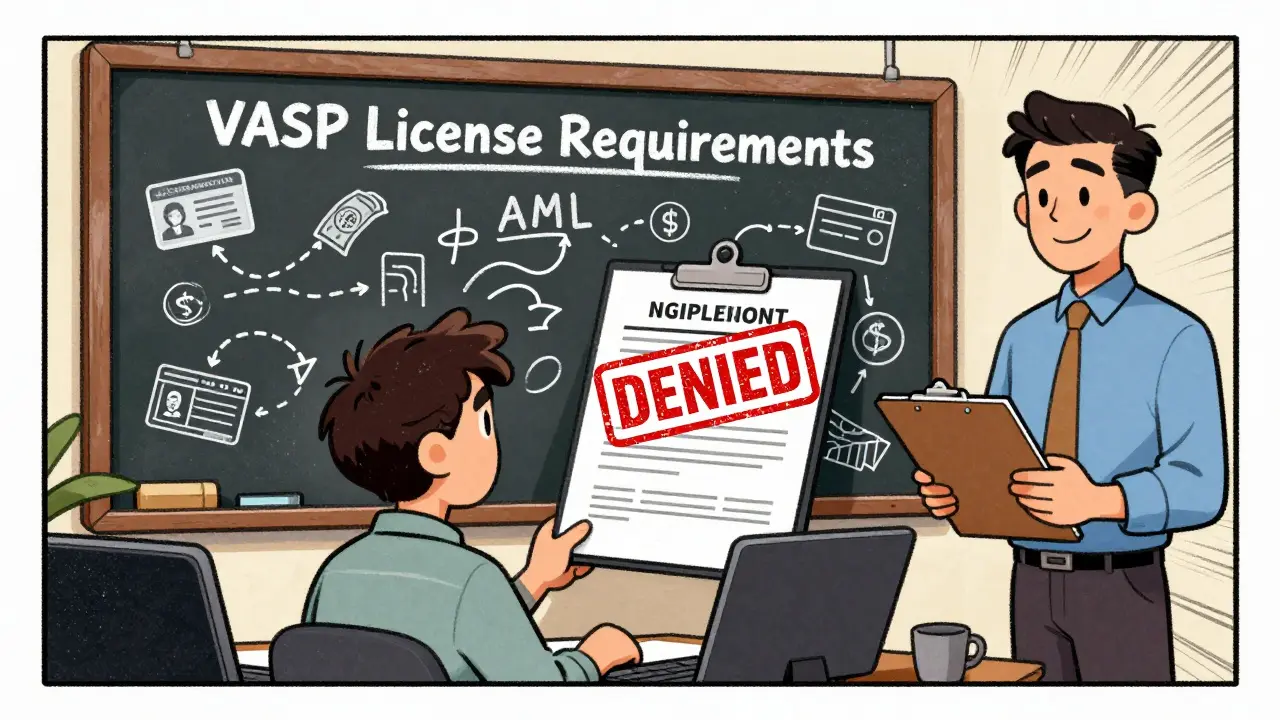
The key to operating legally in Georgia is the Virtual Asset Service Provider (VASP) registration, which became mandatory on July 1, 2023. This isn’t just a formality-it’s a full compliance system.
To get licensed, you need to submit detailed documentation to the National Bank of Georgia (NBG). That includes:
- Names and backgrounds of all beneficial owners
- Organizational structure and management team
- Financial statements and funding sources
- A full Anti-Money Laundering (AML) and Counter-Terrorist Financing (CFT) compliance plan
The Financial Monitoring Service (FMS), under the NBG, reviews every application. They’re not just checking boxes-they’re evaluating whether your systems can actually detect suspicious activity. If your KYC (Know Your Customer) process is weak, or if you don’t log transaction data properly, your application gets rejected.
There’s no shortcut. Even if you’re a small operator, you’re held to the same standard as a large exchange. The NBG doesn’t make exceptions based on size.
Crypto ATMs Are a Major Enforcement Target
Bitcoin ATMs are one of the most common ways people interact with crypto in Georgia. But they’re also one of the easiest ways to bypass oversight-unless you’re licensed.
Here’s how the rule works: If your ATM allows users to deposit cash and send crypto to wallets they don’t control (like an exchange or personal wallet), you’re transmitting value. That means you need a money transmitter license. If the ATM only lets users buy crypto with a card tied to their own account and doesn’t let them send it out, you might qualify for an exemption. But most commercial kiosks don’t fit that narrow exception.
The January 2025 crackdown on Bullet Blockchain and RocketBTM sent a clear message: the state is watching. If you’re operating without a license, you’re not just at risk of fines-you’re at risk of being shut down overnight.
Individuals Pay 0% Tax. Businesses Pay 15%.
Georgia’s strategy isn’t about shutting crypto down-it’s about attracting it. And they’re doing it smartly.
For individuals, crypto transactions are completely tax-free. Buy Bitcoin? No capital gains tax. Sell Ethereum? No income tax. Trade altcoins? Zero. That’s one of the most aggressive tax policies in the world for retail users.
But for businesses? It’s different. Companies that profit from crypto services pay a 15% corporate tax on distributed profits. This creates a revenue stream for the government while still keeping the door open for startups and entrepreneurs.
It’s a balance: make it easy for users, make it fair for businesses. The government currently holds 66 BTC (worth about $6.86 million as of late 2025) and expects around 153,000 users-roughly 14.13% of the population-to be actively using crypto by the end of 2025. Market revenue is projected to hit $1.9 million.
Compliance Isn’t Optional-It’s Built Into the System
Georgia’s system isn’t just about paperwork. It’s about traceability.
All licensed VASPs must:
- Verify user identities with government-issued ID
- Keep records of all transactions for at least five years
- Report any suspicious activity to the Financial Monitoring Service
- Use secure, auditable digital wallet infrastructure
The NBG requires that platforms collect data on transaction origins, destinations, and amounts. This isn’t surveillance for its own sake-it’s to prevent fraud, ransomware payments, and illicit transfers. The IMF praised Georgia’s AML/CFT upgrades in March 2024, calling them “strong” and “aligned with global standards.”
That international validation matters. It means banks and payment processors abroad are more likely to work with Georgian crypto firms. It also means Georgia is less likely to be blacklisted by global financial watchdogs.

What’s Next? Digital Assets in 2026
Georgia isn’t stopping at Bitcoin and Ethereum. The NBG is actively reviewing applications to integrate other digital assets into the financial system. That could include tokenized securities, CBDC pilots, or stablecoins tied to the Georgian lari.
By 2026, the country plans to fully embed digital assets into its AML/CFT framework. That means even more reporting requirements, tighter controls, and likely new licensing categories for different types of digital assets.
For businesses, this means planning ahead. If you’re thinking of launching a crypto service in Georgia, don’t wait until 2026 to get compliant. The rules are already in place. The enforcement is already happening.
Who to Contact If You’re Trying to Get Licensed
If you’re a business owner or developer looking to operate legally in Georgia, the first step is to reach out to the Georgia Department of Banking and Finance. Rod Carnes, Deputy Commissioner for Non-Depository Financial Institutions, is the main contact for licensing inquiries.
The department’s website has detailed guidance on money transmitter licensure for virtual currency kiosk operators. Don’t guess. Don’t assume. Read the official rules. The penalties for non-compliance are swift and severe.
Bottom Line: Georgia Is Crypto-Friendly-But Only If You Play by the Rules
Georgia isn’t the Wild West. It’s not a tax haven with no oversight. It’s a carefully designed ecosystem: low taxes for users, clear rules for businesses, and zero tolerance for unlicensed operators.
If you’re an individual holding crypto? You’re fine. No reporting, no taxes, no hassle.
If you’re building a service that moves crypto? You need a license. Period.
The state isn’t trying to stop innovation. It’s trying to make sure innovation doesn’t become a loophole for crime. And so far, it’s working.
Is it legal to own cryptocurrency in Georgia?
Yes, owning cryptocurrency is completely legal in Georgia. The government does not recognize it as legal tender, but individuals can buy, hold, and trade crypto without any legal restrictions or reporting requirements.
Do I need a license to operate a Bitcoin ATM in Georgia?
Yes, if your Bitcoin ATM allows users to deposit cash and send cryptocurrency to third-party wallets, you must obtain a money transmitter license under Georgia law. Operating without one, as seen in the January 2025 enforcement actions against Bullet Blockchain and RocketBTM, results in immediate shutdown orders.
What is the VASP license, and who needs it?
VASP stands for Virtual Asset Service Provider. It’s the mandatory license required for any business in Georgia that provides crypto services-including exchanges, wallet providers, and custodial services. The license became effective on July 1, 2023, and requires detailed AML/CFT compliance documentation submitted to the National Bank of Georgia.
Are cryptocurrency transactions taxed in Georgia?
Individuals pay 0% tax on cryptocurrency transactions, including capital gains from selling or trading crypto. However, businesses that profit from crypto services are subject to a 15% corporate tax on distributed profits. This policy encourages individual adoption while generating revenue from commercial activity.
What happens if I don’t get a crypto license in Georgia?
Operating without a required license can lead to immediate cease and desist orders, fines, and permanent bans from the market. In January 2025, two companies running unlicensed Bitcoin ATMs were shut down with no warning. The Georgia Department of Banking and Finance actively monitors and enforces compliance.
Can I use a crypto exchange based outside Georgia?
Yes, individuals can use foreign exchanges to buy and hold crypto. However, if you’re a business operating in Georgia and facilitating transactions for local users, you must be licensed under Georgian law-even if your servers are overseas. The regulation follows the service, not the location of the company.
Is Georgia a good place to start a crypto business?
Yes, if you’re prepared to comply. Georgia offers 0% personal crypto taxes, low electricity costs for mining, and a clear regulatory path. The government is actively encouraging innovation, but only for licensed, transparent operators. It’s not a free-for-all-it’s a well-regulated hub.
What’s the timeline for future crypto regulations in Georgia?
The VASP framework launched in 2023, with AML/CFT rules updated in 2023 and enforcement ramping up in 2025. By 2026, Georgia plans to fully integrate digital assets-including tokenized securities and stablecoins-into its AML/CFT system. Businesses should expect more licensing categories and stricter reporting as the framework expands.
Georgia’s approach is simple: if you want to play in crypto, you play by the rules. There’s no middle ground. And for those who follow them, the rewards are real.





Sharmishtha Sohoni
December 4, 2025 AT 22:38So you can own crypto but can't cash out without paperwork? Sounds like Georgia's trying to have its cake and eat it too.
Steve Savage
December 6, 2025 AT 00:59Interesting how they make it easy for individuals but slap a compliance wall on businesses. It’s like saying, 'Come enjoy the beach-but don’t you dare build a sandcastle.'
Kinda brilliant, honestly. Low tax for users keeps the masses happy, and the 15% on businesses? That’s how you fund regulation without scaring off innovation. Smart.
Joe B.
December 7, 2025 AT 21:28Let’s be real-this isn’t crypto-friendly, it’s crypto-conditional. They’re not welcoming innovation, they’re weaponizing compliance.
First, they let you buy crypto tax-free to lure in retail sheep. Then they make it a nightmare for anyone who tries to build infrastructure. That’s not a strategy-it’s a trap. You get the illusion of freedom while the state holds all the keys.
And don’t get me started on those VASP forms. Five years of transaction logs? AML/CFT plans that read like IKEA manuals? You’re not building a business-you’re filing for a PhD in bureaucracy.
Also, 66 BTC held by the state? Cute. That’s $6.86M sitting in cold storage while small operators get shut down for not having a $50k compliance budget. Classic.
Layla Hu
December 9, 2025 AT 19:21I appreciate the clarity here. It’s rare to see a government lay out rules this plainly. No games. No gray areas. Just: ‘Here’s what you need to do.’
For individuals, it’s freedom. For businesses, it’s responsibility. That’s fair.
Nora Colombie
December 9, 2025 AT 23:39Georgia thinks it’s so smart, huh? 0% tax for individuals? Please. That’s just a lure to get Americans and Russians laundering money through ATMs.
And don’t act like they’re not a tax haven. They’re just hiding it behind fancy compliance jargon. 'VASP license' sounds official, but it’s just a velvet rope for the rich.
Meanwhile, the US is still stuck in regulatory purgatory. Georgia’s just the new Panama-except with better Wi-Fi and fewer palm trees.
Greer Dauphin
December 10, 2025 AT 00:25Wait so if I buy crypto on Binance and send it to my wallet in Georgia, I’m cool?
But if I set up a Bitcoin ATM that lets someone deposit $100 and send it to that same wallet… suddenly I’m a criminal?
That’s wild. Like, literally. Who decided that? The same person who said 'you can own a gun but not sell ammo without a background check'? 😅
Also, 15% tax on biz profits? That’s actually reasonable. Most states charge 20+ and still don’t have a clue what they’re doing. Georgia’s got a plan. Respect.
Tatiana Rodriguez
December 10, 2025 AT 10:51This is the most balanced crypto policy I’ve seen in years. Honestly, I cried a little reading it.
Imagine a world where you can hold your Bitcoin without being taxed, but if you want to build something that helps others access it-you’ve got to do it right. No shortcuts. No shady ops. Just clean, traceable, accountable innovation.
The fact that the IMF praised them? That’s huge. It means global banks will actually work with Georgian crypto firms. That’s not just policy-it’s legacy-building.
And those 66 BTC? That’s not a war chest. That’s a statement: 'We’re in this for the long haul.'
I wish more countries had this level of clarity. Not 'crypto is illegal' or 'crypto is the future'-but 'here’s how to do it right.'
Georgia’s not just setting rules. They’re setting an example.
Britney Power
December 10, 2025 AT 20:04While the regulatory framework presented is ostensibly structured and aligned with FATF recommendations, one must critically assess the underlying power dynamics at play. The imposition of a mandatory VASP license, coupled with exhaustive documentation requirements-including beneficial ownership disclosures and transactional archiving-constitutes a form of financial surveillance masquerading as consumer protection.
Moreover, the selective tax exemption for individuals while imposing a 15% corporate tax on distributed profits reveals a neo-liberal economic architecture designed to extract value from entrepreneurial activity under the guise of 'fairness.'
The National Bank of Georgia’s alignment with IMF standards, while superficially commendable, functions as a mechanism of financial colonialism: local actors are coerced into conforming to externally imposed norms, while the state retains control over digital asset reserves (66 BTC) as a sovereign hedge against currency instability.
This is not innovation-it is institutional capture dressed in blockchain aesthetics.
Maggie Harrison
December 10, 2025 AT 22:59Georgia’s doing something right. 🙌
0% tax for people? YES. Clear rules for businesses? YES. Shutting down sketchy ATMs? ABSOLUTELY.
This isn’t 'crypto wild west'-it’s 'crypto with boundaries.' And honestly? We need more of that.
Imagine if every country said: 'You’re free to use it, but if you’re building something that moves money? You gotta be legit.'
Stop crying about regulation. Regulation keeps your money safe. Georgia gets it. 👏🔥