Cross-Border Payment Calculator
Compare traditional bank transfers with blockchain-based payments. See how much you could save in fees and time.
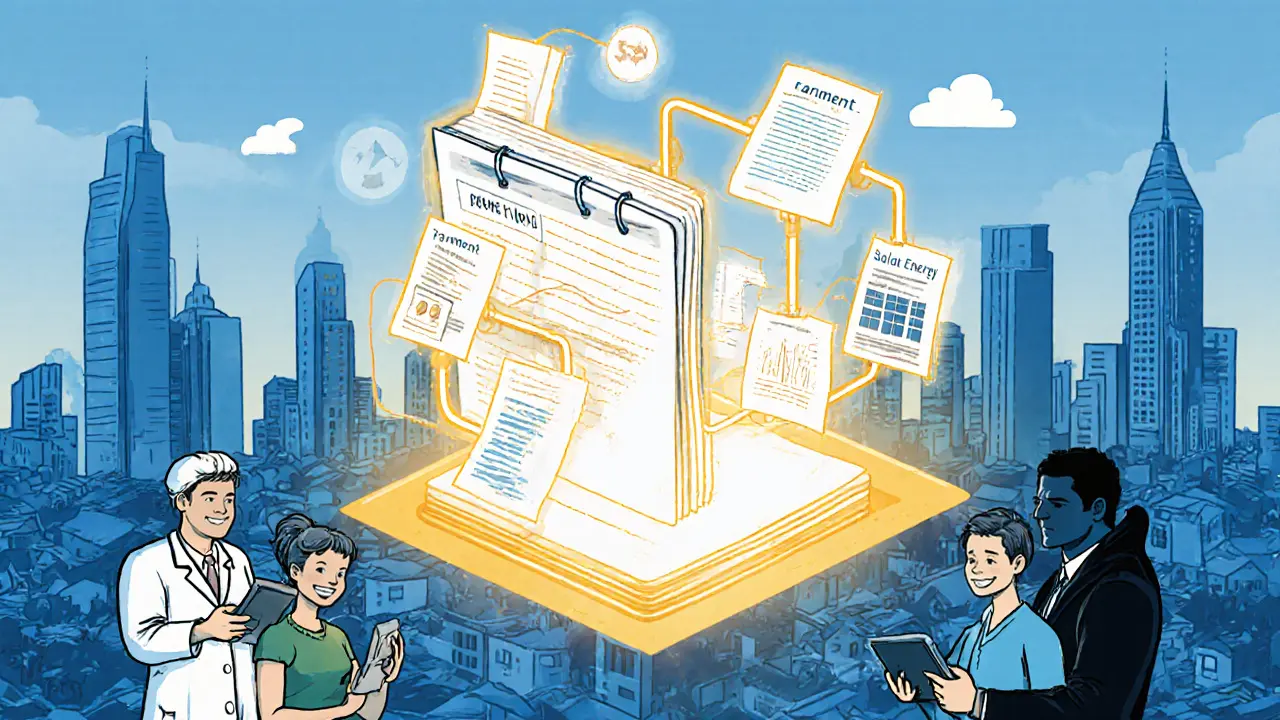
Blockchain isn’t just about Bitcoin anymore. Five years ago, most people thought it was just a fancy way to trade digital money. Today, it’s quietly changing how hospitals track patient records, how farmers prove their coffee is ethically sourced, and how power companies let neighbors sell excess solar energy to each other. The real revolution isn’t in the price of crypto-it’s in the way systems are built from the ground up to be open, tamper-proof, and self-running.
What Blockchain Actually Does (No Jargon)
Think of blockchain as a digital notebook that everyone can see but no one can erase. Every time something happens-a payment, a shipment, a medical test result-it’s written down as a page in this notebook. Once that page is full, it’s locked and chained to the next one. That’s where the name comes from. The notebook isn’t stored in one place like a company server. It’s copied across hundreds or thousands of computers around the world. If someone tries to change an old entry, the system instantly spots the mismatch and rejects it. This isn’t magic. It’s math and code working together. The key ingredients are:- Distributed ledger: No single company owns it. Copies exist everywhere.
- Immutability: Once data is confirmed, it can’t be altered.
- Consensus: Thousands of computers agree on what’s true before it gets recorded.
- Smart contracts: Self-executing rules written in code. If condition A happens, then action B triggers automatically.
Finance: Cutting Out the Middlemen
Financial services still make up the biggest chunk of blockchain use, making up 40% of global adoption in 2024. Why? Because finance is built on trust-and trust is expensive. Traditional banks rely on clearinghouses, intermediaries, and manual checks to verify transactions. A wire transfer from the U.S. to Nigeria might take three days and cost $50. With blockchain, that same transfer can happen in under five minutes for under $1. Platforms like Ripple and Stellar are already doing this at scale. Then there’s decentralized finance, or DeFi. Forget banks. DeFi lets you lend your crypto, earn interest, borrow money, or trade assets-all without walking into a branch. No credit check. No paperwork. Just code. In 2025, DeFi platforms manage over $150 billion in assets, mostly from users in countries with unstable banking systems or limited access to credit. And governments aren’t sitting still. China’s Digital Yuan, the EU’s Digital Euro pilot, and Nigeria’s eNaira are all central bank digital currencies (CBDCs). These aren’t cryptocurrencies. They’re digital versions of real money, powered by blockchain tech. The goal? Faster payments, lower costs, and better control over monetary policy.Supply Chains: From Farm to Fork, Without the Lies
Ever bought organic spinach and wondered if it was really organic? Or bought a diamond and worried it came from a conflict zone? Blockchain makes it impossible to fake. Walmart uses blockchain to track food shipments. Before, tracing the source of a contaminated lettuce batch took seven days. Now, it takes 2.2 seconds. Each step-harvest, packing, shipping, storage-is recorded on the chain. If there’s a problem, you know exactly where it started. In the diamond industry, companies like De Beers use blockchain to prove a stone’s origin. Each diamond gets a digital ID tied to its mining location, cut, and certification. Buyers scan a QR code and see the full history. No more blood diamonds slipping through. This isn’t just for big corporations. Small coffee farmers in Colombia are now using blockchain platforms to prove their beans are shade-grown and fair-trade. Buyers in Germany can verify that before paying. It’s turning trust into a measurable asset.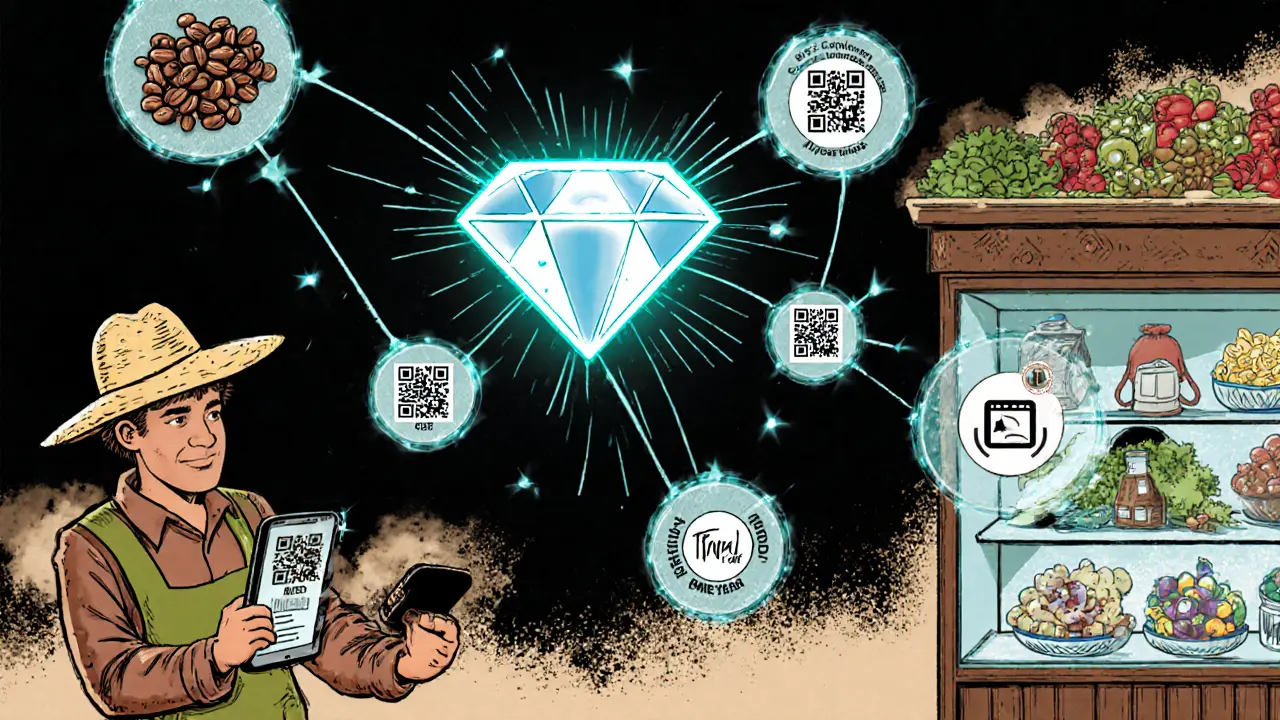
Healthcare: Your Medical Records, Actually Yours
Your medical history shouldn’t be stuck in five different hospital systems. But it is. And when you switch doctors, you’re expected to hand over paper copies or wait weeks for digital transfers. Blockchain changes that. In Estonia, every citizen has a blockchain-based health record. Doctors access it with permission, and every access is logged. No one can delete or alter your history. Even if a hospital’s server gets hacked, your data stays safe because it’s encrypted and spread across the network. In the U.S., startups are building platforms where patients control access to their records. Want to let your cardiologist see your last MRI? You approve it with a tap. No forms. No calls. No waiting. And because the data is immutable, there’s no risk of accidental edits or fraudulent changes. The biggest driver? Regulations. GDPR in Europe and HIPAA in the U.S. demand tighter control over patient data. Blockchain doesn’t just help compliance-it makes it automatic.Energy: Turning Your Rooftop Into a Power Plant
If you have solar panels on your roof, you’re already producing energy. But selling the extra power? That’s messy. You need a utility company to act as middleman. They buy your surplus at a low rate and sell it back to others at a high one. Blockchain flips that. In Brooklyn, a project called LO3 Energy lets neighbors trade solar power directly. You install a smart meter. When your panels make extra electricity, it gets recorded on a blockchain. Your neighbor who’s running out of power buys it with cryptocurrency. No utility company. No middleman. No delays. This model is spreading. In Australia, communities are forming microgrids powered by blockchain. In Kenya, off-grid solar providers use blockchain to track payments from rural households. People pay in small amounts via mobile phones. The system automatically credits their usage. No debt collectors. No late fees. Just clean energy, tracked fairly.Insurance: Paying Out Before You Even File a Claim
Insurance claims are slow. And painful. You get hit by a hailstorm. You file a claim. You wait weeks. You argue with adjusters. You get a check for less than you expected. Parametric insurance changes that. It pays out based on triggers, not damage assessments. If wind speed hits 80 mph in your ZIP code during a storm, your policy automatically pays you $5,000. No inspection. No paperwork. No delay. Blockchain makes this work. Weather data from trusted sensors is fed into a smart contract. If the condition is met, payment happens instantly. Companies like Etherisc and AXA are already doing this for flight delays, crop failures, and natural disasters. In 2025, over 30% of new insurance products in Europe and North America use blockchain-based parametric models. They’re cheaper, faster, and harder to cheat.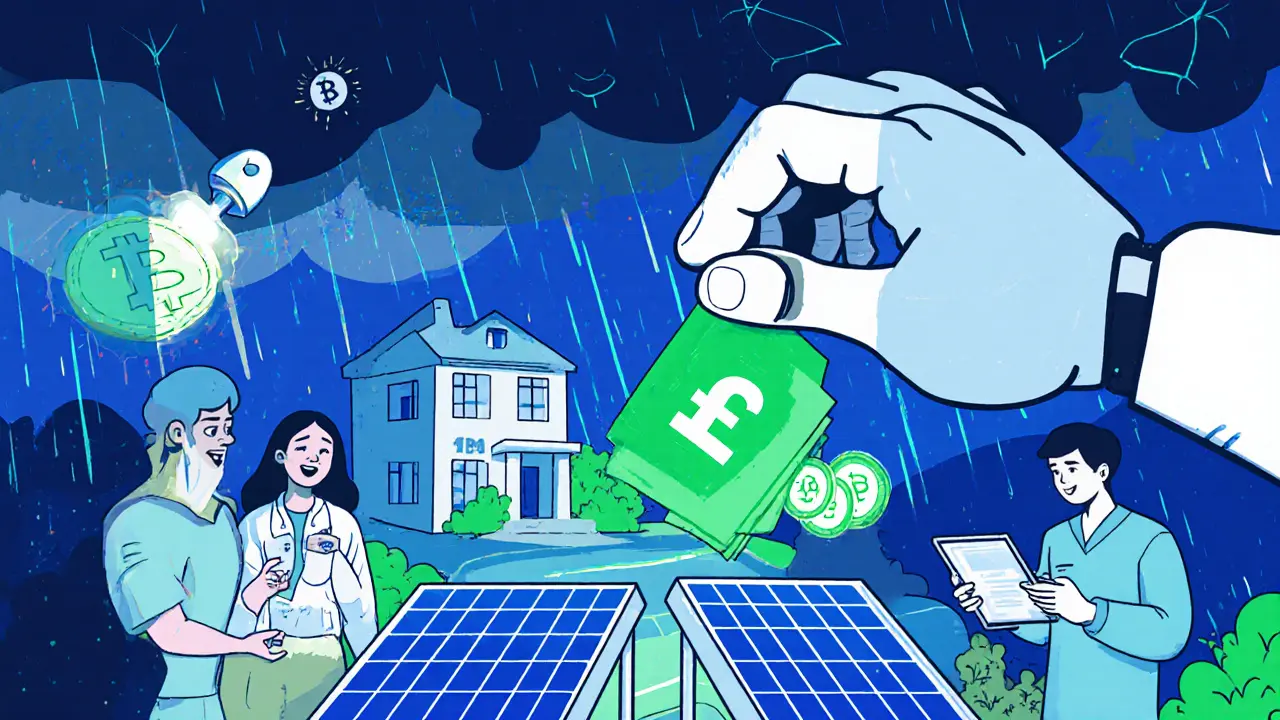
Why It’s Not Everywhere Yet
Blockchain isn’t perfect. And it’s not always the right tool. It’s slower than a regular database. A Bitcoin transaction takes 10 minutes. A credit card takes 2 seconds. So if you’re just logging employee hours in an office, blockchain is overkill. It’s complex. Building a smart contract requires coding skills. One bug in the code can cost millions-like the 2016 DAO hack that lost $60 million. And energy use? Early blockchains like Bitcoin used massive amounts of electricity. But that’s changing. In 2025, over 80% of blockchain networks use Proof-of-Stake or other low-energy consensus methods. Ethereum switched in 2022 and cut its energy use by 99.95%. Regulation is still messy. Some countries ban crypto. Others embrace it. Companies have to navigate a patchwork of laws. But that’s getting clearer as governments draft frameworks.What’s Next?
The next wave is integration. Blockchain isn’t replacing apps. It’s becoming the hidden layer underneath them. AI and blockchain are teaming up. AI analyzes patterns in blockchain data to predict fraud. Smart contracts get smarter by learning from past transactions. Healthcare systems are linking blockchain to wearable devices. Your Fitbit data could trigger a smart contract that lowers your insurance premium if you hit your step goal. Governments are testing blockchain for voting. Estonia already lets citizens vote in national elections via blockchain. The U.S. is piloting it in local elections. The real winners? Companies that use blockchain not as a buzzword, but as a tool to fix broken systems. Not to impress investors. Not to chase hype. But to make things faster, fairer, and more transparent.Frequently Asked Questions
Is blockchain the same as cryptocurrency?
No. Cryptocurrency is one use of blockchain-like email is one use of the internet. Blockchain is the underlying technology that makes secure, transparent records possible. You can use blockchain for supply chains, medical records, or voting without ever touching Bitcoin or Ethereum.
Can blockchain be hacked?
The blockchain itself is extremely hard to hack because it’s spread across thousands of computers. But the apps built on top of it-like wallets or exchanges-can be vulnerable. Most hacks happen because of poor code in smart contracts or stolen private keys, not because the blockchain was broken.
Does blockchain save money?
Yes, but not always. It saves money by cutting out middlemen and reducing fraud. In cross-border payments, companies save up to 70% in fees. In supply chains, fraud drops by 30-50%. But setting up the system costs money upfront. The savings come over time.
Is blockchain environmentally friendly?
Most new blockchains are. The old Proof-of-Work method (used by Bitcoin) used a lot of electricity. But today, 80% of active blockchains use Proof-of-Stake, which uses 99.95% less energy. Ethereum switched in 2022 and now uses less power than a single household.
Do I need to be tech-savvy to use blockchain?
No. You don’t need to know how it works to benefit from it. Just like you don’t need to know how Wi-Fi works to stream a video. When you use a blockchain-based app for payments, tracking food, or managing health records, the tech is hidden behind a simple interface. The complexity is handled behind the scenes.

Janice Jose
November 27, 2025 AT 10:50Man, I never thought about how blockchain could help small farmers get paid fairly. My cousin in Colombia just started using one of those platforms, and he said buyers in Germany are actually paying more because they can verify everything. It’s wild how tech like this can cut out the middlemen who used to take half the profit.
Also, the part about solar power trading in Brooklyn? I live in Austin and we’ve got tons of rooftop panels. If we could do that here, I’d sell my extra juice to my neighbor who’s always running the AC. No more waiting for the utility company to send a check six months later.
Savan Prajapati
November 28, 2025 AT 09:57Blockchain is just hype. Everything can be done with a database. Why waste time and money?
Joel Christian
November 29, 2025 AT 13:49ok so i read this whole thing and like… i get it? but like… why do i care? my bank still takes 3 days to process stuff and my doctor still loses my records. also i think blockchain is just bitcoin in a fancy suit. also i think the guy who wrote this is trying too hard. like ‘tamper-proof’? bro. i just want my coffee to be good and my wifi to work. also i think this is too long. i fell asleep halfway through. lol.
ps. i think the part about diamonds is cool tho. but like… do i really need to know where my diamond came from? i just want it to sparkle.
Vijay Kumar
November 30, 2025 AT 08:23You’re all missing the point. Blockchain isn’t about tech-it’s about truth. Human beings have spent centuries building systems based on lies, middlemen, and power. This is the first time in history we have a tool that forces honesty. No more corruption. No more fraud. No more ‘I didn’t know.’ The system sees everything. And that terrifies the people who profit from chaos.
So yes, it’s slow. Yes, it’s complex. But so was the printing press. And look where that got us.
Brian Bernfeld
November 30, 2025 AT 16:38Let me tell you something real quick-this isn’t just ‘cool tech.’ This is structural change. I’ve worked in healthcare IT for 15 years. I’ve seen records get lost, mixed up, deleted by accident, or locked behind proprietary systems that charge you $200 to get a copy of your own MRI.
When Estonia rolled out blockchain health records, I thought it was sci-fi. Then I saw a demo. A nurse in Tallinn pulls up a 72-year-old woman’s entire medical history-every hospital visit since 2003, every allergy, every prescription-in 12 seconds. No login. No paperwork. Just a QR code and a PIN.
And the best part? The patient controls it. She can revoke access anytime. That’s not innovation. That’s dignity.
And yeah, the energy thing? People still bring up Bitcoin mining like it’s 2015. Ethereum switched to Proof-of-Stake in 2022. Now it uses less power than your fridge. Most new chains are even cleaner. This isn’t a ‘crypto thing.’ It’s a ‘what if we just built systems that actually work’ thing.
And if you think smart contracts are too complex? You don’t need to code them. You just need to use them. Like you don’t need to know how your phone’s GPS works to get directions. The tech is invisible. That’s the whole point.
Ian Esche
December 2, 2025 AT 12:26Blockchain? Sure, whatever. But let’s not pretend this is some American-led revolution. China’s Digital Yuan is already out there, and it’s centralized as hell. Europe’s Digital Euro? More control for bureaucrats. And now we’re supposed to believe this is about freedom?
Real talk: if this tech helps American small businesses cut costs, great. But don’t sell it as some global utopia. It’s just another tool-and the people who control the code still control everything. We’ve seen this movie before.