
Blockchain Transaction Cost Calculator
Cost Breakdown
SavingsOriginal Cost: $0.00
Rollup Cost: $0.00
Total Savings: $0.00
Savings Percentage: 0%
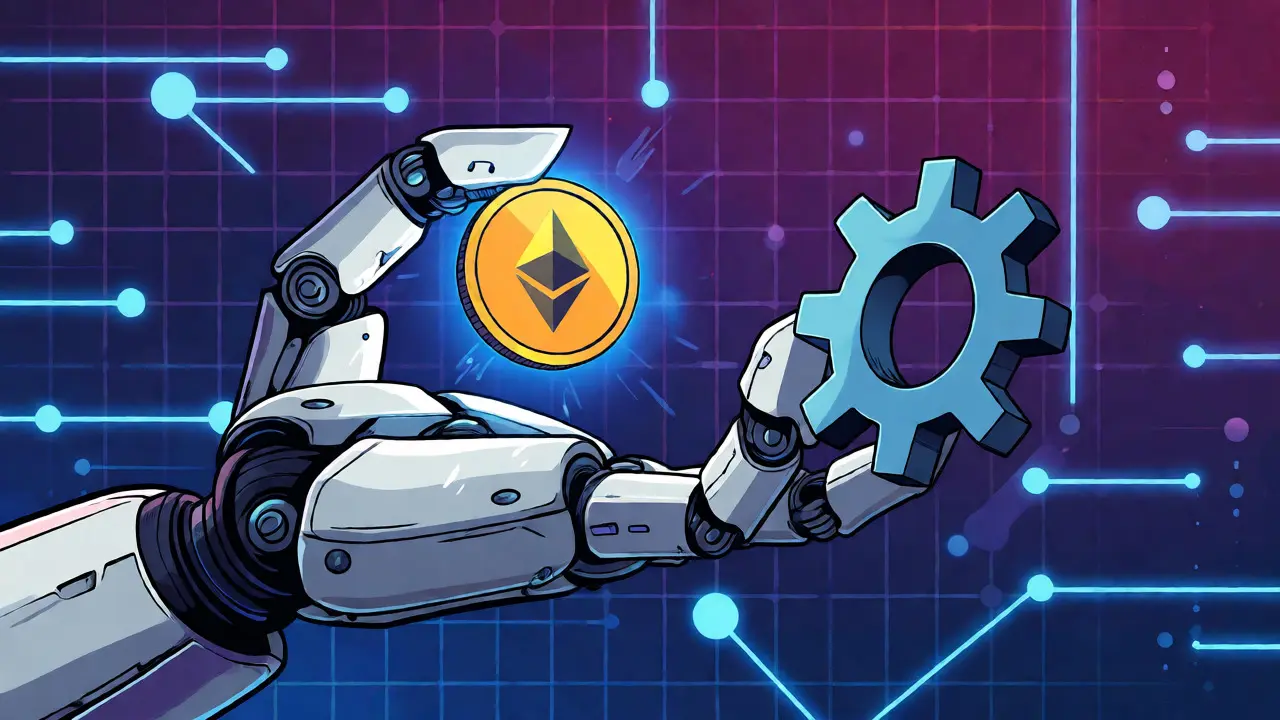
Blockchain transaction fees have been a dealbreaker for millions of users. Whether you're swapping tokens, minting an NFT, or playing a blockchain game, you’ve probably watched your gas fee jump from $1 to $50 in seconds. The problem isn’t just annoying-it’s blocking real adoption. That’s where rollups come in. They don’t just tweak the system; they rebuild how costs work on blockchains like Ethereum, cutting fees by up to 99% while keeping the same security as the main chain.
How Rollups Slash Costs: The Simple Version
Imagine you’re sending 1,000 letters through the postal service. Normally, each letter needs its own envelope, stamp, and trip to the post office. That’s expensive. Now imagine bundling all 1,000 letters into one big box, sending it with one stamp, and letting the post office verify the whole box at once. That’s what rollups do. They take hundreds or thousands of transactions, bundle them off-chain, and submit just one compressed proof to the main blockchain. The main chain doesn’t process each transaction-it just checks if the proof is valid. That’s where the savings come from.On Ethereum, a single transaction used to cost $10-$50 during peak times. With a rollup, that same transaction now costs $0.01-$0.10. Bitcoin users see similar drops: a 5,000 satoshi fee drops to 50 satoshis. That’s not a small improvement-it turns impossible use cases into everyday ones. Micropayments for streaming content, in-game purchases, or tipping creators suddenly make economic sense.
ZK-Rollups vs. Optimistic Rollups: Which Saves More?
There are two main types of rollups, and they cut costs differently.ZK-rollups use zero-knowledge proofs to validate batches. These proofs are tiny-sometimes just a few hundred bytes-even when they represent 10,000 transactions. The cost to verify that proof on Ethereum is fixed, no matter how many transactions it covers. That means the more people use it, the cheaper each transaction gets. It’s like a group ride-share: the more riders, the less you pay per person.
Optimistic rollups assume transactions are valid unless someone challenges them. They need a 7-day window for fraud proofs, which adds complexity. While they’re cheaper than Layer 1, they’re not as efficient as ZK-rollups because they still need to store more data on-chain. For pure cost reduction, ZK-rollups are the clear winner.
Today, leading DeFi protocols like zkSync, StarkNet, and Polygon zkEVM use ZK-rollups. They’re not just saving users money-they’re enabling new kinds of apps that were too expensive to build before.
Why Rollups Don’t Just Lower Fees-They Change the Game
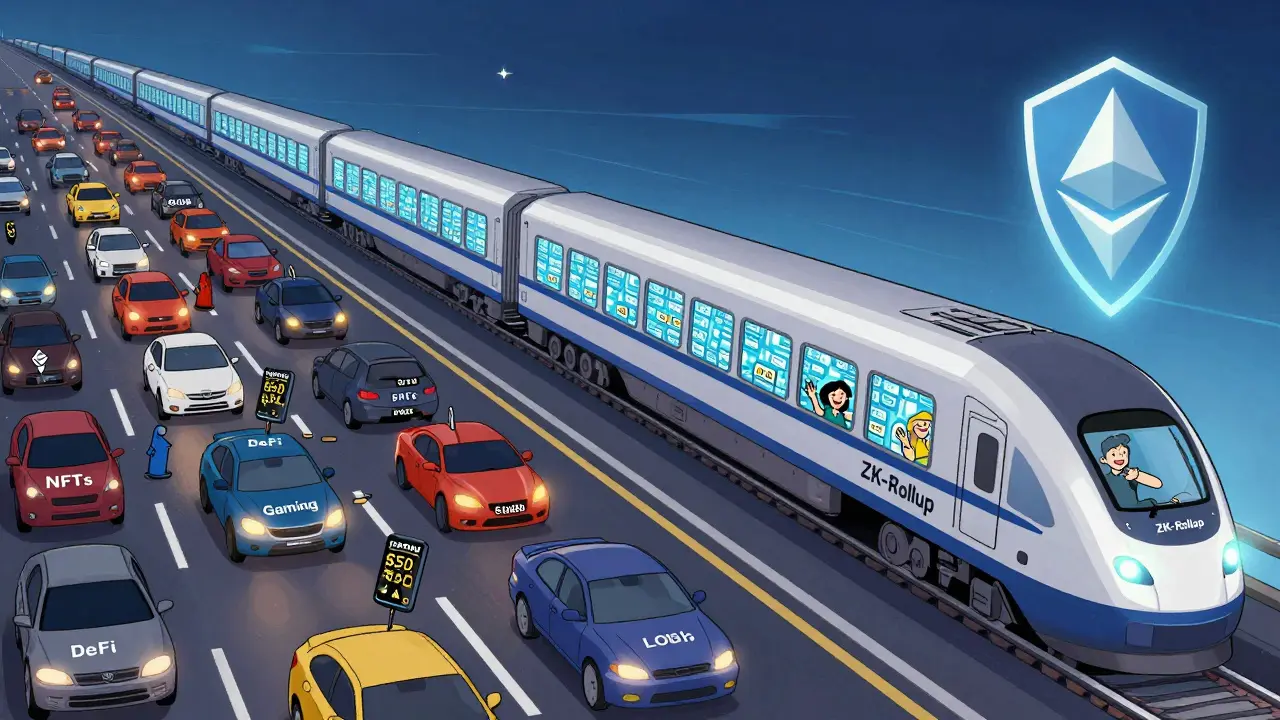
Most scaling solutions try to add more lanes to the highway. Rollups don’t do that. They turn the highway into a freight train.Here’s the key insight: rollups don’t just reduce fees-they redistribute costs. On Layer 1, every node runs every transaction. That’s slow and expensive. Rollups shift the heavy lifting off-chain. Only the final proof needs to be verified on Ethereum. That means:
- Less data stored on-chain = lower blockspace costs
- Less computation per node = faster confirmation times
- Lower congestion on Layer 1 = cheaper fees for everyone, even non-rollup users
This isn’t theoretical. In 2024, Ethereum’s base layer fees dropped 40% year-over-year-not because demand went down, but because 85% of all transactions moved to rollups. That’s the ripple effect: rollups reduce pressure on the main chain, which lowers costs for everyone.
Real-World Impact: Where Rollups Are Already Saving Money
You don’t need to be a developer to feel the difference. Here’s where rollups are making real impact:- DeFi: Swapping tokens on Uniswap via a ZK-rollup costs 95% less than on Ethereum mainnet. That’s why platforms like dYdX and Curve moved their entire operations to rollups.
- Gaming: Games like Gods Unchained and Immutable X let players trade NFTs and earn crypto rewards without paying $10 per click. Without rollups, these games would be unplayable for most users.
- NFTs: Minting a single NFT on Ethereum used to cost $100+. Now, on rollups, it’s under $1. That’s why artists and creators are moving to platforms like Base and Arbitrum.
- Supply Chains: Companies like Maersk and Walmart are testing blockchain tracking for goods. Rollups make it affordable to log every shipment, inspection, and temperature check without breaking the budget.
These aren’t niche experiments. They’re mainstream shifts. In 2025, over 70% of all Ethereum-based DeFi volume happens on rollups. The money is following the cost savings.
The Hidden Trade-Offs: What Rollups Don’t Fix
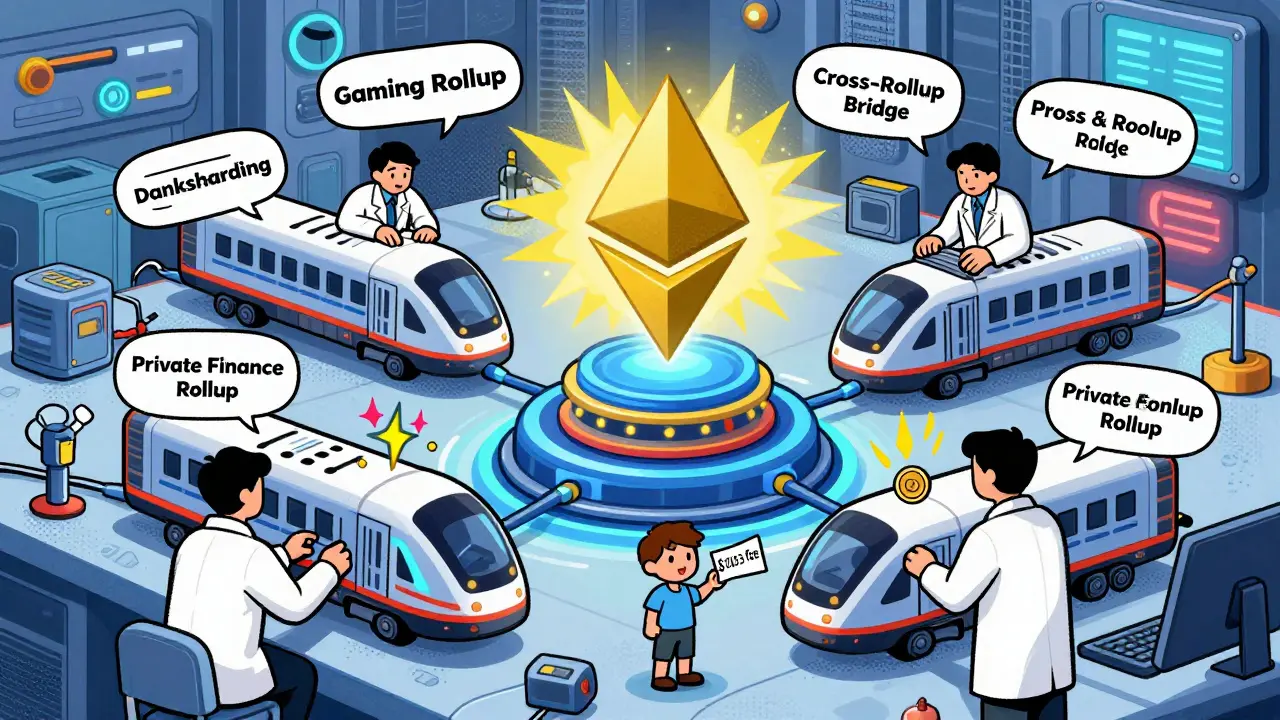
Rollups aren’t magic. They have limits.First, they still depend on Ethereum’s blockspace. If Ethereum gets congested, rollup data submission fees can spike. That’s why projects are pushing for danksharding, a future upgrade that will make data cheaper and faster to store on Ethereum.
Second, rollups can fragment liquidity. If you’re trading on zkSync, your tokens aren’t directly accessible on Arbitrum or Optimism. You need bridges to move between them-and bridges can be risky. That’s why most major protocols now support multi-rollup liquidity pools.
Third, not all apps can easily migrate. Complex smart contracts that rely on direct on-chain interactions (like some DeFi lending protocols) still need Layer 1. Rollups work best for high-volume, repetitive actions-not for every type of blockchain logic.
But here’s the thing: these aren’t dealbreakers. They’re engineering challenges-and they’re being solved. Cross-rollup messaging is improving. New tools let users move assets between rollups in seconds. The ecosystem is adapting.
What’s Next for Rollups?
The next wave of rollups will focus on three things:- Privacy: ZK-proofs can hide transaction details while still proving validity. Future rollups will let users transact anonymously without sacrificing security.
- Interoperability: Projects like LayerZero and Axelar are building bridges that let rollups talk to each other directly-no need for centralized exchanges.
- Modularity: Instead of one rollup doing everything, you’ll see specialized rollups: one for gaming, one for payments, one for private finance. Each optimized for its use case.
By 2026, we’ll likely see rollups as the default way to interact with blockchains-not an optional upgrade. The cost savings are too big to ignore.
Should You Use Rollups?
If you’re a user: yes. Use any wallet or DApp that supports rollups. You’ll pay less, get faster confirmations, and still be just as secure.If you’re a developer: start building on a ZK-rollup like zkSync, StarkNet, or Polygon zkEVM. The tools are mature. The user base is growing. And the cost advantage is undeniable.
If you’re a business: test rollups for high-frequency transactions-NFT minting, loyalty points, supply chain logs. The ROI is clear. You’ll save thousands in fees every month.
Rollups didn’t just make blockchain cheaper. They made it usable. And that’s the real breakthrough.
Are rollups safe?
Yes. Rollups inherit the security of Ethereum or Bitcoin. Even if the rollup operator goes offline, users can still withdraw their funds directly to the main chain. This is a major advantage over sidechains, where a failure can mean permanent loss. ZK-rollups add cryptographic proof to guarantee all transactions are valid.
Do rollups replace Ethereum?
No. Rollups depend on Ethereum to store data and enforce security. They’re Layer 2 solutions, not replacements. Think of them as high-speed lanes that feed into the main highway. Ethereum remains the anchor of trust, while rollups handle the heavy traffic.
Can I use rollups with my current wallet?
Most major wallets like MetaMask, Phantom, and Coinbase Wallet now support rollups automatically. You just need to switch networks in your wallet settings. For example, select ‘zkSync Era’ or ‘Arbitrum One’ instead of ‘Ethereum Mainnet.’ Your funds stay safe-you’re just moving to a cheaper chain.
What’s the difference between rollups and sidechains?
Sidechains like Polygon PoS have their own security and validators. If they’re hacked or go down, your funds could be at risk. Rollups rely on Ethereum’s security. Even if the rollup fails, your money is still protected by Ethereum’s consensus. That’s why rollups are trusted by institutions and large DeFi protocols.
Will rollups make Ethereum fees go to zero?
No-but they’ll make them negligible for most users. Ethereum will still charge a small fee to publish rollup proofs, but that cost is shared across thousands of transactions. For end users, fees will stay under $0.10 even during peak times. The goal isn’t zero-it’s affordable.

Elizabeth Miranda
December 9, 2025 AT 20:32Rollups are honestly one of those rare tech improvements that actually feel like a gift to users. I remember when I tried to mint an NFT last year and got hit with a $90 fee-I just closed the tab and gave up. Now? I can do it for less than a dollar, and it doesn’t feel like I’m funding a hedge fund’s coffee budget. The shift from ‘blockchain is for the rich’ to ‘blockchain is for everyone’ is real, and it’s because of this.
miriam gionfriddo
December 11, 2025 AT 19:58ok but like why is everyone acting like this is magic?? the data is still on ethereum so if the network gets congested again we’re back to paying $20 for a swap?? someone pls explain how this is different from just using polygon??
Chris Mitchell
December 12, 2025 AT 11:08It’s not about zero fees. It’s about predictable, negligible fees. That’s the revolution.
Renelle Wilson
December 13, 2025 AT 00:55I appreciate how this post breaks down the technicalities without oversimplifying. As someone who works in fintech and has spent years explaining blockchain to non-technical stakeholders, I can tell you that the real win here isn’t just cost-it’s accessibility. When a grandmother in Ohio can tip her favorite artist $0.03 without worrying about gas fees, that’s not just innovation, that’s inclusion. And yes, ZK-rollups are the future, not because they’re flashy, but because they scale elegantly. The fact that verification cost stays flat regardless of transaction volume means we’re finally approaching true economic sustainability. It’s not just about saving money-it’s about reimagining what digital interaction can look like when the friction is gone.
ronald dayrit
December 14, 2025 AT 08:35There’s something deeply poetic about rollups. They don’t scream for attention like a new consensus mechanism or a flashy token. They whisper. They quietly take the burden off the fragile backbone of Ethereum and redistribute it with mathematical grace. We’ve spent decades building systems that demand more power, more nodes, more bandwidth. Rollups do the opposite-they compress complexity into elegance. A single proof, a single transaction on-chain, holding the weight of ten thousand others. It’s like the universe optimized itself without needing to rewrite its laws. And yet, we still treat it like a hack. Maybe the real breakthrough isn’t the technology-it’s our willingness to accept that less can be more. That sometimes, the most powerful thing you can do is stop doing everything.
Stanley Wong
December 16, 2025 AT 04:13im still not sure if i trust zk rollups because i dont really understand how the proofs work and also i heard someone say that if the sequencer goes down you cant withdraw but then again i think you can because ethereum is still there so idk maybe im overthinking this
Nicole Parker
December 16, 2025 AT 13:00Reading this made me cry a little. Not because I’m emotional about crypto, but because I finally feel like I can participate. I used to avoid DeFi because I was scared of losing money to fees alone. Now I’m swapping tokens, staking, even trying out a game that lets me earn crypto just for playing. It doesn’t feel like gambling anymore-it feels like participation. And that’s the real win. Not the numbers, not the charts. Just being able to show up without fear.
Chloe Hayslett
December 16, 2025 AT 20:52Wow. So after spending $100 billion on crypto marketing, the big reveal is… we just moved the work off-chain? Groundbreaking. Next you’ll tell me we invented the wheel.