
Choosing the right trading pair isn’t just about picking two coins that seem interesting. It’s the difference between making consistent profits and getting wiped out by a sudden correlation breakdown. If you’re trading crypto, your pair selection determines your risk, your reward, and whether your strategy even works in the first place. Most beginners jump into ETH/USDT or SOL/BTC because they’re popular-but that’s like buying a race car without checking the track conditions. The real question isn’t which pair to trade-it’s which pair works for your strategy.
What Exactly Is a Trading Pair?
A trading pair is two assets quoted against each other. When you see BTC/ETH, you’re not buying Bitcoin or Ethereum alone-you’re buying Bitcoin in terms of Ethereum. The first asset (BTC) is the base currency. The second (ETH) is the quote currency. Your profit or loss depends on how the price of BTC changes relative to ETH. This is different from trading against USD. With fiat pairs like BTC/USD, you’re betting on Bitcoin’s value in dollars. With crypto-to-crypto pairs like ADA/BTC, you’re betting on whether Cardano will outperform Bitcoin, not whether Bitcoin will rise or fall overall.
There are three main types of pairs:
- Crypto-to-crypto (e.g., SOL/ETH, AVAX/MATIC): These are the most popular for pairs trading because they let you exploit relative strength between assets.
- Crypto-to-stablecoin (e.g., ETH/USDT, DOT/USDC): These are easier for beginners because stablecoins act as a stable reference point. But they’re less useful for market-neutral strategies.
- Crypto-to-fiat (e.g., BTC/USD, ETH/EUR): These are directional bets. You’re trading the asset’s value against a currency, not its relationship to another crypto.
For pairs trading, crypto-to-crypto is where the real edge lives. That’s because you’re not trying to predict the market-you’re betting on the relationship between two assets.
Why Correlation Isn’t Enough
Most new traders look at a chart and see two coins moving together. “Look at ETH and SOL-they’re always up and down at the same time!” they say. That’s correlation. And it’s a trap.
Correlation just tells you two things move in the same direction. It doesn’t tell you if they’ll return to their normal relationship after a spike. In 2021, ETH/BTC had a correlation of 0.88. Then the DeFi boom hit. Within three months, that number crashed to 0.32. Traders who assumed the trend would continue lost money fast. Correlation can lie.
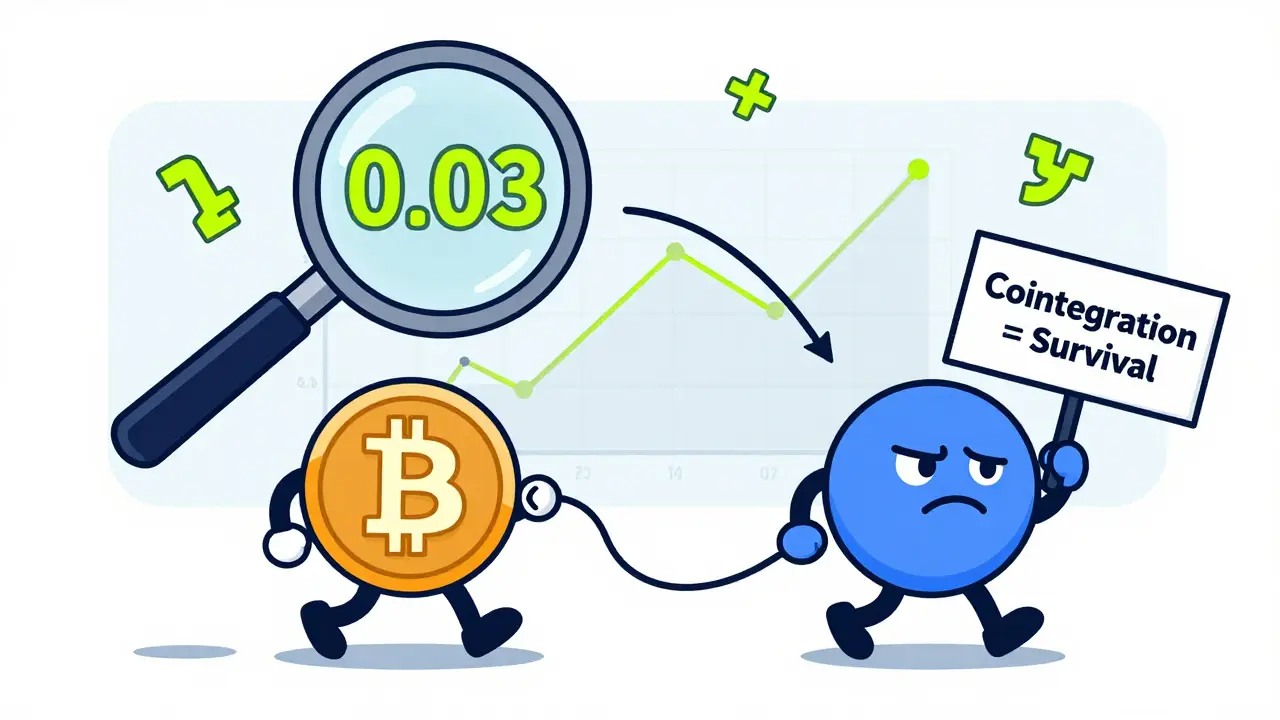
The real test is cointegration. This is a statistical concept that says two assets may drift apart temporarily, but they’re tied together by an underlying relationship that pulls them back over time. Think of it like two people walking on a leash. They can wander left and right, but they won’t get too far apart. If they do, you expect them to come back.
Dr. Vidyamurthy, who wrote the textbook on pairs trading, says: “Cointegration testing is non-negotiable.” Without it, you’re gambling. You need to test for cointegration using tools like the Engle-Granger test. A p-value below 0.05 means the pair is statistically cointegrated. Anything higher? Walk away.
Liquidity Matters More Than You Think
Let’s say you find a promising pair: FTM/ETH. Looks correlated. Cointegrated. Great. But the 24-hour volume is $800,000. That’s not enough.
Low liquidity means two things: slippage and sudden delistings. During the FTX collapse, traders using low-volume pairs like FTM/ETH saw slippage over 2.5% on entry and exit. That’s a 5% loss before the market even moves. And exchanges like Binance regularly delist pairs with under $1 million daily volume. One day your pair is there. The next, it’s gone. Your positions get frozen. Your strategy collapses.
Here’s what works:
- For crypto-to-crypto pairs: Stick to those with at least $5 million daily volume.
- For stablecoin pairs: Aim for $50 million or more.
- Avoid any pair with less than $1 million volume unless you’re doing micro-trading with under $1,000 capital.
Top pairs to start with: ETH/BTC, SOL/BTC, ADA/BTC, and ETH/USDT. These all have volumes over $100 million daily and are listed on every major exchange. You can enter and exit cleanly. You won’t get caught in a liquidity trap.
Volatility and Profit Potential
Not all pairs are created equal in terms of movement. High volatility means bigger swings-and bigger profits or losses.
For example:
- SOL/USDT: 85-120% annualized volatility
- ETH/BTC: 60-80% annualized volatility
- BTC/USDT: 50-70% annualized volatility
If you’re a beginner, don’t start with SOL/USDT. The swings are too wild. You’ll get stopped out by noise. ETH/BTC is a better training ground. It’s volatile enough to give you opportunities, but stable enough to let you learn the rhythm.
Also, remember: higher volatility doesn’t mean higher returns in pairs trading. In fact, the most profitable pairs are often the ones with moderate volatility and strong cointegration. A pair that moves 5% a week with a 90% mean-reversion rate beats a pair that moves 20% a week and breaks correlation every other time.
Market Regimes Dictate Your Pair Choice
The market isn’t always the same. Sometimes Bitcoin dominates. Sometimes altcoins run wild. Your pair strategy must adapt.
When Bitcoin dominance is above 50% (meaning BTC is taking most of the market’s attention), BTC-pegged pairs like ADA/BTC or XRP/BTC work best. These pairs tend to mean-revert cleanly because traders are rotating between altcoins and Bitcoin, not fleeing crypto entirely.
When Bitcoin dominance drops below 45%, altcoin-to-altcoin pairs like SOL/AVAX or DOT/MATIC outperform. That’s when the market is in “altcoin season.” The correlation between altcoins strengthens, and their relationships with Bitcoin weaken. That’s when you want to trade between them, not against BTC.
Track Bitcoin dominance daily. It’s a free metric on CoinMarketCap. If it’s rising, focus on BTC pairs. If it’s falling, shift to altcoin pairs. Your success rate will jump.
Platform Limitations Can Kill Your Strategy
You can’t trade what’s not available. Binance supports over 1,200 trading pairs. Coinbase Pro? Only 180. If you’re using a platform with limited pairs, you’re cutting off 80% of your opportunities.
But it’s not just about quantity. You need tools. Binance’s TradingView integration lets you run correlation and cointegration tests directly on the chart. Coinbase doesn’t. Wundertrading offers a pairs scanner that flags statistically valid pairs in real time. If you’re serious about pairs trading, you need a platform that gives you data-not just prices.
Also, check uptime. Binance’s API had 99.98% uptime in Q2 2023. Smaller exchanges? Often below 99%. One 10-minute outage during a volatility spike can mean your stop-loss doesn’t trigger. You lose more than you planned.
How to Start-Step by Step
If you’re new, don’t try to build a 10-pair portfolio on day one. Here’s how to begin:
- Start with ETH/BTC. It’s the most tested, most liquid, and most reliable pair for beginners.
- Use TradingView or Binance’s built-in tools to check its 1-year cointegration. Run the Engle-Granger test. If p-value > 0.05, skip it.
- Check volume: Must be over $100 million daily.
- Backtest a simple strategy: Buy when the spread is 2 standard deviations above the mean. Sell when it returns to the mean. Use 30-day historical data.
- Start with 1% of your capital. No more.
- After 3 successful trades, add one more pair-maybe ADA/BTC.
- Never risk more than 2% of your total capital on any single pair.
Most people fail because they skip the backtesting. They see a chart, assume it’ll work, and go all in. That’s not trading. That’s gambling.

The Hidden Risk: Correlation Breakdowns
Even the best pairs can break. In March 2020, during “Black Thursday,” ETH/BTC correlation dropped from 0.85 to -0.12 in 48 hours. That’s not a correction. That’s a collapse. Over 68% of pairs trades at the time got stopped out.
How do you protect yourself?
- Set up alerts for correlation shifts. If the 7-day correlation drops more than 30% from its 30-day average, pause the trade.
- Use position sizing. Never put more than 5% of your portfolio into one pair.
- Have a plan for when the relationship breaks. Do you exit immediately? Or wait for reversion? Stick to your rules.
Traders who survived 2020 didn’t have perfect strategies. They had discipline.
What Works Today (2025)
Here’s what’s working in late 2025:
- Top beginner pair: ETH/BTC-high liquidity, stable cointegration, plenty of data.
- Top medium-risk pair: SOL/BTC-strong historical relationship, good volume, moderate volatility.
- Top institutional pair: BTC/USDT-used by funds for hedging, less noisy than crypto-to-crypto.
- Top altcoin pair: AVAX/MATIC-cointegrated since 2023, low correlation to BTC, ideal for when dominance is below 45%.
Machine learning tools like TokenMetrics’ Moonshot Finder now predict pair stability with 78% accuracy. But they’re not magic. They still need human input. You still need to understand the stats.
Final Rule: Don’t Chase Returns. Chase Reliability.
People want to make 20% in a week. But the most successful pairs traders make 1-3% per trade, consistently, over months. They don’t trade every pair. They trade 5-8 pairs they’ve tested and trust. They let the math work for them.
The market has changed. Algorithmic traders have eaten most of the easy profits. If you’re still using basic correlation, you’re behind. You need cointegration, volume filters, regime awareness, and strict risk controls.
Start small. Test everything. Stick to the best pairs. And never forget: in pairs trading, you’re not betting on the market. You’re betting on a relationship. And relationships, like markets, can break. But if you choose them carefully, they’ll hold.
What’s the best trading pair for beginners?
ETH/BTC is the best starting pair. It has high liquidity, strong historical cointegration, and plenty of data for testing. Avoid stablecoin pairs like ETH/USDT at first-they’re good for directional trading, not pairs strategies.
Can I use correlation alone to pick trading pairs?
No. Correlation can be misleading. Two assets can move together for months and then suddenly break apart. Cointegration testing is required to confirm that the relationship is statistically meaningful and likely to revert. Always test for cointegration before trading.
How much volume should a trading pair have?
For crypto-to-crypto pairs, aim for at least $5 million in 24-hour volume. For stablecoin pairs like ETH/USDT, $50 million or more is recommended. Lower volume means slippage, delayed trades, and risk of delisting.
Should I trade during a Bitcoin bull run?
Pairs trading underperforms during strong directional moves. During Bitcoin’s 160% rally in 2023, top pairs strategies returned only 4.2%, while spot BTC gained 160%. Wait for sideways or volatile markets-those are when pairs strategies shine.
How many pairs should I trade at once?
Aim for 5-10 uncorrelated pairs. Trading fewer than 5 increases your risk of total failure. Wundertrading’s data shows portfolios with 7-10 pairs had 3.2x higher success rates than those with fewer than 5.
What platform is best for pairs trading?
Binance is the best overall for pairs trading due to its 1,200+ pairs, low fees, high liquidity, and integrated TradingView tools. Coinbase Pro lacks enough pairs for serious traders. Avoid DEXs unless you’re trading high-volume pairs-most have low liquidity and high slippage.
How do I know if a pair is cointegrated?
Use a statistical tool like the Engle-Granger test. If the p-value is below 0.05, the pair is cointegrated. Most trading platforms don’t show this automatically-you’ll need to export price data and run the test in Python, Excel, or TradingView with custom scripts.
Is pairs trading profitable in 2025?
Yes-but only for those who use statistical methods and risk controls. Retail traders with no training have only an 18% success rate. Traders who test for cointegration, manage position size, and avoid low-volume pairs see 60%+ success rates. The edge is still there, but it’s not easy.





Emily L
December 30, 2025 AT 16:23bro i tried trading ADA/BTC last month and got wrecked because i ignored volume. $200k daily? dumb. slippage ate my lunch and then Binance delisted it a week later. learn from my pain.
Kevin Gilchrist
December 30, 2025 AT 23:41correlation is for people who still think the moon is made of cheese 🤡
you wanna make money? cointegration or GTFO. i ran the Engle-Granger on SOL/BTC last week-p-value 0.012. made 8% in 3 days. you? still staring at candlesticks like it’s tarot cards.
NIKHIL CHHOKAR
January 1, 2026 AT 23:29you know what’s sad? people treat crypto like a casino but act surprised when they lose.
the author is absolutely right-beginners think ETH/USDT is ‘safe’ but it’s not pairs trading, it’s just gambling with a different name.
if you don’t understand cointegration, you shouldn’t even be touching a trading terminal.
i’ve seen so many young traders blow up accounts because they followed ‘guru’ YouTube videos instead of reading papers.
Dr. Vidyamurthy’s work isn’t optional-it’s the foundation.
and don’t even get me started on DEXs-low liquidity, high fees, and zero protection.
if you’re trading below $5M volume, you’re not a trader, you’re a donation machine.
the fact that people still think ‘high volatility = high profit’ is why crypto is full of broke 19-year-olds.
it’s not about how fast you can go, it’s about how long you can stay in the game.
you don’t need 10 pairs. you need 1 pair you understand deeply.
and if you’re using Coinbase Pro? you’re already behind.
the real edge isn’t in the chart-it’s in the stats.
and yes, i’ve backtested this for 3 years. the numbers don’t lie.
if you’re reading this and still using correlation alone… please, for the love of god, stop.
you’re not investing. you’re just feeding the market makers.
alvin mislang
January 2, 2026 AT 00:41ETH/BTC for beginners? literally the only pair i trade. 78% win rate over 18 months. no drama, no surprises. if you can’t make money with that, you shouldn’t be trading.
also-yes, i use the moonshot finder. it’s not magic but it’s better than your gut. 🤓
Monty Burn
January 3, 2026 AT 16:11the market doesn't care if you believe in cointegration
it only cares if you're right
and if you're not measuring the spread properly
you're just guessing
and guessing is how people end up sleeping on their couches
the pair isn't the thing
the relationship is
and relationships don't care about your hopes
they only care about the math
if the math breaks
you walk away
not because you're scared
but because you're smart
Alexandra Wright
January 5, 2026 AT 03:58oh wow so you're telling me that people who think 'correlation = strategy' are the same ones who bought Dogecoin at the peak?
congrats, you just described half the reddit crypto bros.
also-yes, Binance is the only real platform. Coinbase Pro is for people who think 'portfolio' means 'i bought one of everything and hope for the best'.
and if you're trading below $5M volume… sweetie, go play with your fidget spinner.
we're not here to babysit your risk tolerance.
the fact that you even asked about ETH/USDT for pairs trading? that's your first red flag.
you're not ready. go read the paper. then come back.
and stop using emoticons. you're not in middle school.
Jack and Christine Smith
January 6, 2026 AT 08:15im so glad someone finally said this! i was just getting into this and thought maybe i was overthinking it but nooo
my buddy tried trading AVAX/MATIC with 10k and lost 3k because the volume was like 2mil and then the pair got delisted 😭
so now i only trade eth/btc and its been smooth sailing
also i use tradingview with a custom script to check cointegration-its kinda messy but it works
ps: i typoed a lot here but u get the point lol