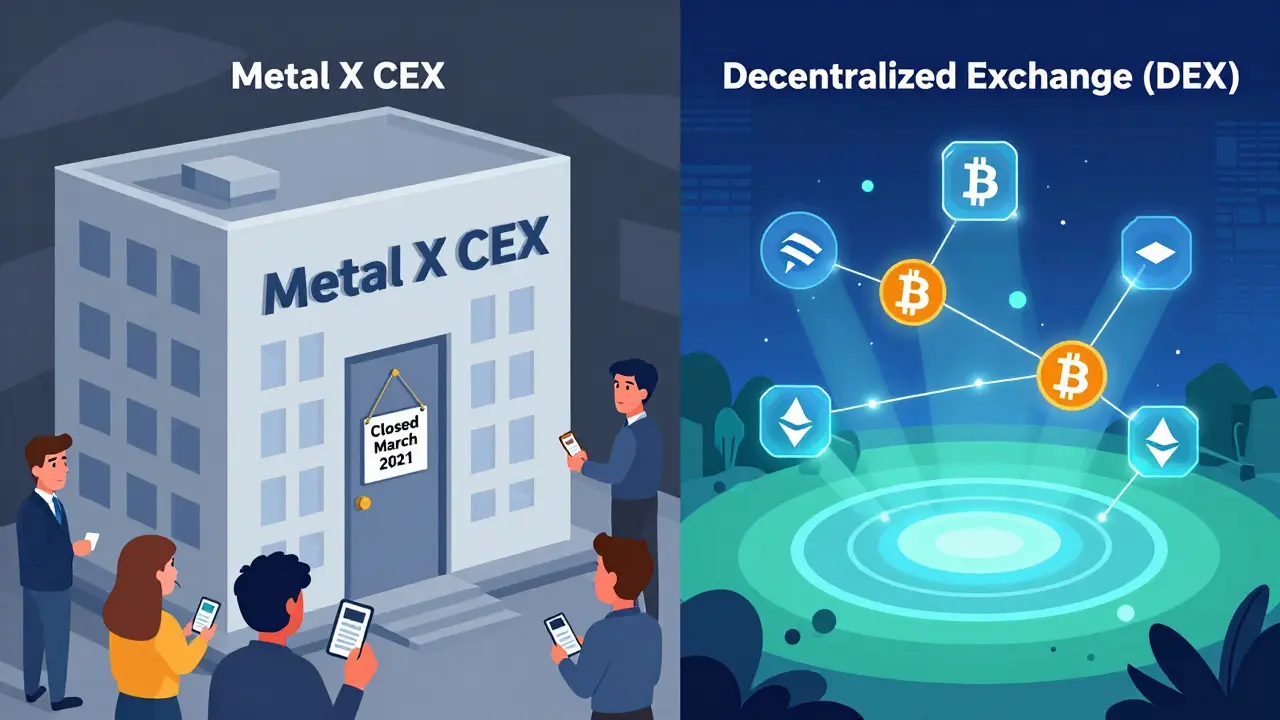
Remember the hype around Metal X back in 2020? It promised to bridge the gap between traditional banking and crypto trading through its integration with Metal Pay. But if you are looking at Metal X today in June 2026, you might be scratching your head. The platform you read about in old tutorials doesn't quite exist anymore. In fact, the centralized version of Metal X shut down its operations in March 2021.
So, is it dead? Not exactly. It has evolved into something different-a decentralized exchange (DEX) component within the broader Metallicus ecosystem. If you are considering using Metal X now, you need to understand that you are not signing up for a traditional exchange like Coinbase or Binance. You are entering a complex DeFi environment that is still maturing. This review breaks down what Metal X actually is today, whether it is safe, how the fees work, and if it makes sense for your portfolio in 2026.
The Evolution: From Centralized Hub to Decentralized Protocol
To understand where Metal X stands, we have to look at where it started. Originally launched in April 2020, Metal X was the trading arm of Metal Pay, a blockchain-based payment processing application designed to simplify fiat-to-crypto conversions. At that time, it operated as a centralized exchange (CEX). This meant they held your funds, managed the order books, and acted as the intermediary in every trade. They even had regulatory licenses, including FinCEN authorization, which gave early users a sense of security.
However, the landscape changed rapidly. On March 29, 2021, Metal X announced it was closing its centralized operations. The company stated they wanted to "redouble their efforts on building out their core platform." For many users, this was a shock. It raised questions about asset recovery and trust. Since then, the focus has shifted entirely to a decentralized model. Today, Metal X functions as a DEX, utilizing smart contracts to execute trades without a central authority holding your assets. This shift aligns with the current industry trend toward self-custody and non-custodial trading, but it also changes the user experience significantly.
How Metal X Works in 2026
If you log onto Metal X today, you won't find the familiar login screen asking for your email and password. Instead, you connect your wallet. The platform operates on the principle of trustless trading. Your assets remain in your digital wallet until the moment of execution, governed by code rather than customer support tickets.
The technical architecture relies on smart contracts programmed to self-execute based on predefined conditions. All transactions are recorded on the blockchain, providing transparency. One of the key features of the current iteration is its multi-chain approach. Metal X supports trading across multiple blockchain networks, utilizing over 10 network bridges. This allows for cross-chain functionality, meaning you can potentially swap assets between different blockchains without paying high gas fees directly, as the protocol handles much of the complexity.
Supported cryptocurrencies include major assets like Bitcoin (BTC), Ethereum (ETH), Tether (USDT), XRP, USDC, and Dogecoin (DOGE). While the list isn't as exhaustive as giant exchanges like Binance, it covers the most liquid and widely used tokens. For traders who primarily deal in these blue-chip assets, the selection is sufficient. However, if you are hunting for obscure altcoins or new meme coins, Metal X likely won't be your go-to spot.
Fees and Costs: What Will You Actually Pay?
Fees are often the deciding factor for active traders. During its centralized phase, Metal X had a maker-taker fee structure. Makers (those adding liquidity) paid 0.05%, while takers (those removing liquidity) paid 0.1%. Some reports suggested higher fees later on, with takers facing 0.25%. These rates were considered above average compared to competitors offering lower tiers for high-volume traders.
In its current decentralized form, the fee structure is more aggressive to attract users. Metal X prominently advertises 0% fees on Bitcoin trades. This is a significant draw for BTC holders looking to swap without eroding their profits. For other assets, the model incentivizes liquidity providers. If you provide liquidity to the pools, you can earn 0.2% on every trade that utilizes your funds. This is a classic Automated Market Maker (AMM) incentive structure, similar to what you see on Uniswap or SushiSwap.
Withdrawal fees during the centralized era were set at 0.0004 BTC per withdrawal, which was slightly below the industry average of 0.0006 BTC. As a DEX, there are no "withdrawals" in the traditional sense since you never deposit funds into the exchange's custody. Instead, you pay network gas fees to interact with the smart contract. Depending on the congestion of the underlying blockchain, these costs can vary wildly. The promise of "no gas fees" for users via bridge support needs careful verification, as some protocols subsidize this cost temporarily to gain market share.
| Feature | Metal X (Current DEX) | Traditional CEX (e.g., Coinbase) |
|---|---|---|
| Custody | Non-custodial (You hold keys) | Custodial (Exchange holds keys) |
| KYC Required | No | Yes |
| Bitcoin Fees | 0% advertised | Variable (often 0.1% - 0.5%) |
| Asset Variety | Limited (~20 major coins) | Extensive (Hundreds of coins) |
| User Interface | Wallet-connected, DeFi style | Login-based, beginner friendly |
Safety and Regulatory Status
Safety is paramount in crypto. When Metal X was a centralized entity, it held an MSB license (number 31000174577713) from FinCEN. This provided a layer of regulatory compliance that many pure DEXs lack. However, since transitioning to a decentralized model, that specific licensing applies less directly to the trading mechanism itself. Smart contracts are immutable; once deployed, they cannot be easily patched if a bug is found. This introduces smart contract risk, which is distinct from the operational risk of a centralized exchange going bankrupt.
The platform integrates with WebAuth 3.0, which includes Passkey support and enhanced security features. This helps protect your connection to the dApp, but it does not eliminate the risk of phishing or private key compromise. You are responsible for securing your wallet. If you lose your seed phrase, there is no customer support team to reset your password. This is the fundamental trade-off of decentralization: greater control comes with greater responsibility.
Expert opinions have been mixed. Analysts praised the initial regulatory credibility but noted the slow coin listing process and limited payment methods during the CEX phase. Current feedback on the DEX version is sparse because the platform is still gaining traction. The closure in 2021 left a scar on brand reputation, so users should approach with caution and start with small amounts to test the waters.
User Experience and Future Roadmap
The interface of Metal X has been described as clean and professional, catering to both novice and experienced traders. It offers various order types, including Market, Limit, Stop Loss, and Take Profit, along with TradingView chart integration. This is unusual for many DEXs, which often offer only simple swaps. Having advanced order types suggests that Metallicus is trying to bring institutional-grade tools to the decentralized space.
Looking ahead, the future of Metal X depends heavily on the 2025-2026 roadmap from Metallicus. According to Maura, VP of Engineering, the plan involves taking "Metal X multichain by deploying our multi-feature decentralized trading platform on Metal L2." Metal L2 is Metallicus's own Layer 2 blockchain solution. Moving to their own L2 could drastically reduce transaction costs and increase speed, making the platform more competitive against giants like Arbitrum or Optimism-based DEXs.
Additionally, upgrades to WebAuth 3.0 aim to improve usability with address book functionality and easier network switching. These improvements address one of the biggest pain points in DeFi: the complexity of managing multiple networks and wallets. If executed well, this could make Metal X a compelling option for users who want the benefits of DeFi without the steep learning curve.
Who Should Use Metal X?
Metal X is not for everyone. If you are a complete beginner who wants to buy $50 worth of Bitcoin with a credit card and forget about it, a centralized exchange like Coinbase or Kraken is likely easier and safer due to established customer support and insurance funds. Metal X requires you to manage your own keys and understand gas fees and bridge mechanics.
However, Metal X is ideal for:
- Privacy-focused traders: Since no KYC is required, you can trade without linking your identity to your wallet address.
- DeFi enthusiasts: Users who prefer non-custodial solutions and want to avoid counterparty risk associated with centralized exchanges.
- Bitcoin swappers: Those looking for zero-fee BTC trades within the supported ecosystems.
- Ecosystem believers: Users already invested in the Metal Pay or Metallicus ecosystem who want seamless integration between payments and trading.
For active day traders relying on deep liquidity for obscure altcoins, Metal X may lack the volume and variety needed. The 24-hour trading volume during its centralized peak was around $5 million, which is modest compared to billions seen on top-tier exchanges. Liquidity depth in the DEX pools will determine slippage rates, so always check the pool depth before executing large orders.
Is Metal X Exchange still open in 2026?
The centralized version of Metal X closed in March 2021. However, the platform has evolved into a decentralized exchange (DEX) within the Metallicus ecosystem. It is currently operational as a DEX, allowing users to trade via smart contracts without a central intermediary.
Do I need to do KYC to use Metal X?
No. As a decentralized exchange, Metal X does not require Know Your Customer (KYC) verification. You connect your wallet and trade anonymously. This contrasts with its previous centralized model, which did require KYC for regulatory compliance.
What are the fees for trading on Metal X?
Metal X advertises 0% fees on Bitcoin trades. For other assets, liquidity providers can earn 0.2% on trades. Users should also consider network gas fees, although the platform aims to minimize these through its multi-chain bridge support and potential migration to Metal L2.
Is Metal X safe to use?
Safety depends on your comfort with DeFi risks. Since it is non-custodial, your funds are not held by the exchange, reducing the risk of exchange hacks. However, you are exposed to smart contract risks and must secure your own private keys. The platform previously held FinCEN licenses, but as a DEX, regulatory protection is limited.
Can I buy crypto with a credit card on Metal X?
Direct fiat on-ramps via credit card were a feature of the integrated Metal Pay service during the centralized era. As a DEX, Metal X primarily facilitates crypto-to-crypto swaps. To fund your account, you would typically need to transfer crypto from another exchange or wallet that supports fiat purchases.





ravi mahla
June 22, 2026 AT 14:550% fees on BTC? Yeah right. There is always a catch with these 'free' DEXs, usually hidden in the slippage or the bridge spread. I tried something similar last year and lost more on gas than I saved on fees. Classic bait.
Annemarie Fitzgerald
June 23, 2026 AT 07:35i mean... if they shut down in 2021 why are we even talking about it now?
it feels like chasing ghosts. the whole concept of trusting code over people is just another layer of illusion. we think we are free but we are just slaves to the algorithm. very poetic really. also i hate how hard it is to find good info without ads everywhere
Abby Sivertsen
June 24, 2026 AT 09:05I get the skepticism, but for some people not having KYC is actually a relief. Not everyone wants their trading history linked to their identity. It’s not about hiding crimes, sometimes it’s just about privacy. But yeah, you gotta know what you’re doing with smart contracts.
Benjamin Eisen
June 24, 2026 AT 11:20hey guys i was reading this and it seems like a cool pivot from CEX to DEX. i dont really understand the tech side much but it sounds interesting that they have limit orders on a dex? thats rare right? maybe i should try it out with a small amount just to see how it works. thoughts?
Mark Brunschwiler
June 25, 2026 AT 13:58Why does everyone care so much about Metal X? It is dead. The brand is dead. You are putting your money into a protocol that has no real support team. If the contract breaks, you lose everything. No refunds. No help. Just silence. It makes me sick how people ignore basic risk management for zero fees. Wake up.
Terry Hyland
June 25, 2026 AT 20:49They say no KYC but the bridges track everything. They are feeding data to the big banks anyway. Do not fall for the decentralization lie. It is all controlled by the same elites who wanted Metal Pay shut down in the first place. Keep your coins off chain or you are already owned.