Blockchain Scaling: How Networks Handle More Users Without Slowing Down
When you send Bitcoin or Ethereum, it doesn’t just disappear into the void—it gets packed into a block, a digital container that holds a batch of transactions and links to the one before it. This chain of blocks is what makes blockchain secure—but it also creates a bottleneck. As more people join, the network gets congested, fees spike, and transactions take minutes or hours. That’s where blockchain scaling, the process of increasing how many transactions a network can handle per second comes in. Without it, crypto can’t scale beyond niche use cases. It’s not just about speed; it’s about making crypto usable for everyday payments, DeFi, and even gaming.
There are two main ways to tackle this: Layer 2 solutions, systems built on top of the main blockchain to process transactions off-chain and then settle them back, and protocol upgrades, changes to the core blockchain code to make it more efficient. Think of Layer 2 like adding express lanes to a highway. Instead of every car going through the main toll booth, many get processed on a parallel road and then merged back. Projects like Polygon, Arbitrum, and Optimism use this approach for Ethereum. Meanwhile, protocol upgrades—like Ethereum’s shift to proof-of-stake—cut down the energy and time needed to confirm each block. Both methods aim to reduce fees and increase transaction throughput, which is just a fancy way of saying "how many transactions fit in a given time."
But scaling isn’t just a tech problem—it’s a trade-off. Faster networks often mean less decentralization or weaker security. Some solutions rely on trusted operators instead of full node verification. Others create fragmented ecosystems where assets move between chains, increasing complexity. That’s why you’ll see posts here covering everything from blockchain scaling tools like rollups to the risks of centralized sidechains. You’ll also find real-world examples: how Nigeria’s crypto users rely on fast, low-cost networks to bypass banking limits, or how institutional investors watch on-chain metrics to predict which scaling solutions will win. Some posts even dig into the hidden costs—like how mining pools evolve to support heavier traffic, or how tokenized assets struggle when the underlying chain can’t keep up.
What you’ll find below isn’t theory. It’s what’s actually happening on chains right now—the good, the bad, and the barely working. From exchanges that handle millions of trades daily to dead tokens that never got off the ground because their blockchain couldn’t scale, these stories show why scaling isn’t optional. It’s the difference between crypto being a curiosity and becoming a utility. Whether you’re holding Bitcoin, trading on a DEX, or just trying to send $5 to a friend, this is the backbone of what makes it all possible—or impossible.
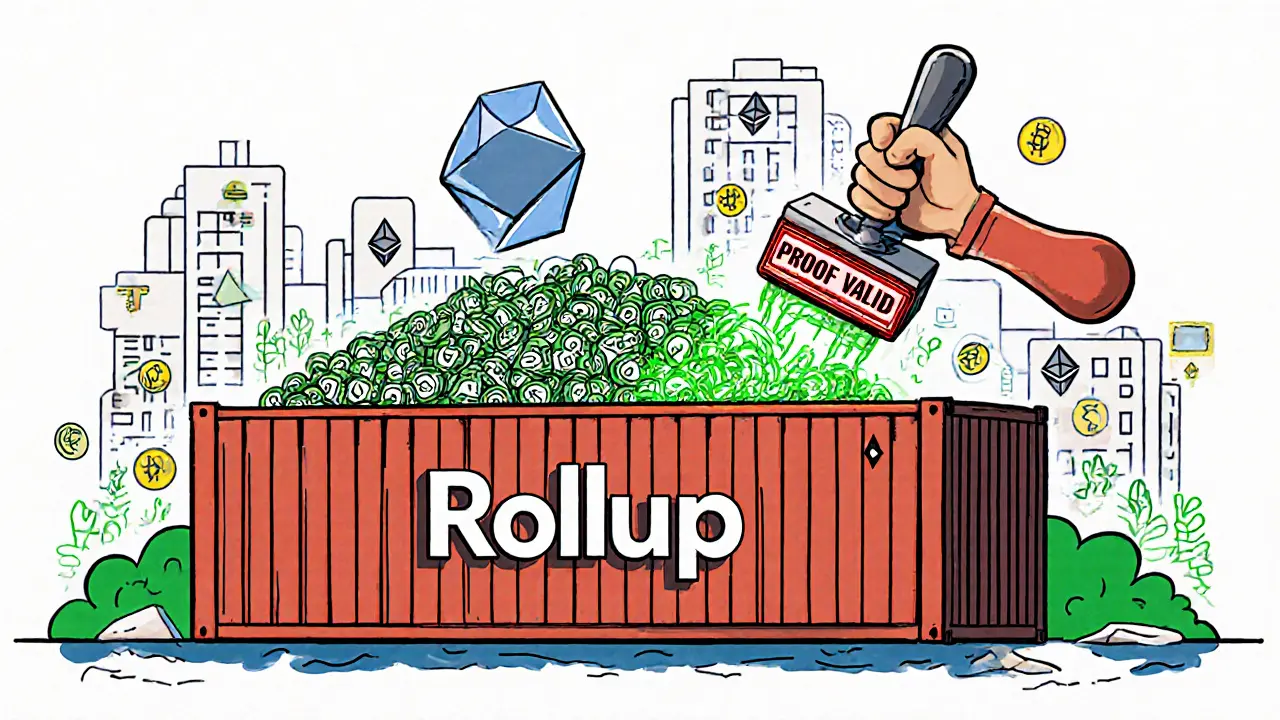
Future of Rollup Technology: How Layer-2 Scaling Will Shape Blockchain Adoption
- 8 Comments
- Oct, 29 2025
Rollup technology is solving blockchain's biggest problem: scalability. By batching transactions off-chain, ZK-rollups and Optimistic Rollups slash fees and boost speed while keeping security intact. Here's what's changing in 2025 and beyond.