
Crypto Loan LTV Calculator
Required Collateral:
Loan-to-Value (LTV):
Max Borrowable:
Liquidation Price:
Liquidation Penalty: 5-10%
WARNING: Your collateral is below liquidation threshold. Add more collateral or repay loan immediately.
When you take out a loan in traditional banking, the bank looks at your credit score, income, and history. In crypto lending, none of that matters. Instead, you’re asked to lock up more crypto than you’re borrowing. This isn’t a quirk-it’s the backbone of how decentralized finance stays secure. That system is called over-collateralization.
What Exactly Is Over-Collateralization?
Over-collateralization means you put up more value in collateral than the loan you’re getting. If you want $10,000 in USDC, you might need to deposit $15,000 worth of ETH. That extra $5,000 isn’t a bonus-it’s your safety net. And it’s the lender’s too.This isn’t just common-it’s the default in DeFi. Platforms like Aave, Compound, and MakerDAO all use it. Why? Because crypto prices swing wildly. ETH can drop 30% in a day. If lenders only took collateral equal to the loan, a small price drop could leave them with less than they lent out. Over-collateralization builds in a buffer so the loan stays covered, even during a crash.
How It Works Step by Step
Here’s how it plays out in real life:
- You pick a lending platform and connect your wallet.
- You choose which crypto to use as collateral-usually ETH, BTC, or stablecoins like USDC.
- You deposit the collateral. The platform calculates your loan-to-value (LTV) ratio. For example, if you deposit $15,000 in ETH and borrow $10,000, your LTV is 66%.
- The platform locks your collateral in a smart contract. You can’t touch it until you repay the loan.
- As long as your collateral value stays above the required threshold (say, 150% of the loan), you’re good.
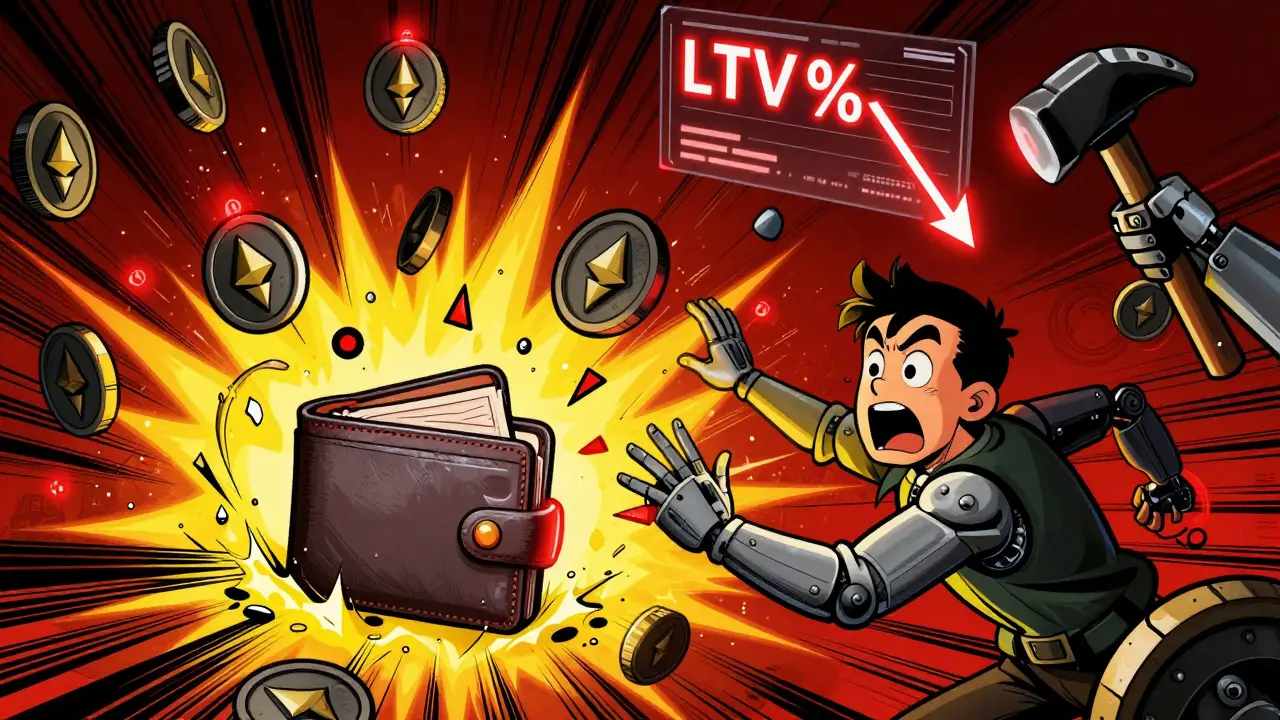
- If your collateral drops too low-maybe ETH crashes and your $15,000 becomes $12,000-the system alerts you to add more or pay down the loan.
- If you ignore it, the smart contract automatically sells part of your collateral to cover the loan. This is called liquidation.
There’s no human reviewing your application. No credit check. No phone call. Just code enforcing rules. That’s the power-and the risk-of DeFi.
Why Borrowers Accept This System
It seems unfair to lock up $15,000 to get $10,000. So why do people do it?
- Avoiding taxes: If you sell your ETH to get cash, you might owe capital gains tax. By borrowing against it instead, you keep your assets and defer taxes.
- Betting on price growth: You believe ETH will go up. You borrow USDC to buy more crypto, hoping your collateral’s value rises faster than your loan grows.
- Leverage for trading: Traders use these loans to amplify positions-borrowing to buy more, then selling high. It’s risky, but it’s a core strategy in crypto markets.
- Access to liquidity without selling: You don’t want to give up your Bitcoin. But you need cash for rent, a car, or an investment. This lets you access fiat or stablecoin liquidity without touching your holdings.
For many, it’s not about getting cheap money. It’s about keeping control of their assets while still using them as financial tools.
The Risks: Liquidation and Opportunity Cost
Over-collateralization isn’t free. There are real downsides.
Liquidation risk is the biggest. If your collateral drops too fast, you get wiped out. In 2022, when ETH fell over 70% in a few months, tens of thousands of borrowers got liquidated. Some lost 100% of their collateral because they didn’t monitor their LTV. The system doesn’t care if you’re having a bad day. It just executes the code.
Opportunity cost is the quiet killer. That $15,000 in ETH could’ve been staked, traded, or used in another DeFi protocol to earn yield. Instead, it’s locked up. You’re giving up potential returns just to borrow a fraction of it.
And managing it isn’t easy. You need to watch prices, track your LTV, and be ready to add more collateral-or pay back part of the loan-on short notice. It’s not a set-it-and-forget-it system. It’s a full-time job if you’re doing it seriously.
Why Stablecoins Are the Preferred Collateral
Not all collateral is equal. While ETH and BTC are common, many lenders prefer stablecoins like USDC or DAI as collateral. Why?
Because they’re stable. If you deposit $10,000 in USDC, it’s still worth $10,000 tomorrow. That means your LTV doesn’t swing wildly. Lenders can offer higher loan amounts with lower risk. Some platforms even let you borrow up to 90% of your stablecoin collateral-because the risk is low.
On the flip side, if you use volatile crypto as collateral, lenders cap your loan at 50-70%. That’s why you’ll see people depositing ETH to borrow USDC, then using that USDC as collateral to borrow more. It’s a way to squeeze more leverage out of the system.

Under-Collateralization: The Holy Grail DeFi Can’t Crack
One of the biggest open questions in DeFi is: Can we lend without over-collateralization?
In traditional banking, your credit score says you’re trustworthy. In DeFi, there’s no credit score. So the system says: “Prove you have more than you owe.” But that excludes millions of people who hold little crypto but have steady income or good financial habits.
Some projects are trying to fix this. MakerDAO’s “Credit DeFi” initiative is testing on-chain reputation systems. Others use off-chain data-like bank statements or pay stubs-verified through zero-knowledge proofs. A few platforms let you borrow small amounts without collateral, backed by your history on the platform.
But so far, none of these have scaled. The market still trusts locked-up crypto more than any algorithm. Until we have a reliable, decentralized way to measure trustworthiness, over-collateralization will stay the rule.
How It Compares to Traditional Finance
Over-collateralization isn’t new. It’s used in mortgage-backed securities (MBS) and collateralized loan obligations (CLO). In those systems, the total value of loans is less than the value of the underlying assets. If a few borrowers default, the extra value covers the loss.
The difference? In traditional finance, this is done by banks with lawyers, regulators, and months of paperwork. In DeFi, it’s done by code in seconds. No middlemen. No delays. But also no appeals.
Traditional loans rely on trust and legal enforcement. Crypto loans rely on math and automation. One is human. The other is mechanical. Both aim for the same thing: safety.
What’s Next for Over-Collateralization?
Don’t expect it to disappear. Even as DeFi grows, the volatility of crypto assets keeps over-collateralization essential. But it will evolve.
Future systems might offer tiered collateral ratios. A borrower with a long history on the platform might get 70% LTV instead of 50%. Someone new might still need 150%. Reputation becomes collateral.
Oracles might pull in off-chain data-like employment records or tax filings-to adjust risk. Smart contracts could auto-adjust loan terms based on market conditions.
But the core idea won’t change: you can’t borrow without putting something valuable on the line. That’s the price of permissionless, global, and open finance.
For now, if you want to borrow in crypto, you need to be ready to lock up more than you get. It’s not ideal. But it’s the only system that’s worked-at scale-for over a decade.
Is over-collateralization required for all crypto loans?
Almost all major DeFi platforms require over-collateralization. A few experimental platforms offer under-collateralized or uncollateralized loans, but these are rare, have low limits, and often require identity verification or off-chain data. For now, if you’re using Aave, Compound, or MakerDAO, you’ll need to post more collateral than you borrow.
What happens if my collateral drops in value?
The platform will notify you to add more collateral or repay part of your loan. If you don’t act in time, the smart contract will automatically sell enough of your collateral to bring your loan back into compliance. This is called liquidation, and you’ll lose the portion sold-plus pay a liquidation penalty, usually 5-10%.
Can I use any crypto as collateral?
No. Each platform has a list of approved assets. Usually, it’s ETH, BTC, USDC, DAI, and a few other high-liquidity tokens. Newer or less-traded coins are often excluded because they’re too volatile or hard to sell quickly during liquidation. Always check the platform’s collateral list before depositing.
Why do lenders care about the loan-to-value (LTV) ratio?
The LTV ratio tells lenders how much cushion they have before they’re at risk. A 50% LTV means you’ve deposited twice the value of your loan. Even if the collateral drops 40%, you’re still covered. A 90% LTV leaves almost no room for error. Lenders set LTV limits based on how risky the collateral is-stablecoins get higher limits, volatile tokens get lower ones.
Is over-collateralization safer than traditional loans?
It’s safer for lenders, but not necessarily for borrowers. Lenders face near-zero default risk because they can instantly liquidate collateral. But borrowers face total loss risk if they don’t monitor their positions. Traditional loans can be restructured or negotiated. Crypto loans can’t. One is flexible. The other is absolute.




Joe West
December 6, 2025 AT 02:09Over-collateralization isn’t just a DeFi quirk-it’s the reason you don’t wake up to a $0 wallet after a 40% crypto crash. I’ve seen people lose everything because they thought ‘it’ll bounce back.’ Spoiler: it doesn’t always. Lock up the extra 50% and sleep like a baby.
Martin Hansen
December 7, 2025 AT 04:24Let’s be real-anyone who thinks DeFi should work like Chase is just clinging to the 20th century. You want convenience? Go to a bank. You want freedom? Then accept that your ETH is collateral, not a status symbol. The fact that you need to *think* about your LTV is the whole damn point. If you can’t handle that, maybe crypto isn’t for you.
Mariam Almatrook
December 7, 2025 AT 10:19One cannot help but observe, with a certain degree of intellectual consternation, that the prevailing orthodoxy surrounding over-collateralization in decentralized finance is predicated upon an archaic, almost feudal, notion of value as mere fungible asset quantity-rather than as an emergent property of trust, reputation, and social capital. The system is not merely inefficient; it is morally regressive.
Chris Mitchell
December 8, 2025 AT 12:53It’s not about locking up crypto. It’s about not being a slave to volatility. If you can’t handle the math, don’t play the game. Simple.
rita linda
December 8, 2025 AT 14:08Let’s not pretend this isn’t a Western-centric model built on Anglo-American financial dogma. In emerging markets, people don’t hoard ETH-they use remittances, microloans, and community trust. DeFi’s obsession with collateral is just crypto colonialism dressed up as innovation. The system excludes the very people it claims to empower.
jonathan dunlow
December 9, 2025 AT 09:13Look, I get it-over-collateralization feels like paying a premium just to borrow your own money. But think of it like this: you’re not just borrowing cash, you’re buying peace of mind. No surprise margin calls. No midnight panic when Bitcoin drops 20%. You set your LTV, you monitor it, you adjust. It’s not hard-it’s just different. And once you stop fighting it and start working with it? Man, the freedom is insane. I’ve borrowed $8K in USDC against $15K in ETH and used it to buy more ETH, stake it, and still had cash for rent. No bank would ever let me do that. This isn’t finance-it’s financial superpowers. You just gotta learn the rules before you play.
nicholas forbes
December 9, 2025 AT 09:57Some of you are acting like over-collateralization is a flaw. It’s not. It’s the firewall. Without it, DeFi collapses. The fact that you can’t just ‘trust’ someone is why this works globally. No ID, no bank, no bureaucracy-just math. That’s the revolution.
Regina Jestrow
December 10, 2025 AT 10:29I just tried to borrow against my SOL and got liquidated within 4 hours because I didn’t realize the LTV threshold was 70%. I lost $3,000. I cried. Then I read every thread on this. Now I only use ETH and USDC. And I set alerts. And I sleep better. This system is brutal-but it’s fair. You just have to respect it.
Richard T
December 11, 2025 AT 14:07One thing people forget: over-collateralization isn’t just about risk-it’s about access. It lets someone in Lagos borrow against BTC without a bank account. It lets a student in Texas buy more ETH without selling. It’s not perfect, but it’s the first system that lets anyone, anywhere, participate in global finance without permission. The fact that we’re even talking about under-collateralization shows how far we’ve come. We’re not trying to fix it-we’re trying to evolve it.