BIO Token Value Calculator
Calculate the current and potential value of your BIO tokens based on the current market price. This tool helps you understand your investment's potential value at different price points.
Your Investment Value
Based on Bio Protocol (BIO) price of $0.0864 (October 2025) and 1.66B tokens in circulation.
Remember: This is a hypothetical calculation for educational purposes only. Crypto investments carry significant risk.
Bio Protocol isn’t just another crypto coin. It’s a radical experiment in how science gets funded-built on blockchain, run by communities, and focused on fixing broken systems in biotech research. If you’ve ever wondered why curing rare diseases takes decades and billions of dollars, Bio Protocol is trying to answer that question with tokens, smart contracts, and decentralized governance.
What Exactly Is Bio Protocol (BIO)?
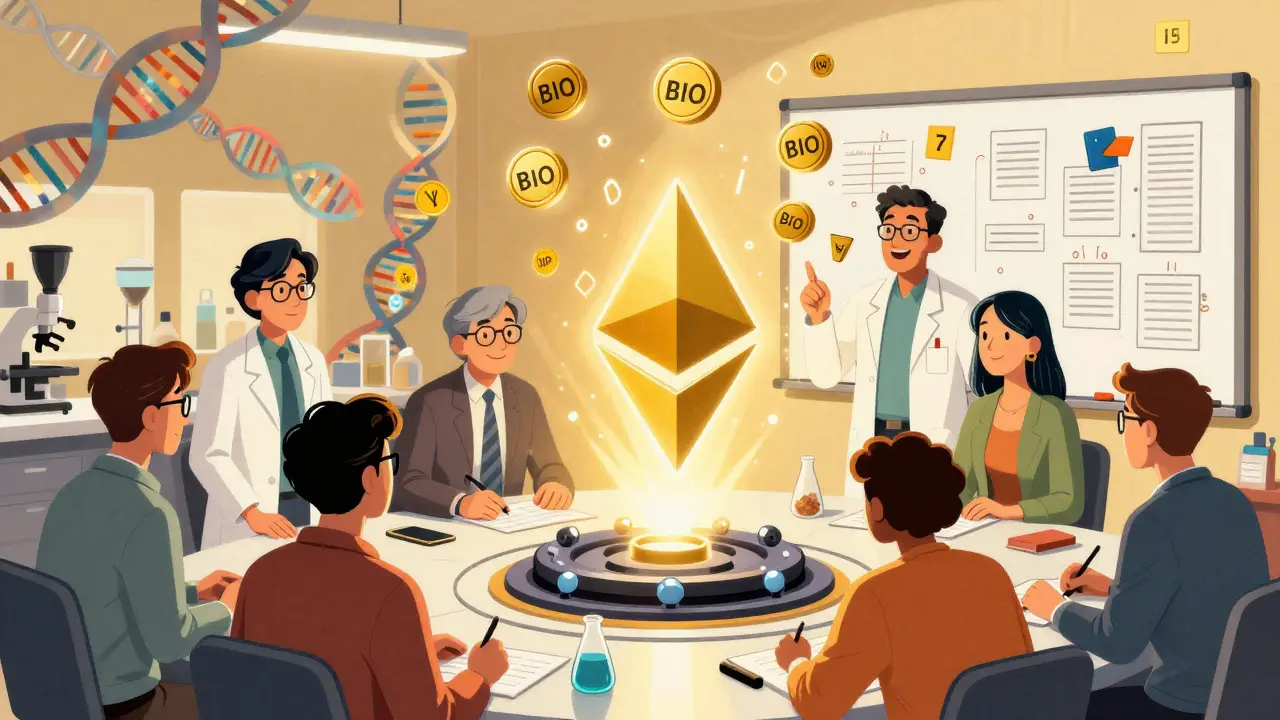
Bio Protocol, or BIO, is the native token of a platform designed to turn biotech research into a collaborative, open-source movement. Unlike traditional drug development, where big pharma controls funding and patents, Bio Protocol lets anyone-researchers, patients, investors-pool money and ideas to fund science. It’s called Decentralized Science, or DeSci, and BIO is the fuel that makes it work.
Launched in 2024, Bio Protocol runs on Ethereum as an ERC-20 token with the contract address 0xcb1592591996765ec0efc1f92599a19767ee5ffa. It also supports Solana since its V2 upgrade in October 2025, making transactions faster and cheaper. The total supply is 3.32 billion BIO tokens, with about 1.66 billion already in circulation. As of October 2025, each BIO token traded around $0.0864, giving it a market cap of roughly $265 million.
How Does Bio Protocol Actually Work?
The magic of Bio Protocol isn’t just the token-it’s the system around it. The platform is built on four key pieces:
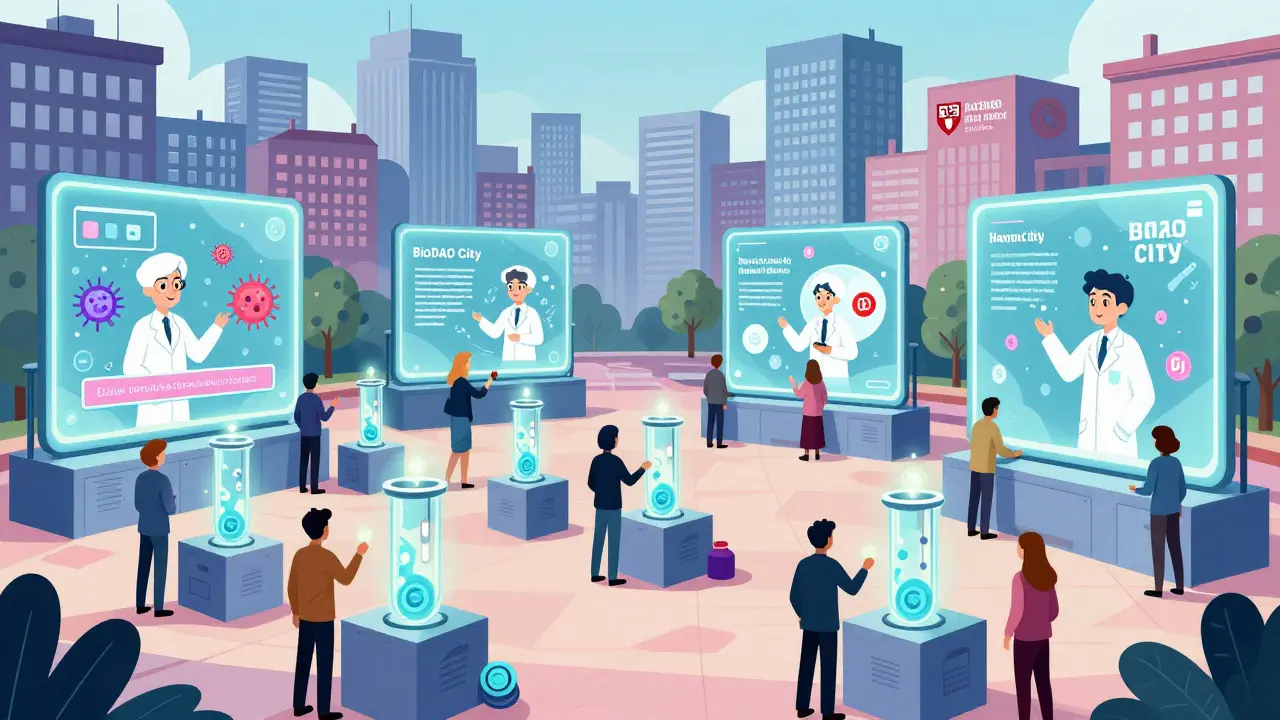
- BioDAOs - These are community-run research groups focused on specific goals, like curing a rare disease or extending healthy lifespan. Think of them like open-source labs where anyone can contribute funds or ideas.
- Curation Mechanism - Not every project gets funded. A group of token holders vote on which research proposals are worth backing, using a weighted system based on BIO holdings and reputation.
- BIO and Acc Tokens - BIO is for voting and governance. Acc tokens are rewards for participating-like staking, submitting research, or reviewing proposals. You earn Acc by helping the ecosystem grow.
- IP Tokens - This is the most groundbreaking part. When a BioDAO successfully develops a drug or diagnostic tool, the intellectual property is split into digital tokens. Holders of those IP tokens get a share of future royalties, meaning you could profit from a cure you helped fund.
For example, VitaDAO-a BioDAO focused on longevity-raised over $10 million in BIO tokens to fund anti-aging research. If their project leads to a patent, every BIO holder who voted for it gets a cut. No middlemen. No corporate patents locked behind paywalls.
How Is Bio Protocol Different From Other Crypto Projects?
Most crypto projects either promise financial returns or hype up tech without real-world use. Bio Protocol is different because it’s solving a $1.7 trillion problem: the broken biotech funding model.
Traditional drug development takes 10-15 years and $2-3 billion to get a single drug approved. Most of that money goes to bureaucracy, not science. Bio Protocol cuts that down by removing layers of investors and legal teams. Instead, it uses a network of volunteers and token holders to decide what gets funded.
Compared to other DeSci projects like Ocean Protocol (data marketplace) or HairDAO (focused only on hair loss), Bio Protocol is the infrastructure layer. It doesn’t run the research-it enables it. VitaDAO, HairDAO, and others are built on top of Bio Protocol’s system. That’s why it’s become one of the top three DeSci projects by market cap, behind only Ocean Protocol and Incentivise.
The DeSci sector exploded in 2024, growing 2,640%-far outpacing AI’s 350% growth. Bio Protocol’s backing from Binance Labs helped it scale quickly. By September 2025, there were 47 active BioDAOs, 85,000 unique wallet holders of BIO, and over 12,000 people actively voting on research proposals.
Where Can You Buy BIO Tokens?
You can buy BIO on major exchanges like Binance, Phemex, and KuCoin. To hold it securely, you’ll need a Web3 wallet like MetaMask or Trust Wallet. Once you have BIO, you can:
- Vote on which research projects get funded
- Stake your tokens to earn Acc rewards
- Join a BioDAO and help review scientific proposals
- Trade or hold as a bet on the future of decentralized medicine
The 24-hour trading volume hovers around $20 million, which is modest compared to Bitcoin or Ethereum, but healthy for a niche DeSci project. The price has ranged between $0.08 and $0.13 over the past week, showing moderate volatility.
What Are the Risks?
Bio Protocol is bold, but it’s not without problems.
First, regulation. The FDA and European Medicines Agency have no clear rules for blockchain-based drug research. If a BioDAO develops a treatment, who approves it? Can it be sold legally? No one knows yet.
Second, governance fatigue. Voting on complex scientific proposals isn’t easy. Most token holders aren’t biologists. Some projects have stalled because voters didn’t understand the science behind them. Trustpilot reviews of VitaDAO mention slow decision-making as a common complaint.
Third, token incentives may misalign. If people vote for flashy projects with high ROI potential instead of slow, high-impact research, the system could favor marketing over medicine. Critics argue that science needs peer review, not democracy.
And yes-there’s liquidity risk. With only $20 million in daily volume, large buyers or sellers can swing the price. Don’t expect the same stability as Bitcoin.
Who Is Behind Bio Protocol?
The project was founded by Paul Kohlhaas, a biotech entrepreneur with experience in venture funding and open science. He saw firsthand how funding bottlenecks killed promising research. Bio Protocol is his answer.
Binance Labs, the investment arm of the world’s largest crypto exchange, backed the project early. That gave it credibility, access to users, and technical support. Since then, Bio Protocol has partnered with Harvard Medical School’s Innovation Lab and the Max Planck Institute for Biotechnology-two of the most respected names in science.
The code is open-source on GitHub, with over 120 commits in the last 30 days as of October 2025. That’s a good sign. Active development means the team is listening and improving.
Is Bio Protocol Worth Your Time?
If you’re a crypto investor looking for the next meme coin, Bio Protocol isn’t for you. It’s not about quick flips.
If you care about science, health equity, or want to be part of something that could change how medicine is made, then it’s one of the most compelling projects in crypto today.
Imagine this: You hold a few BIO tokens. You vote to fund a study on a rare childhood disease. Two years later, that study leads to a treatment. You don’t own the company-but you own a piece of the patent. And every time someone uses that treatment, you get paid.
That’s not science fiction. That’s Bio Protocol in action.
It’s still early. The platform is rough around the edges. Governance is slow. Regulation is murky. But the vision is clear: science shouldn’t be owned by corporations. It should belong to the people who need it most.
How to Get Started With Bio Protocol
Here’s a simple step-by-step to begin:
- Get a Web3 wallet (MetaMask recommended).
- Buy ETH or SOL and swap for BIO on Binance or Phemex.
- Connect your wallet to the Bio Protocol dApp at bio.xyz.
- Explore active BioDAOs and read their research proposals.
- Vote on projects you believe in.
- Stake BIO to earn Acc tokens and help secure the network.
It takes 2-3 hours to get comfortable with the system. The documentation is solid, rated 4 out of 5 by users. If you’ve used DeFi before, you’ll recognize the flow.
Is Bio Protocol (BIO) a good investment?
BIO isn’t a traditional investment. It’s a bet on the future of science. If decentralized research succeeds, BIO could rise in value as demand grows. But if regulators shut it down or governance fails, the token could lose value. Only invest what you’re willing to lose, and only if you believe in the mission.
Can I really profit from a cure funded by Bio Protocol?
Yes-but only if the research succeeds and the IP is tokenized. When a BioDAO develops a patentable treatment, fractional ownership is distributed as IP tokens. BIO holders who voted for that project may receive a share of future royalties. This isn’t guaranteed-it depends on the success of the science.
Do I need to be a scientist to use Bio Protocol?
No. You don’t need a lab coat. You just need a crypto wallet and an interest in where science is headed. Voting doesn’t require expertise-just the willingness to support research you believe in. Experts review proposals, but the community decides what gets funded.
How is Bio Protocol different from VitaDAO?
Bio Protocol is the infrastructure. VitaDAO is one of many research groups built on top of it. VitaDAO focuses only on longevity research. Bio Protocol enables dozens of DAOs-each focused on different diseases, from cancer to rare genetic disorders. Think of Bio Protocol as the operating system, and VitaDAO as an app running on it.
Is Bio Protocol regulated?
Not yet. The U.S. FDA and EMA have no clear rules for blockchain-based research funding. That’s both a risk and an opportunity. It means Bio Protocol can move fast, but it also means future regulations could disrupt the model. The team is working with legal experts to prepare for compliance.
What happens if a BioDAO fails?
If a research project doesn’t deliver results, the tokens tied to it may lose value. But the BIO token itself isn’t tied to any single project. It’s the governance token for the whole ecosystem. Even if one BioDAO fails, others can still succeed. The system is designed to be resilient.
Can I use BIO to pay for medical treatments?
No. BIO is not a payment token for clinics or hospitals. It’s a governance and funding tool. Even if a BioDAO creates a treatment, you’ll still pay for it in dollars or insurance. BIO lets you help fund the research-not buy the medicine directly.
What’s the long-term vision for Bio Protocol?
Binance Labs predicts Bio Protocol could capture 15-20% of the decentralized biotech funding market by 2027-potentially growing the ecosystem to $2.5-3.5 billion. The goal is to make biotech innovation faster, cheaper, and open to everyone. If successful, it could reshape how drugs are discovered and who benefits from them.
Final Thoughts
Bio Protocol is one of the few crypto projects that doesn’t just talk about changing the world-it’s trying to change how science works. It’s messy, imperfect, and still unproven. But it’s also the most real example of crypto doing something that traditional institutions can’t-or won’t-do.
If you believe science should be open, collaborative, and owned by the public-not locked behind corporate patents-then BIO is worth watching. Not as a get-rich-quick scheme. But as a chance to be part of something bigger.




Regina Jestrow
December 4, 2025 AT 23:27Okay but can we talk about how wild it is that a 22-year-old grad student in Finland just got $500k in BIO to study mitochondrial repair? No corporate board. No VC terms. Just a proposal, some votes, and now they’re running trials. This isn’t crypto. This is science becoming a public utility.
Joe West
December 5, 2025 AT 16:41For real - if you’re new to DeSci, don’t overthink the token price. The real value is in the Acc tokens you earn by reviewing papers or staking. I’ve reviewed 17 proposals so far, earned 4,200 Acc, and now I’m getting early access to preprint data from three BioDAOs. It’s like being a peer reviewer on steroids. And yes, I’m still a biologist. I just don’t work for a university anymore.
Martin Hansen
December 6, 2025 AT 03:16Let’s be honest - this is just crypto bros trying to buy Nobel Prizes. You think a bunch of guys on Discord voting on CRISPR edits is going to outpace the NIH? Wake up. Science isn’t a DAO. It’s a slow, rigorous, peer-reviewed process. You don’t get to democratize truth with a token. This is just another bubble dressed in lab coats.
Chris Mitchell
December 6, 2025 AT 09:28Regulation isn’t the threat. Complacency is.
rita linda
December 7, 2025 AT 06:17Why are we letting decentralized governance dictate medical research? This is a slippery slope toward chaos. We need trained professionals, not random wallet holders with 200 BIO tokens deciding which cancer trials get funded. This isn’t innovation - it’s negligence wrapped in blockchain.
Maggie Harrison
December 7, 2025 AT 16:29Imagine if your grandma’s rare disease treatment was funded by strangers on the internet… and YOU got paid every time someone used it. 🤯 I’m not even a scientist but I just staked 500 BIO. This is the future. And it’s weirdly beautiful. 💙🧬
jonathan dunlow
December 9, 2025 AT 09:28Look - I’ve been in biotech for 18 years. I’ve seen projects die because a CFO decided the ROI wasn’t sexy enough. I’ve watched brilliant researchers leave because they couldn’t get funding for ‘unprofitable’ diseases. Bio Protocol isn’t perfect - yeah, governance is clunky, yeah, some voters don’t understand the science - but it’s the first time regular people have had a real voice. I voted for a project on Duchenne muscular dystrophy last month. The team got funded. They’re in pre-clinical now. That’s not magic. That’s momentum. And it’s growing. Every single vote matters. Even if you’re just holding 10 BIO. You’re part of it now. Don’t sleep on this.
Mariam Almatrook
December 9, 2025 AT 21:25One must question the epistemological foundations of this endeavor. The conflation of financial incentivization with scientific merit constitutes a profound ontological error - one that risks commodifying the very pursuit of truth. The notion that a token, a mere symbolic representation of speculative capital, can adjudicate the validity of empirical inquiry is not merely naive - it is an affront to the Enlightenment tradition upon which modern science was erected. One cannot democratize the scientific method without diluting its rigor. This is not progress. It is epistemic decay dressed in Web3 glitter.
nicholas forbes
December 11, 2025 AT 02:40I respect the vision, but I’ve seen this movie before. Remember the Kickstarter cancer cures? Most never delivered. This feels like the same energy - just with more smart contracts. I’m not against it, but I’m not betting my rent money on it either.
Richard T
December 12, 2025 AT 20:14Hey, if you’re curious how to get involved without diving into wallets - check out the Bio Protocol Discord. They have a ‘Newbie Research Buddy’ program where experienced reviewers walk you through proposals. I helped a high schooler understand a glioblastoma proposal last week. She voted for the first time. That’s the real win. You don’t need to be a scientist. You just need to care.