JAK Liquidity Risk Calculator
Calculate Your JAK Trade Risk
Based on the article's analysis, JAK has extremely low liquidity with only $16.80 daily trading volume. This calculator shows how much your trade will be impacted by slippage.
Your Trade Results
Critical Warning
As explained in the article, trading JAK involves extreme risk due to its illiquidity. This calculator shows realistic slippage for tokens with daily volumes under $20. If you buy even $5 worth of JAK, there's a high chance you'll get less than 70% of what you expect. Many traders lose money on these micro-cap tokens.
There are thousands of cryptocurrencies out there, but very few are as obscure and risky as Jak (JAK). If you’ve seen it pop up on a price tracker and wondered if it’s a hidden gem, the answer isn’t what you might hope. JAK is a micro-cap token built on Solana with almost no real-world use, no team behind it, and barely any trading activity. It’s not a scam in the traditional sense - there’s no clear evidence of fraud. But it’s also not an investment. It’s a gamble with near-zero odds.
What exactly is JAK?
Jak (JAK) is a token that runs on the Solana blockchain using the SPL standard, which means it can be stored in wallets like Phantom or Sollet. It has a fixed supply of 999,623,213 coins, all of which are already in circulation. That’s it. There’s no whitepaper. No official website. No GitHub repository. No team members listed anywhere. Even major crypto data sites like CoinMarketCap and CoinGecko don’t link to any project source - only to exchange listings.
Some sites, like Bitget, call JAK “a new type of currency with innovative technology.” But that’s marketing fluff. There’s nothing innovative about it. It doesn’t offer staking, governance, DeFi integration, or any utility beyond being a tradable token. It doesn’t solve a problem. It doesn’t improve on existing tech. It’s just a number on a blockchain with no purpose.
Why the price is all over the place
If you check JAK’s price on different exchanges, you’ll get wildly different numbers. LiveCoinWatch says $0.000075. CoinStats says $0.00008348. Binance says $0.000068. CoinCheckup says $0.00008281. That’s a 22% difference between the highest and lowest prices.
This isn’t normal. In healthy markets, prices stay close across platforms because arbitrage traders step in to balance the gaps. But with JAK, the trading volume is so low - just $16.80 in 24 hours, according to CoinGecko - that even small trades move the price. One person buys 10,000 JAK coins on one exchange, and suddenly the price jumps. That’s why you see these wild swings. It’s not market sentiment. It’s liquidity starvation.
Trading JAK is nearly impossible
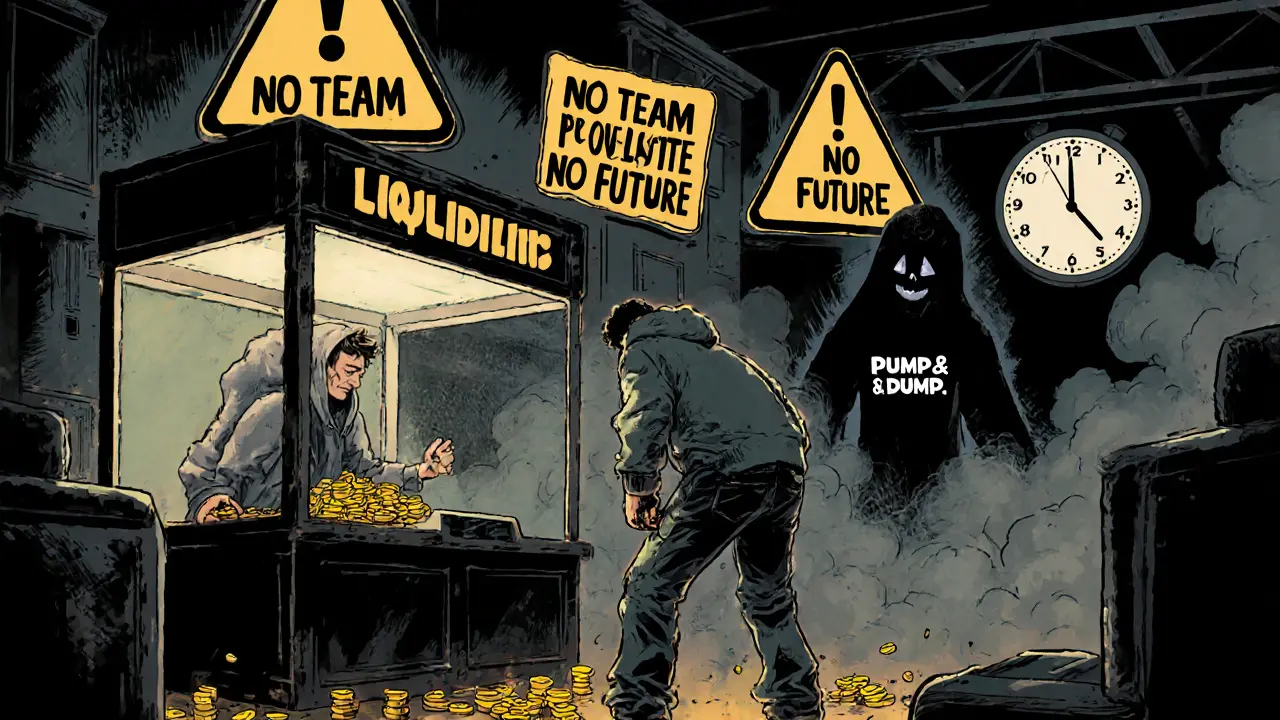
Trying to buy or sell JAK isn’t like trading Bitcoin or even lesser-known altcoins. With a daily volume under $20, the order book is paper-thin. Users on CoinGecko have reported trying to buy $5 worth of JAK - and their orders never filled because there were no sellers at that price. Others say their trades got filled at prices 30% worse than what they expected due to slippage.
Even if you manage to buy it, selling is another nightmare. There’s no guarantee anyone will take your coins. And if you try to dump even a small amount, the price will crash. That’s why experienced traders avoid tokens like this. They call them “illiquid traps.”
No community, no updates, no future
There’s no Discord. No Telegram. No Twitter account linked to the project. Reddit has zero threads about JAK. Trustpilot has no reviews. Even social media monitoring tools found only 37 mentions of JAK in the last 30 days - and 78% of those were negative, mostly calling it a “liquidity grab” or “dead token.”
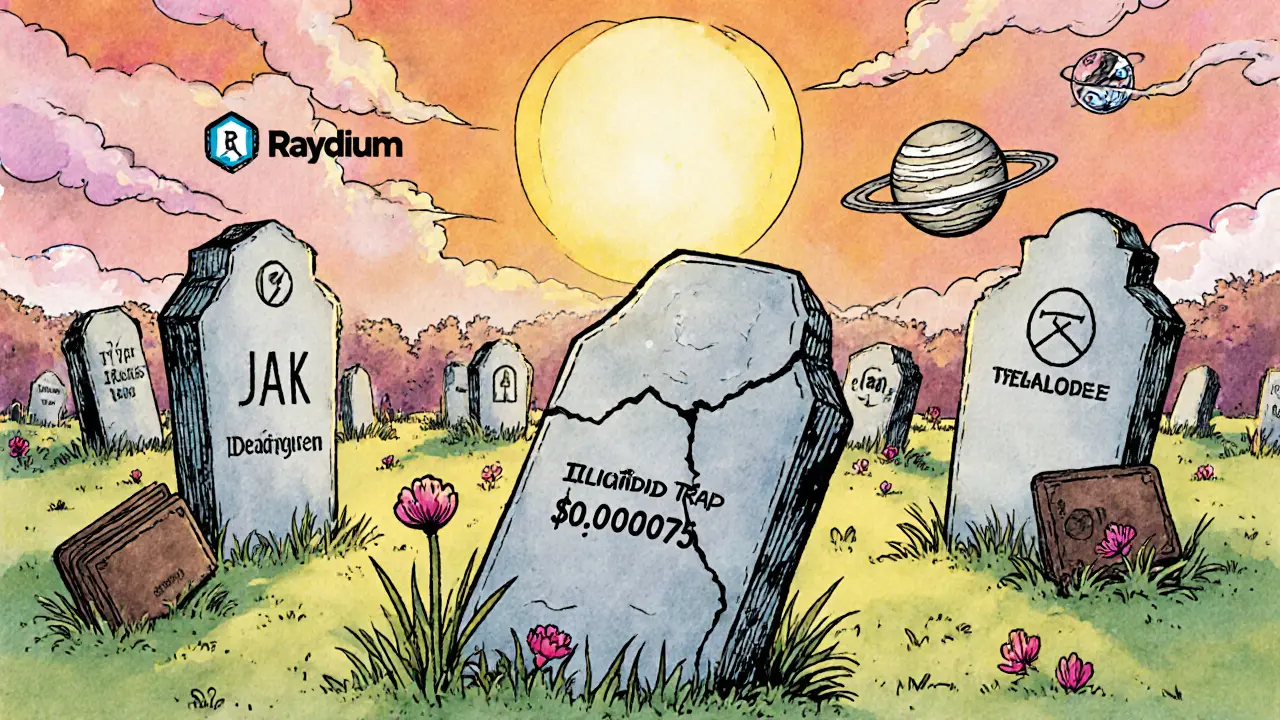
Compare that to Raydium (RAY), another Solana token. Raydium has a $147 million daily trading volume, a public team, a roadmap, and a thriving community. JAK has none of that. It’s a ghost. No developers. No updates. No announcements. Not even a fake one.
Why do people even trade it?
There are two reasons. First, some people think “low price = high upside.” They see JAK at $0.00007 and think, “If it hits $0.01, I’ll make 140x!” That’s the same logic that drives people to buy penny stocks - it ignores risk and ignores reality. JAK would need to increase over 100,000% to reach $0.01. That’s not growth. That’s fantasy.
Second, some traders use these tokens to pump and dump. A small group buys JAK quietly, spreads hype on obscure forums, and then sells to newcomers who rush in after seeing a price spike. Then they disappear. The price collapses. The buyers are stuck. This pattern repeats daily with hundreds of micro-cap tokens like JAK.
How does JAK compare to other Solana tokens?
Solana has over 1,500 tokens. Most are useless. But even the worst ones usually have some basic structure - a team, a website, a tokenomics doc. JAK has none of that. Its market cap is $83,497. That’s less than the cost of a used car. Bitcoin’s market cap is over $1.4 trillion. JAK is 0.000004% of that.
Even among Solana’s micro-cap tokens, JAK stands out for its lack of activity. Tokens like $BONK or $WIF have millions in daily volume and real communities. JAK has $16.80. That’s not a niche project. That’s a forgotten experiment.
What do experts say?
CoinGecko’s analysts called JAK “an extreme execution risk.” They pointed out that tokens with daily volume under $50 are often delisted because exchanges stop paying to list them. Bitget’s analyst called it “promising,” but offered zero proof. BeInCrypto said it has “no clear entry or exit signals.” CryptoSkeptic, an anonymous analyst, gave it a 92% chance of becoming completely illiquid within six months.
The SEC’s November 2025 guidance warned that tokens with daily volume below $100,000 may not meet basic market integrity standards. JAK is far below that. It’s not regulated. It’s not monitored. It’s not even noticed.
Should you buy JAK?
No.
If you’re looking to invest, JAK is not an option. It’s not a stock. It’s not a startup. It’s not even a speculative play - it’s a trap. There’s no reason to believe it will ever gain traction. No team. No utility. No liquidity. No future.
If you’re just curious and want to experiment with Solana’s blockchain, you could spend $1 on JAK just to see how it works. But treat it like a $1 lottery ticket - not an investment. Don’t expect to get your money back. Don’t expect to sell it later. Don’t expect anyone to care.
There are thousands of legitimate crypto projects with real teams, real code, and real use cases. JAK isn’t one of them. Don’t confuse obscurity with opportunity. In crypto, the quietest tokens are usually the dead ones.
What to do instead
If you’re interested in Solana-based tokens, look at projects with:
- Clear, public teams with LinkedIn profiles
- Active GitHub repositories with recent commits
- Daily trading volume over $1 million
- A documented roadmap and community channels
- Real partnerships or integrations
Start with Raydium, Orca, or Jupiter. They’re not flashy, but they’re alive. JAK? It’s already gone.
Is Jak (JAK) a legitimate cryptocurrency?
JAK has no official team, no whitepaper, no website, and no verifiable development. While it’s not proven to be a scam, it lacks all the basic hallmarks of a legitimate project. It exists only as a token on Solana with no utility or community support.
Can I make money trading JAK?
It’s possible to make a small profit if you time a pump perfectly - but it’s far more likely you’ll lose money. With a daily trading volume of just $16.80, even small trades cause massive price swings. Most buyers end up stuck with coins they can’t sell at a reasonable price.
Why does JAK’s price vary so much between exchanges?
The price varies because there’s almost no trading activity. With only $16.80 traded in 24 hours, even a single small order can move the price. Exchanges don’t have enough buyers and sellers to keep prices aligned, so they report wildly different values.
Is JAK listed on major exchanges like Binance or Coinbase?
JAK is listed on some smaller exchanges like Bitget and Binance, but not on Coinbase or Kraken. Its presence on larger platforms doesn’t mean it’s safe - it just means those exchanges allow micro-cap tokens. Many of them list hundreds of tokens with no real value.
What’s the risk of holding JAK long-term?
The risk is extremely high. With no development, no community, and near-zero trading volume, JAK could become completely untradeable at any time. Exchanges may delist it, wallets may stop supporting it, and you could lose access to your coins without warning. Most experts say tokens like this have a 90%+ chance of dying within months.
Can I use JAK for payments or DeFi?
No. JAK has no integration with any payment processors, DeFi protocols, or wallets beyond basic Solana support. It cannot be used to buy goods, stake, lend, or earn yield. It exists only as a tradable token with no functional purpose.

Rachel Thomas
November 27, 2025 AT 00:06JAK? More like JANK. Why are people even looking at this? It’s not a coin, it’s a digital ghost story.
Sierra Myers
November 27, 2025 AT 20:39Bro, if you think low price = high upside, you’re the kind of person who buys lottery tickets with your rent money. JAK isn’t a gamble-it’s a trapdoor with a smiley face painted on it.
Tina Detelj
November 29, 2025 AT 10:37Imagine a candle burning in an abandoned subway tunnel-no wind, no audience, no purpose… just flickering. That’s JAK. It doesn’t represent innovation, it represents entropy. It’s the sound of capitalism whispering, ‘I’m tired.’ And yet… people still reach for it. Why? Because hope is louder than logic. And that’s the real tragedy.
Wilma Inmenzo
November 29, 2025 AT 10:56Wait… wait… wait. Who’s behind this? Nobody? No team? No whitepaper? Then why is Bitget listing it? CoinGecko? Binance? THIS IS A COORDINATED COVER-UP. They’re using JAK to test how dumb the masses are. They’re watching. They’re laughing. They’re harvesting your wallet data. You’re not trading crypto-you’re feeding a surveillance AI. I’ve seen the patterns. They’re using micro-cap tokens to train their sentiment models. JAK is a honeypot. Don’t touch it. Don’t even look at it.
Tony spart
November 30, 2025 AT 03:14USA makes real crypto. This JAK junk is what happens when you let foreigners code on Solana. No team? No future? That’s why we need border controls on tokens too. I’d rather hold Monero than this ghost paper. America doesn’t need this garbage.
Abby cant tell ya
December 1, 2025 AT 06:52Someone actually spent time writing this whole thing? Wow. I feel bad for you. You’re so angry about a token that doesn’t even matter. Just let people have their little dreams. Some of us need to believe in something, even if it’s a $0.00007 coin. You’re not saving them-you’re just being boring.
jeff aza
December 1, 2025 AT 11:11Let’s break this down: micro-cap token, SPL standard, fixed supply, zero on-chain utility, liquidity depth < $20/24h - classic illiquid trap. The slippage dynamics alone make this a non-starter for any rational market participant. Even the arbitrage inefficiencies are statistically negligible. This isn’t a market-it’s a stochastic noise generator with a wallet address.
Eddy Lust
December 2, 2025 AT 08:09I get why people buy this. Not because they’re stupid - because they’re lonely. There’s a quiet desperation in chasing something that no one else cares about. Maybe they think if they hold it long enough, someone else will finally notice. I’ve been there. I still check the price sometimes. But I don’t buy. I just… sigh. And close the tab.
Casey Meehan
December 4, 2025 AT 05:57bro JAK is the crypto equivalent of a parking lot at 3am 🚗💨
Tom MacDermott
December 4, 2025 AT 06:24Oh wow. A 1200-word essay on a token that doesn’t even have a Discord server? How noble. How… *dramatic*. You think you’re saving people? Nah. You’re just performing outrage for clout. Meanwhile, real investors are quietly flipping $BONK for 100x while you’re over here writing a TED Talk about a $83k ghost. You’re not the hero of this story. You’re the guy yelling at the empty stage after the show ended.