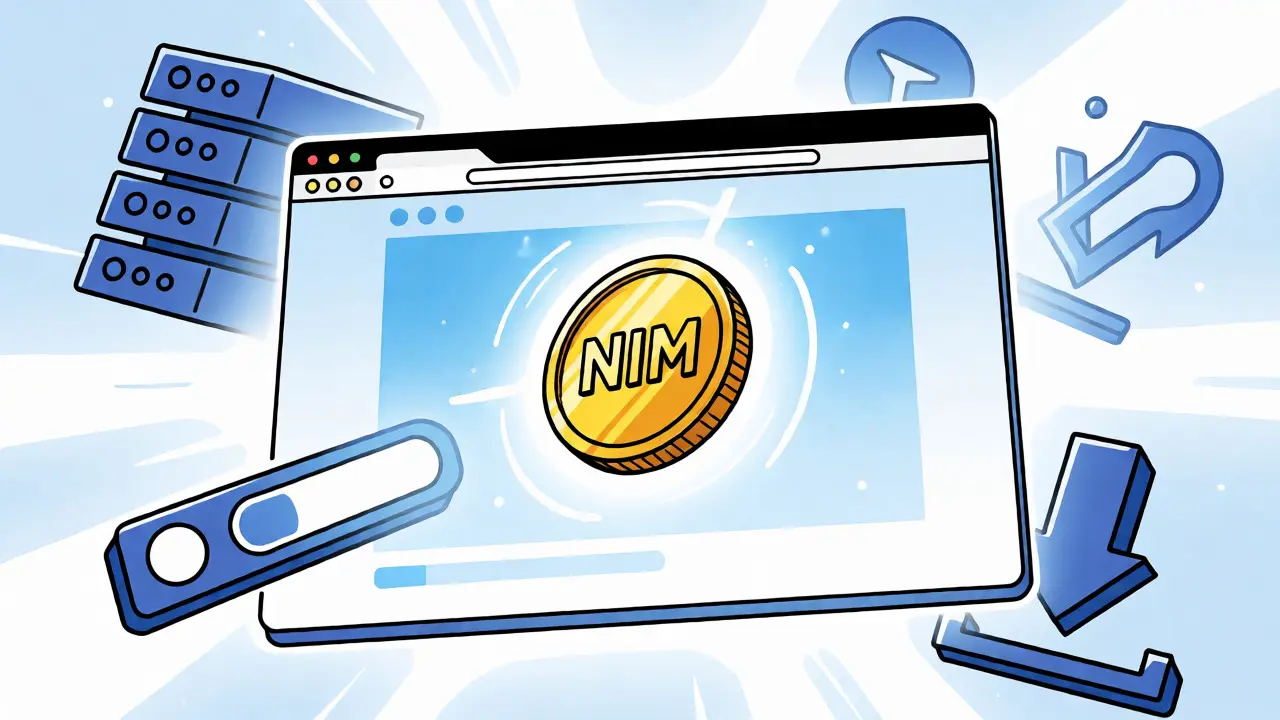
You know that annoying friction when you try to use cryptocurrency? You have to download a heavy wallet, sync a massive blockchain file for hours, and pray your computer doesn’t crash. Now imagine running a full node directly in your Chrome or Safari browser without installing a single thing. That’s the core promise of Nimiq (NIM), a web-native Layer 1 blockchain designed to make crypto payments as easy as sending an email. Founded by Silicon Valley engineers Elion Chin and Philipp von Styp-Rekowsky, Nimiq launched its mainnet in April 2018 with a specific goal: remove the technical barriers that keep mainstream users away from digital cash.
As of November 2026, Nimiq isn’t trying to be the next Ethereum killer or the fastest trading platform. It’s aiming to be the most accessible payment rail on the web. With a market cap hovering around $7.8 million and a fixed supply of 21 billion coins, it occupies a unique niche. But does this browser-based approach actually work, or is it just a gimmick? Let’s break down how it functions, why it switched to Proof-of-Stake, and whether it has any real-world utility beyond being a cool tech demo.
The Core Concept: A Blockchain That Lives in Your Browser
Most cryptocurrencies require you to run dedicated software to interact with the network. If you want to validate transactions or check balances independently, you need a desktop application or a mobile app that downloads gigabytes of data. Nimiq flips this model. It is built specifically for the web, allowing users to run full nodes directly within standard browsers like Firefox, Chrome, and Safari.
This architecture changes the security model significantly. When you open the Nimiq Wallet in your browser, you aren’t trusting a third-party server to tell you your balance. Instead, your browser connects directly to other peers in the network. Each wallet acts as a legitimate peer, creating a true peer-to-peer system. This means no middlemen can freeze your account, and you retain complete control over your private keys because everything happens client-side. There are no personal data submissions required to get started-you can create an account and start transacting in under 30 seconds.
Technical Specs: Speed, Supply, and Consensus
Under the hood, Nimiq combines elements from Bitcoin and Ethereum but strips away the complexity that hinders speed. It’s often described as a third-generation protocol because it prioritizes usability alongside decentralization. Here is how the numbers stack up against traditional systems:
| Feature | Nimiq (NIM) | Bitcoin | PayPal |
|---|---|---|---|
| Transaction Confirmation Time | ~1 second | ~10 minutes | Instant (internal) / Days (withdrawal) |
| Throughput | 1,000 TPS | ~7 TPS | Variable (high volume) |
| Consensus Mechanism | Proof-of-Stake (since May 2024) | Proof-of-Work | Centralized Database |
| Energy Cost per Transaction | Less than an email | High | Low |
| Fees | Zero for participants | Variable | Merchant fees |
The shift to Proof-of-Stake (PoS) in May 2024 was a major milestone. Before this, Nimiq used a mining mechanism similar to Bitcoin’s, which led to concerns about centralization since large mining pools had disproportionate power. By moving to PoS, the network improved energy efficiency dramatically-transactions now consume less energy than sending a simple email-and enhanced performance. The block reward structure mirrors Bitcoin’s halving events, starting at 5 NIM per block and halving every 2.1 million blocks, ensuring scarcity remains part of the economic model.

How the Ecosystem Works: Wallets and Staking
The user experience is where Nimiq tries to differentiate itself from clunky DeFi platforms. The official Nimiq Wallet is more than just a place to store coins; it’s an integrated hub for financial activity. One standout feature is the built-in decentralized exchange. You can swap NIM for Bitcoin, USDC, or USDT directly within the interface. Crucially, the platform handles gas fees automatically for stablecoin transactions on Polygon, meaning you don’t need to hold MATIC tokens just to move your USDC. This removes one of the biggest headaches for beginners.
Staking is another key component. Since the transition to PoS, users can lock their NIM tokens to secure the network and earn rewards. The annual percentage yield (APY) reaches up to 15%, with typical returns hovering around 12.8%. This isn’t just passive income; it’s active participation. By staking, you help prevent double-spending attacks and maintain the integrity of the ledger. The process is intuitive enough that non-technical users can set it up in a few clicks, though you should remember that unstaking might involve a waiting period depending on current network conditions.
Real-World Utility: Payments and Interoperability
Crypto projects often fail because they solve problems nobody has. Nimiq targets a very specific pain point: cross-border and peer-to-peer payments. Because it uses Hashed Timelock Contracts, the network supports payment channels. This allows for instant off-chain transactions, which is vital for scalability. If you’re buying coffee, you don’t want to wait for a global consensus round; you want confirmation in milliseconds.
Interoperability is handled through atomic swaps. This technology lets you exchange NIM for other cryptocurrencies across different blockchains without relying on a centralized exchange like Coinbase or Binance. If you hold Bitcoin, you can swap it for NIM directly, keeping custody of your assets throughout the trade. Furthermore, Nimiq integrates with the Lightning Network via onion routing techniques, adding a layer of anonymity similar to Tor. This makes it attractive for users who value privacy alongside speed.
On the merchant side, acceptance is growing but still limited compared to giants like Visa. Currently, NIM is accepted at roughly 31,000 locations worldwide. Partnerships with payment processors like Bluecode and NAKA aim to expand this reach to over 75 million points. For businesses, integrating Nimiq is straightforward because it doesn’t require specialized hardware-just a web-enabled terminal or even a smartphone.
Pros and Cons: Is It Worth Your Attention?
No project is perfect, and Nimiq has clear trade-offs. On the plus side, the accessibility factor is unmatched. You don’t need a powerful gaming PC to run a node; a laptop with a modern browser suffices. The zero-fee model for network participants is also a strong selling point for frequent small transfers. Additionally, the non-profit governance structure means there’s no venture capital firm pushing for aggressive token unlocks to dump on retail investors.
However, the downsides are significant for traders. The market capitalization is relatively low, which leads to lower liquidity and higher price volatility. Large trades can move the price more easily than on major exchanges. Also, while the browser-node concept is elegant, it relies on the user’s device staying online and active. If you close your tab, you stop syncing. This is fine for casual users but might frustrate developers building complex applications that need constant background synchronization.
Another concern is the historical concentration of mining power before the PoS switch. While PoS mitigates this, the ecosystem is still smaller than competitors like Solana or Avalanche. Fewer developers mean fewer dApps and integrations. If you’re looking for a wide range of lending protocols or NFT marketplaces, Nimiq’s native ecosystem is currently quite lean.
Final Verdict
Nimiq is not trying to win the race for smart contract dominance. It’s focused on being the easiest way to send and receive value on the web. If you value sovereignty, low friction, and eco-friendly transactions, it’s a compelling option. The 2024 move to Proof-of-Stake solved many of its early criticisms regarding energy use and centralization. However, if you’re chasing high-yield DeFi opportunities or massive trading volumes, you might find the ecosystem too quiet.
For now, Nimiq serves best as a payment tool rather than a speculative asset. Its strength lies in its simplicity: open a browser, click a button, send money. In a world where crypto UX is often terrible, that simplicity is a feature worth paying attention to.
Do I need to download software to use Nimiq?
No. Nimiq is designed to be web-native. You can run a full node and manage your funds entirely within a standard web browser like Chrome, Firefox, or Safari without installing any additional applications.
Is Nimiq still mined?
No. As of May 2024, Nimiq fully transitioned from Proof-of-Work mining to Proof-of-Stake. New NIM coins are now generated through staking rewards rather than computational mining.
What is the maximum supply of NIM?
The total supply is capped at 21 billion NIM coins, similar to Bitcoin’s 21 million cap but scaled differently due to Nimiq’s faster block times and larger unit granularity.
Can I stake NIM for rewards?
Yes. Users can stake their NIM tokens to support network security and earn yields ranging from approximately 12% to 15% APY. This can be done directly through the Nimiq Wallet.
Are there transaction fees on Nimiq?
Network participants typically pay zero fees for basic transactions. However, using features like atomic swaps or interacting with external networks may incur minor costs depending on the specific service provider.