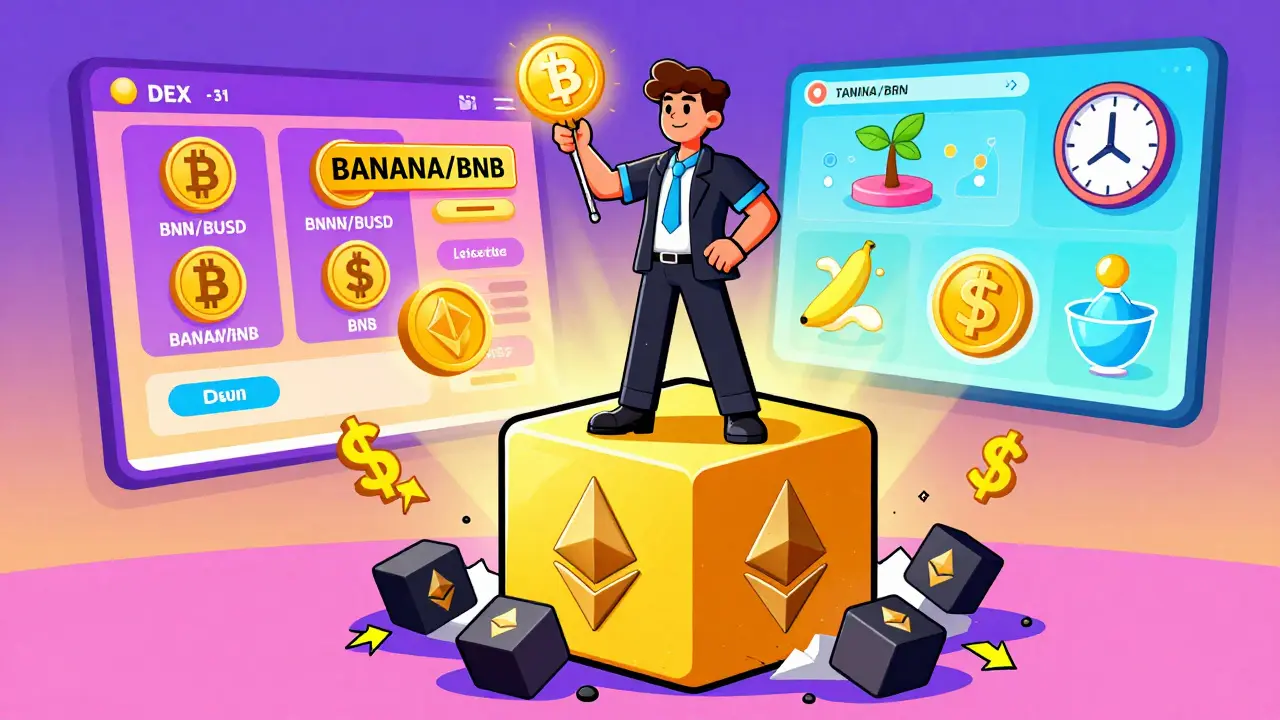
Most people think ApeSwap is on Ethereum. It’s not. That’s the first thing you need to know.
It’s Not on Ethereum - It’s on Binance Smart Chain
ApeSwap runs on Binance Smart Chain (BSC), not Ethereum. If you’re looking for an Ethereum-based exchange, you’re wasting time. BSC was built to solve Ethereum’s biggest problems: slow transactions and crazy gas fees. On ApeSwap, a token swap takes 3 to 5 seconds and costs less than 10 cents. On Ethereum, that same swap could cost $5 to $20 and take minutes. For anyone trading small amounts or farming yields, that difference isn’t just nice - it’s necessary.The platform launched in 2021 and quickly became popular because it offered high rewards without the Ethereum price tag. It’s not a centralized exchange like Coinbase or Binance. You don’t deposit funds. You don’t go through KYC. You connect your wallet - usually MetaMask - and trade directly from your account. That’s what makes it a decentralized exchange, or DEX.
How ApeSwap Works: AMM, Liquidity, and BANANA Tokens
ApeSwap uses an Automated Market Maker (AMM) model. That means there’s no order book. Instead, trades happen against liquidity pools - pools of two tokens locked in a smart contract. If you want to swap BNB for BUSD, you’re trading against a pool filled by other users who deposited those tokens.When you add liquidity, you earn fees from every trade in that pool. That’s called yield farming. ApeSwap offers pools with APYs between 100% and 400%, depending on the token pair. Some of the most popular are BNB/BUSD, BANANA/BNB, and ETH/BSC tokens through cross-chain bridges.
The native token is BANANA. It’s not just a reward token - it’s the backbone of the whole system. You use BANANA to pay trading fees, vote on governance proposals, and unlock special farming pools. You can also stake BANANA to earn more BANANA, or lock it up in long-term vaults for higher returns. As of early 2026, BANANA trades around $18, but predictions vary wildly. Some models say it could hit $38 by year-end. Others warn it could drop to $12. Volatility is built into the system. If you’re farming, you’re not just chasing yield - you’re betting on token price.
Trading Pairs and Liquidity: What’s Available?
ApeSwap supports over 107 trading pairs. Most are BSC-based tokens - think meme coins, new DeFi projects, and tokens from other BSC chains. You won’t find Bitcoin or Ethereum directly, but you can swap for wrapped versions like wETH or WBTC. The platform also lets you bridge assets from Ethereum to BSC, though that adds complexity and extra fees.Compared to bigger DEXs like PancakeSwap or Uniswap, ApeSwap has lower trading volume. That means wider spreads and slippage on large trades. If you’re swapping $500 of a new token, you might get a bad price. But for smaller trades under $200, it’s smooth. The interface is clean, almost identical to PancakeSwap. If you’ve used that before, you’ll feel right at home.
Yield Farming and Staking: High Returns, High Risk
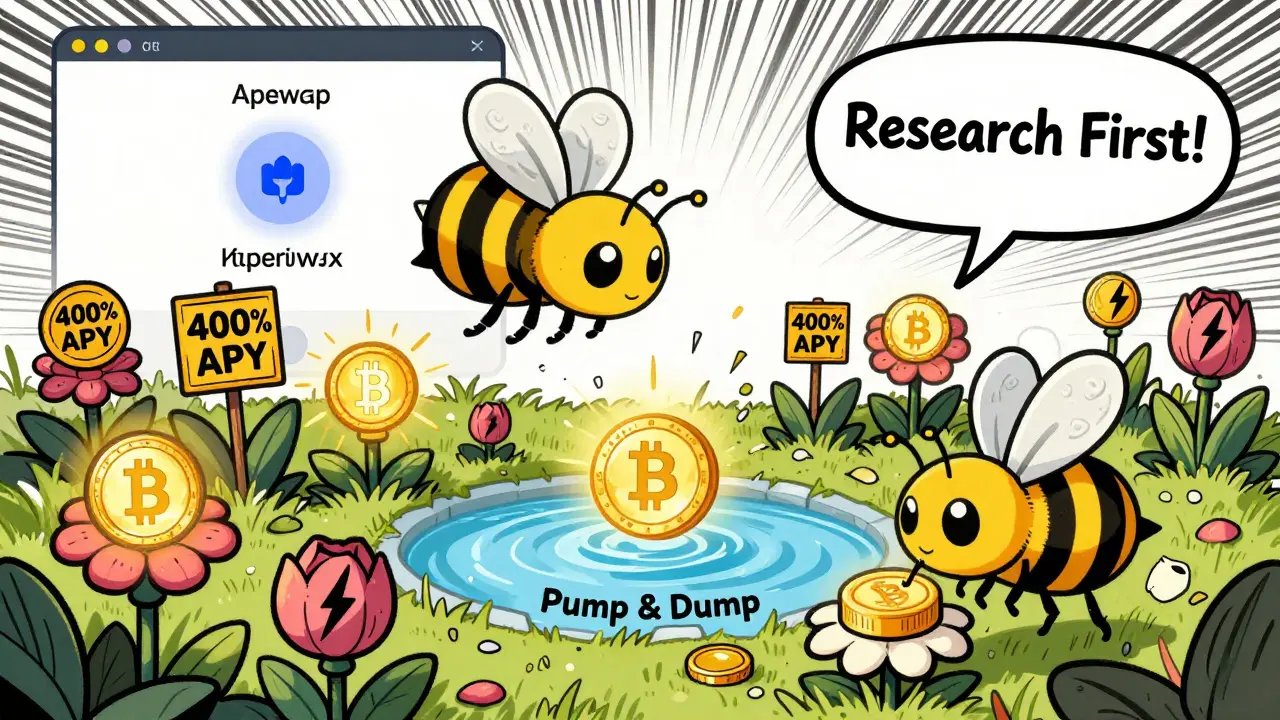
Yield farming on ApeSwap is where most users make - or lose - money. The platform offers several ways to earn:- Liquidity Provision: Deposit two tokens into a pool. Earn trading fees and BANANA rewards.
- Staking: Lock BANANA alone to earn more BANANA. APYs range from 20% to 80%.
- Master Chef Pools: Stake BANANA or other tokens for multi-token rewards. Some offer 300%+ APY, but these often last only a few weeks before the rewards drop.
- Lockup Vaults: Lock BANANA for 30, 90, or 365 days. Longer locks = higher APYs, sometimes over 100%.
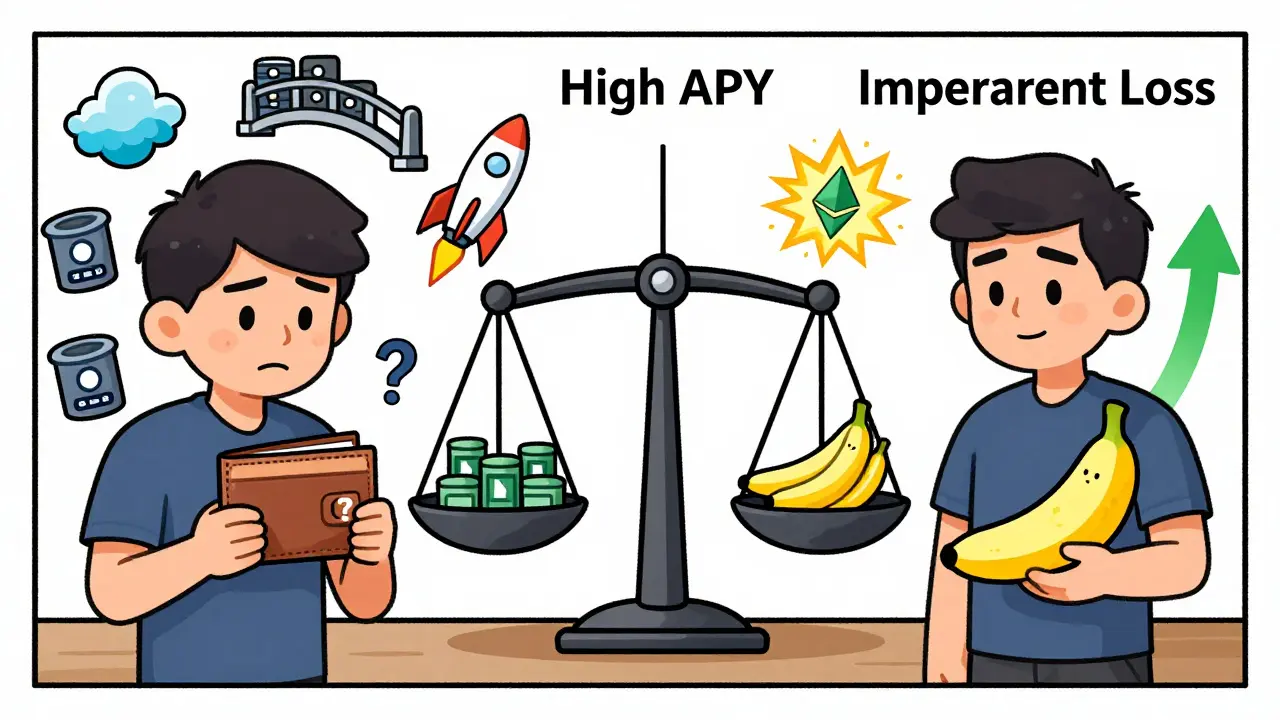
Here’s the catch: most high-yield pools are designed to attract users quickly, then pump and dump. Many tokens in these pools have no real utility. They’re just hype. If the token price crashes, your rewards might be worth less than what you staked. You can earn 400% APY, but if the token drops 70%, you’re still down. That’s why experienced users say: don’t chase APY. Chase liquidity and token fundamentals.
Wallets, Security, and How to Get Started
You need a Web3 wallet. MetaMask is the most common. Trust Wallet and WalletConnect also work. You connect it to ApeSwap’s website - no sign-up, no email, no verification. That’s the beauty of DeFi. But it’s also the danger. If you lose your private key, your funds are gone. There’s no customer service to recover them.To start:
- Install MetaMask and set up a wallet.
- Buy BNB on a centralized exchange like Binance or Coinbase.
- Send BNB to your MetaMask wallet.
- Go to apeswap.finance and connect your wallet.
- Swap BNB for BANANA or another token.
- Click "Liquidity" to add funds to a pool or "Farms" to start earning.
Always double-check the contract address. Scammers clone the site all the time. The real ApeSwap URL is apeswap.finance. Anything else is fake. Bookmark it.
Pros and Cons: Is ApeSwap Worth It?
Pros:- Extremely low transaction fees - under $0.10 per swap.
- Fast transactions - 3 to 5 seconds.
- High APYs on farming pools - some over 400%.
- No KYC - full control over your funds.
- Active community on Discord and Telegram.
- Not on Ethereum - if you want ETH, you need a bridge.
- Low trading volume - slippage on large trades.
- Complex for beginners - too many pools, too many tokens.
- High risk - many farming tokens are pump-and-dump schemes.
- Limited documentation - tutorials are mostly community-made.
Who is ApeSwap for? Not beginners. Not people who want to hold Bitcoin. It’s for crypto-savvy users who understand impermanent loss, know how to read token contracts, and are comfortable with high-risk, high-reward DeFi mechanics. If you’re looking for a safe place to store your crypto, this isn’t it. If you’re looking to earn extra yield on idle tokens and you’re okay with volatility, it’s a strong option.
How It Compares to Other DEXs
| Feature | ApeSwap | PancakeSwap | Uniswap |
|---|---|---|---|
| Blockchain | Binance Smart Chain | Binance Smart Chain | Ethereum |
| Average Swap Fee | $0.05-$0.10 | $0.05-$0.10 | $3-$20 |
| Swap Speed | 3-5 seconds | 3-5 seconds | 15-60 seconds |
| Native Token | BANANA | CAKE | UNI |
| Trading Pairs | 107+ | 500+ | 1,200+ |
| Best For | High-yield farming on BSC | General BSC trading | Ethereum-based DeFi |
PancakeSwap is the giant on BSC. It has more pairs, more volume, and more liquidity. But ApeSwap offers more unique farming mechanics and often higher rewards on newer tokens. Uniswap is the leader on Ethereum, but its fees make small trades impractical. If you’re on BSC, ApeSwap is a solid alternative to PancakeSwap - especially if you like their community events and tokenomics.
Final Verdict: Use It, But Don’t Trust It
ApeSwap isn’t a place to park your life savings. It’s a tool for active traders and yield farmers who know what they’re doing. The platform is well-built, secure (as long as you protect your wallet), and offers some of the best yields on BSC. But the risks are real. Many tokens listed here have no team, no roadmap, and no future. You’re essentially betting on hype.If you’re serious about using ApeSwap, start small. Test the waters with $50. Learn how liquidity pools work. Watch how your rewards change with token price swings. Read the contract addresses. Join their Discord. Don’t just follow Telegram influencers. And never invest more than you can afford to lose.
The crypto world moves fast. ApeSwap might fade in a year. Or it might grow into a major DeFi hub. Right now, it’s a powerful, high-risk tool. Use it wisely.
Is ApeSwap on Ethereum?
No, ApeSwap runs on Binance Smart Chain (BSC), not Ethereum. While some users bridge assets from Ethereum to BSC, the core platform and all native trading happen on BSC. This keeps fees low and transactions fast. If you want an Ethereum-based DEX, look at Uniswap or SushiSwap instead.
What is the BANANA token used for?
BANANA is ApeSwap’s native token. It’s used to pay trading fees, vote on governance proposals, unlock special farming pools, and earn rewards through staking. Holding or locking BANANA gives you access to higher APYs and exclusive features. It’s the backbone of the platform’s economy.
Can I lose money on ApeSwap?
Yes, easily. You can lose money through impermanent loss (when token prices in a pool change), token crashes, or scams. Many farming pools are designed to attract users with high APYs, then collapse. Always research the token before depositing. Never invest more than you can afford to lose.
How do I connect my wallet to ApeSwap?
Go to apeswap.finance, click "Connect Wallet," and select MetaMask, Trust Wallet, or WalletConnect. Make sure you’re on the official site - scammers copy the design. Never share your private key or seed phrase. Once connected, you can swap, farm, or stake directly from your wallet.
Are there any fees on ApeSwap?
Yes, but they’re very low. Each swap has a 0.2% trading fee. Half of that goes to liquidity providers, and the other half goes to the BANANA treasury. Network fees on BSC are under $0.10 per transaction. This is much cheaper than Ethereum, where fees can be 10 to 100 times higher.
Is ApeSwap regulated?
No, ApeSwap is a decentralized platform with no central authority. There’s no KYC, no customer support, and no regulatory oversight. That’s by design. It also means there’s no legal recourse if something goes wrong. You’re fully responsible for your funds and actions.
What’s the best way to earn on ApeSwap?
The safest way is to provide liquidity to stablecoin pairs like BUSD/BNB or BANANA/BUSD. These have lower APYs (usually 20-80%) but much less risk than meme coin pools. For higher returns, try staking BANANA in long-term vaults. Avoid pools with tokens you don’t understand or that have no clear use case. Always check the contract address and audit status.




Becky Chenier
January 10, 2026 AT 22:08ApeSwap’s BSC focus makes total sense for small traders. Ethereum fees are a joke for anyone not moving six figures. I’ve switched everything over - gas costs alone saved me hundreds last month.
Staci Armezzani
January 11, 2026 AT 16:22For beginners: don’t jump into high-APY pools without understanding impermanent loss. I lost $800 on a 500% APY meme coin pool last year because I didn’t check the token contract. Now I only farm stable pairs. BANANA staking in 365-day vaults? That’s my sweet spot - steady, low drama, decent returns.
Brittany Slick
January 12, 2026 AT 09:52There’s something magical about connecting your wallet and just… trading. No forms. No waiting. Just you, your keys, and a sea of tokens. ApeSwap feels like the wild west of DeFi - messy, dangerous, but alive with possibility. I love that chaos. It’s not banking. It’s rebellion.
greg greg
January 12, 2026 AT 18:09Let’s talk about the real elephant in the room - why does everyone keep comparing ApeSwap to PancakeSwap like they’re interchangeable? PancakeSwap has 500+ pairs because it’s a graveyard of dead tokens. ApeSwap’s 107 are curated, often with actual community governance behind them. The volume is lower? Good. That means less front-running and more room for real yield farmers, not bots. Also, the BANANA treasury allocation is way more transparent than CAKE’s. And don’t get me started on how their lockup vaults incentivize long-term holding instead of just flipping. This isn’t a clone - it’s a refinement. Why do people keep missing that?
LeeAnn Herker
January 14, 2026 AT 02:47Oh wow, another ‘ApeSwap is great’ post. Let me guess - you’re also convinced the BANANA token isn’t just a pump-and-dump scheme designed by a guy in a basement with a Discord server and a fake whitepaper? 😏 The ‘community’? That’s 2000 bots and 3 actual devs. The ‘low fees’? Yeah, because BSC is a centralized mess run by Binance, which just got fined $4B last month. And you think this is ‘decentralized’? Honey. You’re not a user. You’re a data point. Wake up.
Sherry Giles
January 15, 2026 AT 16:18Canada’s got better crypto options than this garbage. Why are Americans still clinging to BSC like it’s the future? Binance is a US-regulated shell game. If you’re not on Ethereum or Solana, you’re just feeding the machine. ApeSwap? More like ApeTrap.
Andy Schichter
January 17, 2026 AT 03:34I read this whole thing. Then I went outside. The sun was shining. I didn’t need to know about BANANA vaults. I just needed to feel grass under my feet. Why do we do this to ourselves?
Caitlin Colwell
January 18, 2026 AT 01:24Low fees. Fast swaps. No KYC. That’s all I need to know.
Calen Adams
January 19, 2026 AT 12:55Let’s cut through the noise - ApeSwap is the most underrated DEX on BSC right now. The liquidity mining mechanics are engineered for retention, not just hype. The BANANA tokenomics aren’t just a reward token - they’re a governance backbone with real staking incentives. And yes, the APYs are insane, but that’s because the protocol is actively incentivizing early adopters. This isn’t a meme coin play - it’s a DeFi infrastructure play. If you’re not using it for yield aggregation or cross-chain bridging, you’re leaving 30-50% of your potential returns on the table. Get in early, stack BANANA, lock it, and let the treasury work for you. This is how DeFi evolves - not with Ethereum gas fees, but with smart, aggressive incentive design. Stop comparing it to PancakeSwap. ApeSwap is the next-gen model.