Gas Fee Calculator
Compare Gas Fees
See how much you save by trading on Harmony instead of Ethereum
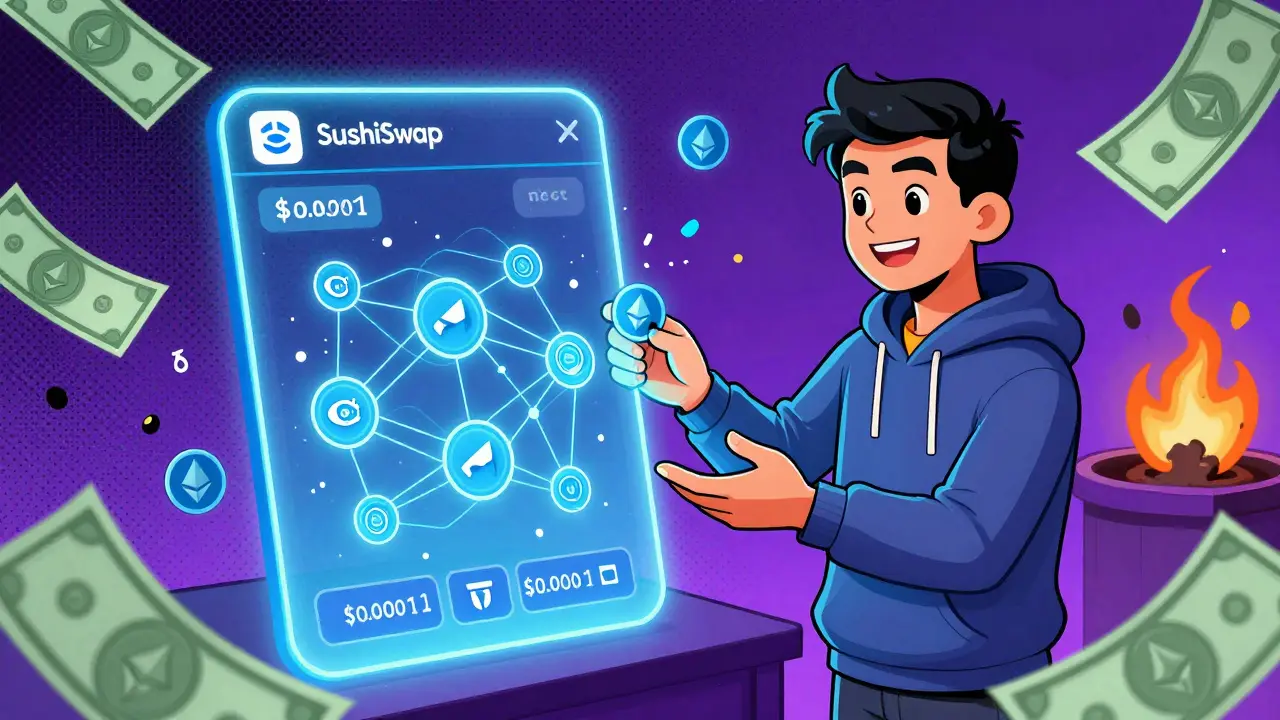
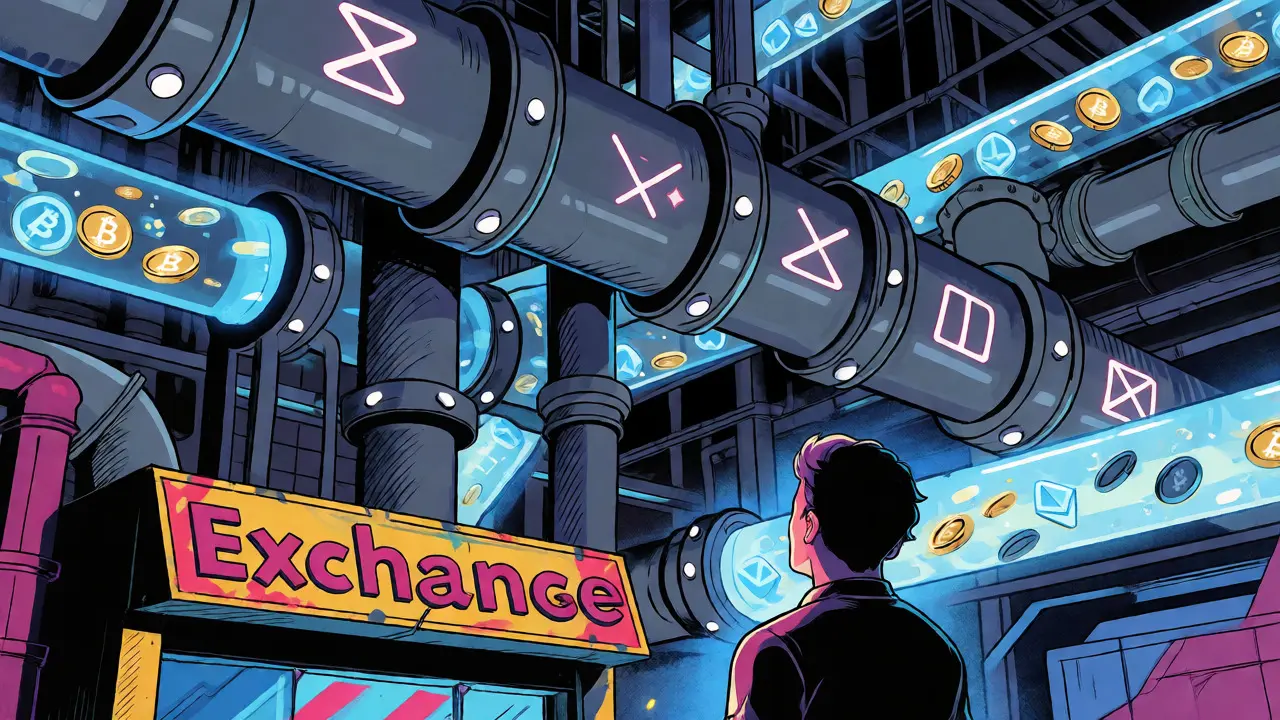
Trading crypto on Ethereum used to cost more than the value of the tokens you were swapping. A simple trade of $50 worth of ETH could cost you $15 in gas fees. That’s not trading - that’s paying a toll just to play. Enter SushiSwap (Harmony): a decentralized exchange built specifically to fix that problem. It’s not just another copy of Uniswap. It’s a version of SushiSwap optimized for Harmony’s ultra-fast, ultra-cheap blockchain. If you’re tired of paying $10 just to swap ONE tokens or USDC, this is where you need to look.
What Makes SushiSwap on Harmony Different?
SushiSwap started on Ethereum in 2020 as a fork of Uniswap. It quickly became known for its community-driven model - and its controversial past. Back then, the anonymous founder, Chef Nomi, pulled $14 million in ETH before giving it back and handing control to the community. That incident still echoes in DeFi circles. But today, SushiSwap is led by 0xMaki and Joseph Delong, and it’s spread across 15+ blockchains. Harmony is one of its most successful deployments.Why Harmony? Because Harmony solves what Ethereum never could: speed and cost. Harmony transactions settle in under 2 seconds. Gas fees? Around $0.0001 per swap. Compare that to Ethereum’s average of $15 during peak times. That’s a 99.9% drop in cost. For small traders, that’s life-changing. You can swap small amounts of ONE, USDC, or SUSHI without worrying about fees eating your profits.
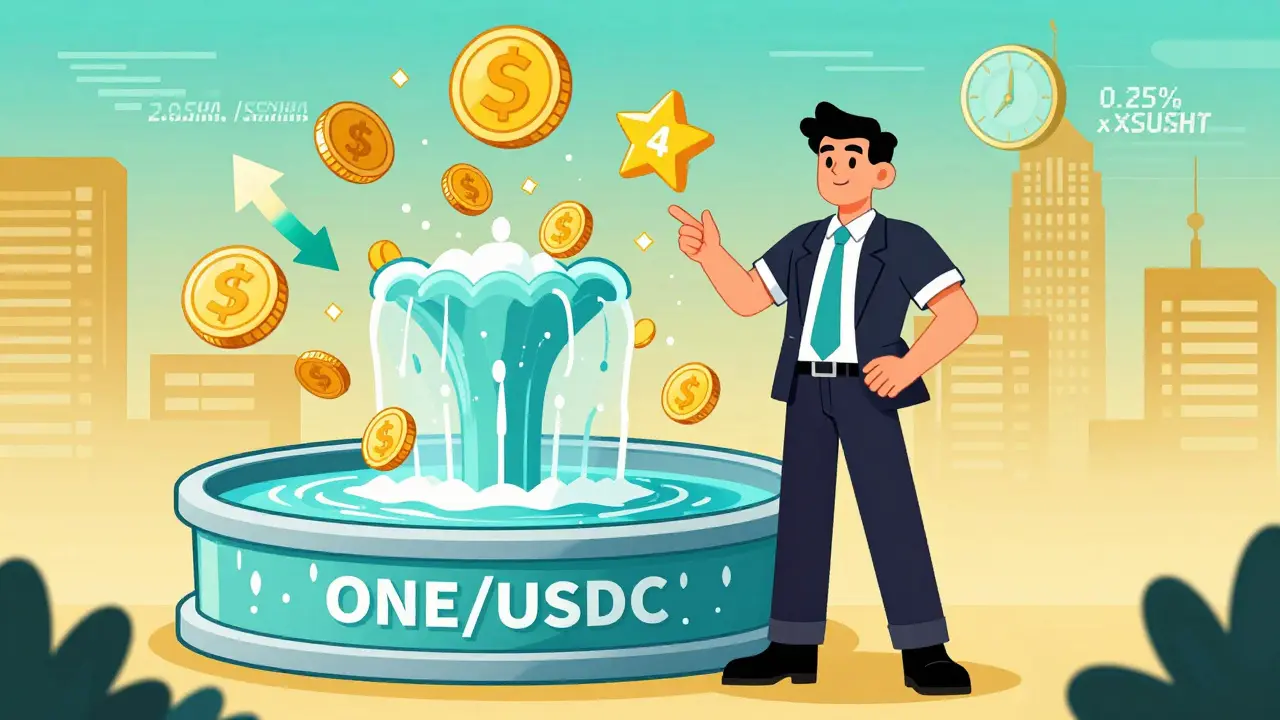
The platform uses the same Automated Market Maker (AMM) model as Uniswap - no order books, just liquidity pools. But SushiSwap adds something Uniswap doesn’t: rewards. Every time someone trades, 0.25% of the fee goes to liquidity providers. Another 0.05% goes to people who stake xSUSHI. That’s two ways to earn just by holding tokens in a pool. On Uniswap v3, you get nothing but trading fees. On SushiSwap (Harmony), you get paid twice.
How It Works: Liquidity Pools and Rewards
SushiSwap (Harmony) supports 13 tokens and 35 trading pairs. The most popular pairs are ONE/USDC, SUSHI/ONE, and ETH/ONE (bridged via Horizon Bridge). To trade, you don’t need a middleman. You connect your wallet - usually MetaMask - and swap directly with a pool of other people’s tokens.Want to earn more? Add liquidity. Let’s say you put $1,000 worth of ONE and $1,000 worth of USDC into the ONE/USDC pool. You become a liquidity provider (LP). Now, every time someone trades between ONE and USDC, you earn 0.25% of that trade. On top of that, you get SUSHI tokens as a reward - distributed weekly from the MasterChef contract.
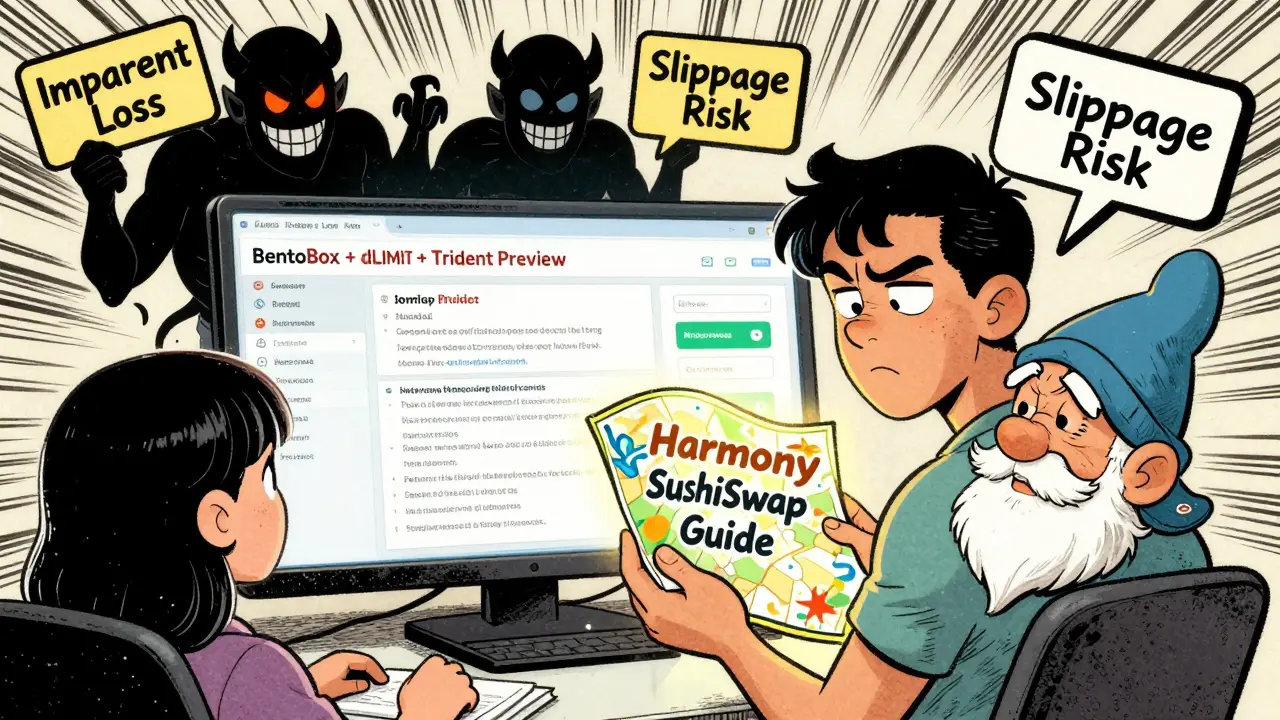
According to user reports from Reddit and Discord, some LPs are seeing APYs over 20% on the ONE/USDC pool after factoring in gas and rewards. That’s not a scam - it’s the math. With low fees and high volume, the rewards compound fast. But here’s the catch: you also get exposure to price swings. If ONE drops 30%, your LP position might lose value even if you earn rewards. That’s called impermanent loss. It’s a risk all AMMs carry.
There’s also BentoBox, a vault system that lets you deposit tokens once and use them across multiple DeFi strategies - like lending or staking - without moving them around. It saves gas and boosts efficiency. But unlike on Ethereum or Polygon, you can’t use Kashi lending on Harmony yet. Some features are still missing.
Compared to Other DEXs on Harmony
Harmony has other decentralized exchanges: Pangolin, ThorSwap, ViperSwap. But SushiSwap leads in total value locked (TVL). As of Q3 2025, it holds $42.7 million - 46% of Harmony’s entire DEX market. Pangolin is second with 29%.Why does it lead? Two reasons: brand trust and rewards. SushiSwap has been around longer. People know the name. And the dual-reward system (trading fees + SUSHI) is unique. Pangolin, for example, only gives trading fees. ThorSwap is simpler but doesn’t have the same ecosystem.
But SushiSwap isn’t perfect. Its liquidity pools are smaller than Uniswap’s on Ethereum. For example, the SUSHI/USDC pool on Harmony averages $1.2 million. On Ethereum, the same pair has over $15 million. That means bigger trades get messy. If you try to swap $50,000, you might see slippage over 2%. On centralized exchanges like ProBit Global, slippage stays under 0.5%. So if you’re a big trader, stick to centralized platforms.
Another downside: fragmented liquidity. SushiSwap is spread across 15+ chains. Your SUSHI tokens on Harmony are separate from those on Polygon or Arbitrum. You can’t move them without bridging - and bridging has its own risks.
Security and Risks
Harmony’s blockchain is secure. It uses a proof-of-stake system with 250 validator nodes. Transactions are final in under 2 seconds. That’s solid.But SushiSwap’s code is complex. It’s got staking, farming, vaults, bridges - all layered on top of each other. More features = more code = more bugs. OpenZeppelin’s November 2024 audit found that Harmony contracts received 40% less audit attention than Ethereum ones. That’s a red flag.
There’s also the ghost of Chef Nomi. Even though control is now in community hands, the memory of that $14 million withdrawal still makes some wary. And while no major hack has hit SushiSwap (Harmony) yet, the platform’s complexity makes it a target.
Most users report no issues. But on Reddit, there are stories of people losing $87 trying to unstake SUSHI from Harmony after switching wallets. Mistakes happen. And customer support? Slow. Harmony-specific issues take 24-48 hours to get answered. Ethereum issues? 4-6 hours.
Getting Started: Step-by-Step
If you’re new, here’s how to start:- Add Harmony to MetaMask: Go to Settings > Networks > Add Network. Use these settings:
- Network Name: Harmony Mainnet
- New RPC URL: https://api.s0.t.hmny.io
- Chain ID: 1666600000
- Symbol: ONE
- Block Explorer: https://explorer.harmony.one
- Bridge your ETH or USDC: Use the Horizon Bridge to move assets from Ethereum to Harmony. Wait 15-20 minutes. Don’t rush this step.
- Approve tokens: On SushiSwap, click “Approve” for the token you want to trade. It costs about $0.0003.
- Swap or add liquidity: Pick your pair, set slippage to 0.5-1% (don’t go higher unless you know what you’re doing), and confirm.
Beginners often mess up slippage. If you set it too low (like 0.1%), your trade fails. Too high (like 5%), and you get ripped off. Stick to 0.5-1% for most trades.
Also, many users report failed transactions during Harmony’s February 2025 network upgrade. That’s fixed now, but it’s a reminder: blockchain upgrades can break things.
What Users Say
Trustpilot has 127 reviews for SushiSwap (Harmony). Average rating: 4.1/5. The good? “Near-zero fees,” “easy bridging,” “reliable for small swaps.” The bad? “Confusing interface,” “failed transactions,” “no live support.”On Reddit, HarmonyHodler69 says they earned 23.7% APY on ONE/USDC. DeFiNewbie88 says it took three tries to figure out slippage. SushiMaster420 lost $87 trying to unstake. These aren’t outliers - they’re common experiences.
The community has stepped in to fill gaps. There’s a GitHub wiki called “Harmony SushiSwap Wiki” with 428 stars. It’s updated as recently as November 2025. Official docs? Barely helpful. The wiki is what you’ll actually use.
Future Plans and Roadmap
SushiSwap isn’t standing still. In August 2025, they added dLIMIT and DCA protocols to Harmony - meaning you can now set limit orders and dollar-cost average your buys. That’s huge. Before, you could only swap instantly. Now you can schedule trades.The big one? Trident. Scheduled for January 2026, Trident will bring concentrated liquidity pools to Harmony. Think of it like Uniswap v3: you pick price ranges where your liquidity works. This could increase capital efficiency by 3-5x. That means smaller pools can handle bigger trades with less slippage.
Harmony itself is upgrading too. By 2026, transaction finality will drop to 1 second. If that happens, SushiSwap (Harmony) could pull in users from Ethereum who are tired of fees.
Analysts are split. Delphi Digital says SushiSwap’s Harmony deployment is “one of the most successful multi-chain expansions in DeFi.” Bernstein warns that spreading too thin across 15 chains could kill the project. The truth? It’s working now. But it’s fragile. If Harmony’s growth stalls, so does SushiSwap’s.
Who Is This For?
SushiSwap (Harmony) is perfect if you’re:- A retail trader swapping small amounts of ONE, USDC, or SUSHI
- Looking for yield farming with low gas costs
- Already using Harmony and want the best DEX
- Willing to learn how to bridge and manage wallets
It’s not for you if you:
- Want to trade $100,000+ in one go (slippage will hurt)
- Need instant customer support (it’s slow)
- Prefer centralized exchanges with KYC and 24/7 help
- Don’t want to deal with staking, bridging, or multiple tokens
Most users are between 25 and 34. Over 70% are from emerging markets. That makes sense. In places where banking is expensive or unreliable, $0.0001 gas fees are a game-changer.
Final Verdict
SushiSwap (Harmony) isn’t the fanciest DEX. It’s not the safest. But for what it does - low-cost, rewarding crypto trading - it’s unmatched on Harmony. It’s the best option for small traders who want to earn while they swap. The rewards are real. The fees are dirt cheap. The interface is clunky but functional.Is it perfect? No. But in DeFi, perfection doesn’t exist. It’s about trade-offs. SushiSwap (Harmony) gives you speed, rewards, and low cost. In return, you get complexity, slower support, and some risk.
If you’re serious about trading on Harmony, this is your starting point. Just don’t go all-in. Start small. Learn the steps. Watch your slippage. And never send funds without testing with a tiny amount first.
Is SushiSwap on Harmony safe to use?
SushiSwap (Harmony) uses audited smart contracts and Harmony’s secure proof-of-stake network. But its complexity increases risk. There’s no insurance, and support is slow. Never deposit more than you can afford to lose. Use small test amounts first.
How do I get ONE tokens to use on SushiSwap?
Buy ONE on a centralized exchange like Binance or ProBit Global, then bridge it to Harmony using the Horizon Bridge. You can also swap ETH or USDC on Ethereum and bridge those over. The bridge takes 15-20 minutes.
Can I use MetaMask with SushiSwap on Harmony?
Yes. MetaMask is the most common wallet. Just add Harmony’s RPC endpoint (https://api.s0.t.hmny.io) and Chain ID 1666600000. Then connect to SushiSwap as you would on Ethereum.
What’s the difference between SUSHI and xSUSHI?
SUSHI is the native token used for rewards and governance. xSUSHI is what you get when you stake SUSHI. Staking locks your SUSHI for 4 years and gives you xSUSHI, which earns 0.05% of every trade fee. You can’t spend xSUSHI - it’s a staking receipt.
Why are my transactions failing on SushiSwap (Harmony)?
Most failures are due to slippage settings. Set it to 0.5-1% for standard swaps. If you’re trading a new token, go up to 2%. Also, check if Harmony is undergoing a network upgrade - those can cause temporary failures. Always check the official Discord or GitHub for status updates.
Will SushiSwap (Harmony) still work if Harmony’s price drops?
Yes. The platform runs on the Harmony blockchain, not the price of ONE. As long as the network is up, you can trade. But if ONE crashes hard, liquidity might dry up because people pull out. That could make swaps harder and increase slippage.


Lynne Kuper
December 13, 2025 AT 11:45Okay but let’s be real - $0.0001 gas fees are the only reason I’m still on Harmony. On Ethereum, I’d be paying more to trade than I’d make on a $20 swap. SushiSwap here is basically the only thing keeping me in DeFi without needing a second job to cover fees. Also, the dual-reward system? Chef’s kiss. 🤌
Bridget Suhr
December 14, 2025 AT 02:56i just tried to unstake my sushii and it took 3 days and 2 failed txns… i think i lost $87 like that one guy said. but hey at least the fees were free lol 🤡
Ike McMahon
December 14, 2025 AT 09:19Slippage at 0.5–1% is non-negotiable. Set it higher and you’re giving away free money. Also, always test with $1 first. No exceptions.
Joey Cacace
December 16, 2025 AT 06:01I am truly delighted to have discovered the exceptional efficiency of SushiSwap on Harmony. The technological architecture is both elegant and profoundly accessible to retail participants. I have personally witnessed my APY exceed 23% with minimal friction - a testament to the brilliance of decentralized innovation. May we all continue to thrive in this new financial paradigm. 🌟
Sarah Luttrell
December 17, 2025 AT 18:33Wow. So you’re telling me this ‘decentralized’ thing is just Ethereum’s trash fire with a cheaper dumpster? 😭 I thought we were building the future, not just moving our gambling to a country with cheaper internet. At least on Ethereum you get to cry about $15 gas with the cool kids. Here? You’re just the guy who lost $87 on a wallet switch and no one even noticed. 💀
PRECIOUS EGWABOR
December 18, 2025 AT 01:08Look, if you’re still using MetaMask on Harmony and thinking you’re ‘decentralized,’ you’re just a tourist. Real players are using WalletConnect with custom RPCs and staking xSUSHI across three chains. This platform? It’s cute. But until Trident drops and liquidity centralizes, it’s just a glorified playground for weekend degens. And don’t even get me started on that ‘Harmony SushiSwap Wiki’ - it’s a fanfic with 428 stars. Pathetic.
Taylor Farano
December 18, 2025 AT 02:30APY over 20%? Cute. That’s just yield farming with a side of impermanent loss and a side of ‘hope.’ You think you’re earning? You’re just getting paid in volatility. And the fact that you’re all acting like this is some revolutionary breakthrough? Please. This is DeFi’s equivalent of selling bottled water in a desert - everyone’s thirsty, so you charge $0.0001 and call it innovation. Meanwhile, the real money’s still on Coinbase. You’re not building the future. You’re just the last person to leave the sinking ship, waving a SUSHI token like a flag.