Ethereum Hard Fork: What It Is, Why It Matters, and What’s Really Happening
When you hear Ethereum hard fork, a permanent split in the Ethereum blockchain that changes its core rules. Also known as Ethereum network upgrade, it’s not just a software update—it’s a reset of the entire system’s agreement on what’s valid and what’s not. Unlike soft forks, which are backward-compatible, a hard fork forces everyone to upgrade or get left behind. If you don’t update your node or wallet, you’re stuck on an old version that no one else recognizes. That’s why hard forks are serious business.
Think of it like changing the rules of a game mid-season. In 2016, the Ethereum community split after the DAO hack, creating Ethereum (ETH) and Ethereum Classic (ETC). That was a hard fork—and it showed how political, technical, and emotional these decisions can be. Since then, Ethereum has gone through multiple hard forks, each one fixing security holes, improving speed, or switching consensus. The biggest one? The Merge in 2022, which killed mining and switched Ethereum to proof-of-stake. That wasn’t just a tweak—it was the end of an era.
Hard forks don’t just affect developers. They impact your wallet, your staking rewards, and even your taxes. If a fork creates a new coin, you might get free tokens—but you also risk losing access if your exchange doesn’t support it. And if a fork fails to gain enough support, it dies quietly. That’s why not every planned fork makes it. Some are canceled. Others get merged into larger upgrades. The key is knowing which forks matter and which are just noise.
Behind every Ethereum hard fork is a battle between decentralization and efficiency. Some want faster, cheaper transactions. Others want to keep mining alive. Some push for more privacy. Others demand strict compliance. These aren’t just technical debates—they’re about who controls the network. And that’s why you need to pay attention, even if you’re not a coder.
The posts below cut through the confusion. You’ll find real breakdowns of past forks, what they changed, and how they affected users. You’ll see how exchanges handled the Merge, what happened to miners, and why some tokens vanished overnight. There are also warnings about fake airdrops tied to fork rumors—because scammers love when the network is in flux. Whether you’re holding ETH, staking, or just trying to avoid losing money, this collection gives you the facts, not the fluff.
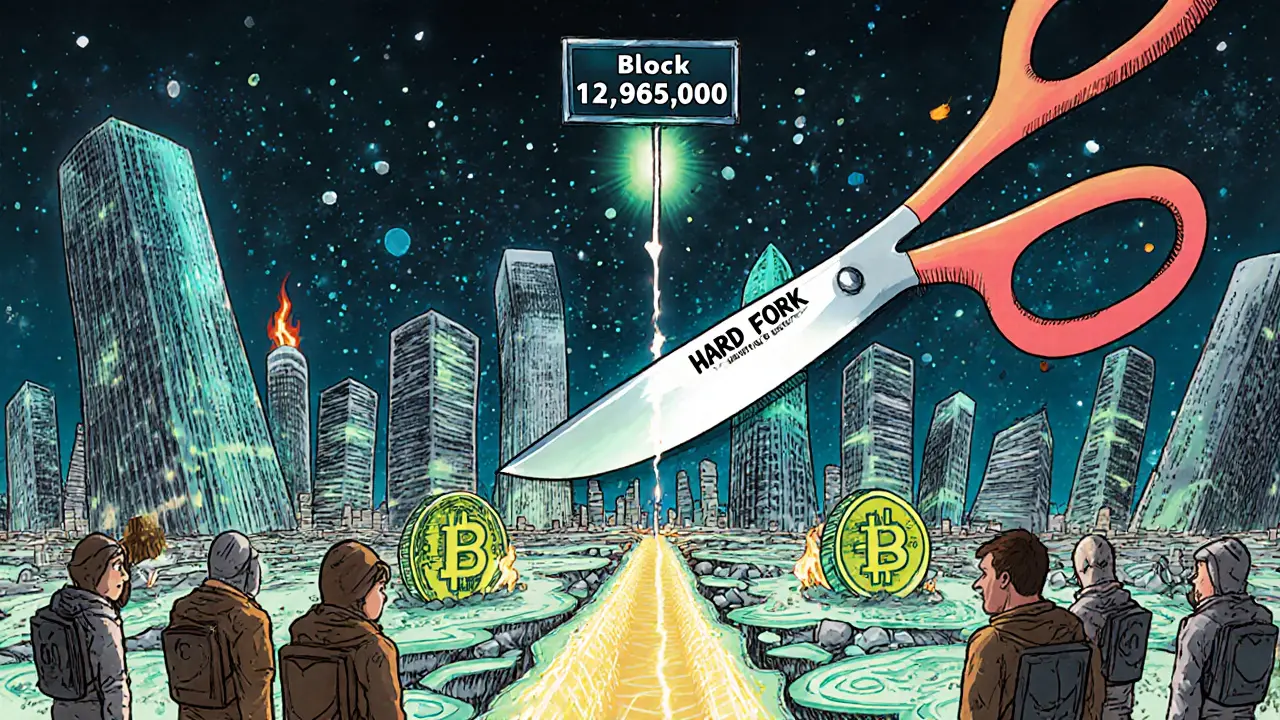
How Ethereum Hard Forks Upgrade the Network
- 10 Comments
- Feb, 19 2025
Ethereum hard forks are critical upgrades that break old rules to fix security flaws, reduce fees, and switch to greener consensus. Learn how The Merge and EIP-1559 transformed the network-and why future forks are unavoidable.