
Getting free cryptocurrency through an airdrop might feel like winning the lottery - until tax season hits. You didn’t pay for it. You didn’t mine it. You just woke up one day with new tokens in your wallet. But the IRS and other tax agencies don’t see it as a gift. They see it as income. And that means you owe taxes - right now, not when you sell.
Why Airdrops Are Taxable (Even If You Didn’t Ask for Them)
An airdrop happens when a blockchain project gives away free tokens to wallet addresses. Maybe you held Ethereum before a new chain launched. Maybe you used a DeFi protocol for months. Maybe you signed up for a newsletter. Whatever the reason, if tokens show up in your wallet, the IRS says you’ve received taxable income. The key moment isn’t when you sell. It’s when you receive them. The IRS clarified this in 2019 with Revenue Ruling 2019-24. If you get new crypto because of a hard fork and an airdrop, you must report the fair market value of those tokens on the day they land in your wallet. That’s it. No exceptions. No "I didn’t ask for it" defense. Say you got 200 units of a new token called $ZEN. On the day it arrived, $ZEN traded at $0.30 per unit. That’s $60 in taxable income. Even if $ZEN crashes to $0.01 next week, you still owe tax on the $60 you received. The IRS doesn’t care if you lost money later - you made income when you got it.How to Calculate the Value - And Why It’s Tricky
You can’t just guess. You need an exact fair market value at the exact time the tokens hit your wallet. That’s harder than it sounds. If the token is already trading on major exchanges like Coinbase or Binance, use the price from one of those platforms at the timestamp of the transaction. Most wallets and blockchain explorers (like Etherscan) show the exact time a transaction was confirmed. That’s your timestamp. But what if it’s a brand-new token with no trading history? You might see it listed on a tiny exchange with low volume. That’s not reliable. In that case, you have to use a reasonable method - like the average price across multiple reputable exchanges within a short window (say, 5 minutes) around the receipt time. Keep a screenshot or log of your source. The IRS expects you to make a good-faith effort. Most people mess this up. They assume, "It was free, so it’s not worth reporting." Then they get hit with a notice years later when the IRS cross-references blockchain data with tax filings.What Happens When You Sell or Trade Your Airdropped Tokens
Now you’ve got your $60 of $ZEN. You hold it for 14 months, then sell it for $150. You made $90 in profit. That’s a capital gain. Your cost basis - the value you used to calculate your original income - is $60. So your gain is $90. Because you held it over a year, it’s a long-term capital gain. That’s taxed at 0%, 15%, or 20%, depending on your income. But if you sold it in 6 months for $150? That’s a short-term capital gain. You pay ordinary income tax rates on that $90 - up to 37% federally, plus state tax. This isn’t double taxation. It’s two separate events: income when you received it, capital gain when you sold it. The $60 you already paid tax on isn’t taxed again. Only the $90 profit is.What If You Didn’t Claim the Airdrop? Does That Matter?
Yes. If you didn’t claim the airdrop - meaning you didn’t move the tokens or even acknowledge them - you still owe tax. The IRS doesn’t care if you ignored it. If the tokens were accessible in your wallet, you received them. You’re responsible. Some people think, "I didn’t touch it, so it’s not mine." But legally, if you have control over the private keys and the tokens are in your wallet, you have constructive receipt. That’s enough for the IRS. A lot of people find out years later they had a $5,000 airdrop from 2021 they never reported. Now they owe taxes, penalties, and interest. It’s not a small issue.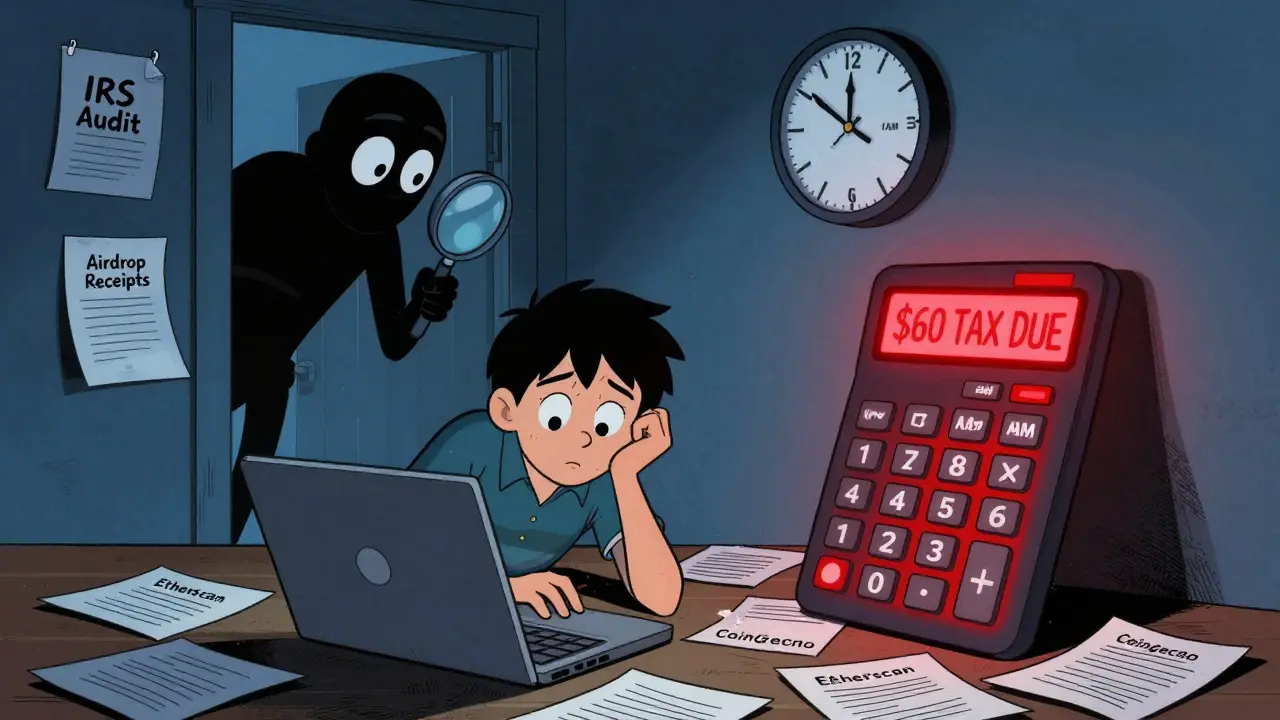
International Rules - It’s Not the Same Everywhere
If you’re not in the U.S., your rules change. But if you’re a U.S. taxpayer, you still report worldwide income. That means even if you got an airdrop from a European project, you still owe U.S. taxes. Canada treats some airdrops as non-taxable if they’re part of a network upgrade, not a marketing giveaway. Germany is similar - if the airdrop is tied to a hard fork, it might be tax-free. But in Australia and the UK, it’s treated like the U.S.: taxable income at receipt. The EU has no unified rule. Some countries tax it as income. Others wait until you sell. But if you’re a U.S. citizen or resident, you follow U.S. rules - no matter where the airdrop came from.What You Need to Track (And How to Do It)
You need four things for every airdrop:- The date and time the tokens arrived
- The exact number of tokens received
- The fair market value at that moment
- What you did with them later (sold, traded, held)
What Happens If You Don’t Report
The IRS has been scanning blockchains since 2021. They’ve partnered with blockchain analytics firms like Chainalysis. They know who got what. If you didn’t report an airdrop and the IRS finds out, you’ll get a notice. You’ll owe the tax, plus an accuracy-related penalty of 20% of the underpaid amount. Interest piles on top of that - compounding daily. Worse, if they think you intentionally hid it, penalties can go up to 75%. And if you’re filing from overseas, you might also trigger FBAR or FATCA reporting requirements for foreign financial accounts. Don’t gamble with this. Even a $100 airdrop isn’t worth the risk.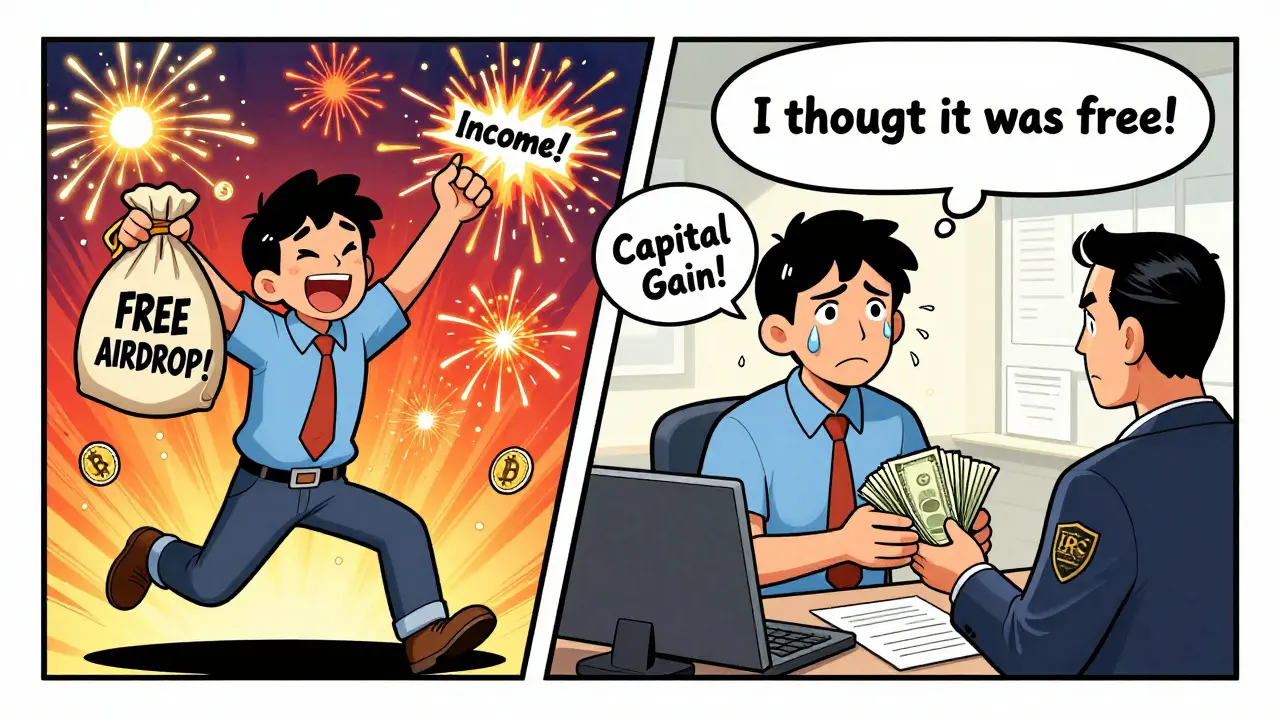
Real-World Examples
In 2020, Uniswap airdropped 400 UNI tokens to users who had traded on their platform before September 2020. Millions got them. Many didn’t know they had to report it. By 2023, thousands of people were scrambling to amend past returns because the UNI tokens had risen from $2 to over $10. Another example: the ENS airdrop in November 2021. People who had registered .eth domains got 100-2,000 ENS tokens. At the time, ENS was worth $20-$30. That meant a $2,000-$60,000 taxable income event for some users. Many didn’t realize they owed taxes until they tried to sell. These weren’t edge cases. They were mainstream. And they’re happening every week now.What’s Changing in 2026?
The Biden administration is pushing for stronger crypto reporting rules. New legislation could require exchanges and DeFi platforms to report airdrop distributions directly to the IRS - similar to how 1099s work for stocks. Some states are also stepping in. California treats crypto like regular income and doesn’t offer special breaks. Wyoming doesn’t tax crypto at the state level - but you still owe federal tax. The bottom line: the rules are getting tighter, not looser.What Should You Do Now?
If you’ve ever received a crypto airdrop:- Check every wallet you’ve ever used - even old ones.
- Look for any token you didn’t buy.
- Find the receipt date and fair market value.
- If you didn’t report it, file an amended return (Form 1040-X) for that year.
- Start tracking everything going forward.




Jeffrey Dufoe
January 22, 2026 AT 01:05Man I just got my first airdrop last month and had no idea I owed taxes on it. Thought it was like a free t-shirt. Now I’m scrambling to dig up my old wallet logs. Thanks for the heads up.
Abdulahi Oluwasegun Fagbayi
January 22, 2026 AT 14:45Free crypto isn’t free-it’s just debt with a blockchain logo. The IRS doesn’t care if you didn’t ask for it. If it landed in your wallet, you accepted it by not deleting it. Welcome to the new economy, where even silence is a contract.
katie gibson
January 22, 2026 AT 17:24okay but like… who even *wants* to track this? i got 300 tokens from some project i never heard of and now i have to dig through blockchain explorers like some kind of crypto detective?? this is why i hate taxes. also why does the government care if i got free internet money??
Tselane Sebatane
January 22, 2026 AT 17:50You think this is bad? Wait till you realize your airdrop from 2021 is worth $12k now and you never reported it. I had a friend who ignored a $7k ENS airdrop because he thought it was spam. Now he owes $3k in penalties plus interest. Don’t be that person. Save your screenshots. Track every single one. Your future self will thank you-or sue you.
Margaret Roberts
January 23, 2026 AT 01:57This is all a setup. The IRS doesn’t care about your crypto-they care about control. They know you’re holding it, they know when you got it, they know your wallet address. They’re using this to build a financial surveillance state. Next thing you know, they’ll tax you for breathing air. This isn’t taxation-it’s digital serfdom.
Linda Prehn
January 24, 2026 AT 07:20Why do people act like this is new? People got stock dividends in the 90s and paid taxes on them. Airdrops are just digital dividends. Stop acting like the government is out to get you because you got free tokens. You got value. Value is income. End of story. Also stop misspelling ‘fair market value’ it’s not that hard
Clark Dilworth
January 24, 2026 AT 19:38Constructive receipt doctrine applies here-non-custodial wallets still confer dominion and control per IRC §61. The moment the UTXO is confirmed and spendable, income is realized regardless of intent. Most retail users conflate ‘not asking for it’ with ‘not receiving it’-a fatal legal misapprehension. Use Koinly, log the timestamp, cross-reference with CoinGecko’s API feed, and file Form 8949 with Schedule D. If you’re doing DeFi, you’re in the tax game now.
Roshmi Chatterjee
January 26, 2026 AT 04:44I just got my first airdrop from a Solana project last week and I was so excited until I read this. Now I’m terrified. But honestly, this is so helpful. I didn’t even know where to start. I just checked my wallet on SolanaFM and found the exact time it arrived. I looked up the price on CoinGecko at that second-it was $0.18. So 150 tokens = $27 taxable income. I saved a screenshot and made a folder. I’m gonna file it with my 2024 taxes. Thank you for making this feel manageable instead of scary.
Mark Estareja
January 26, 2026 AT 14:45Bro I got a 2021 airdrop worth $8k that I forgot about. I just filed an amended return last month. Took me 3 weeks to find the transaction on Etherscan. The IRS didn’t penalize me because I came forward. They just want you to pay. Don’t wait for them to find you. Do it now. Your sanity will thank you.