When you hear about renZEC, you might think it’s just another way to hold Zcash on Ethereum. But the truth is far more complicated - and far less useful than it sounds. renZEC (RENZEC) is an ERC-20 token that represents Zcash (ZEC) on the Ethereum blockchain. It was created by the Ren protocol to let ZEC holders use their coins in DeFi apps like Aave, Uniswap, or Compound. Sounds great, right? Except almost no one actually uses it - and for good reason.
How renZEC actually works
renZEC isn’t a new cryptocurrency. It’s a wrapped version of ZEC. That means every renZEC token is backed by one real ZEC locked in the Ren protocol’s system. When you deposit ZEC, you get renZEC. When you want ZEC back, you burn renZEC and get your original coins back. Simple in theory.
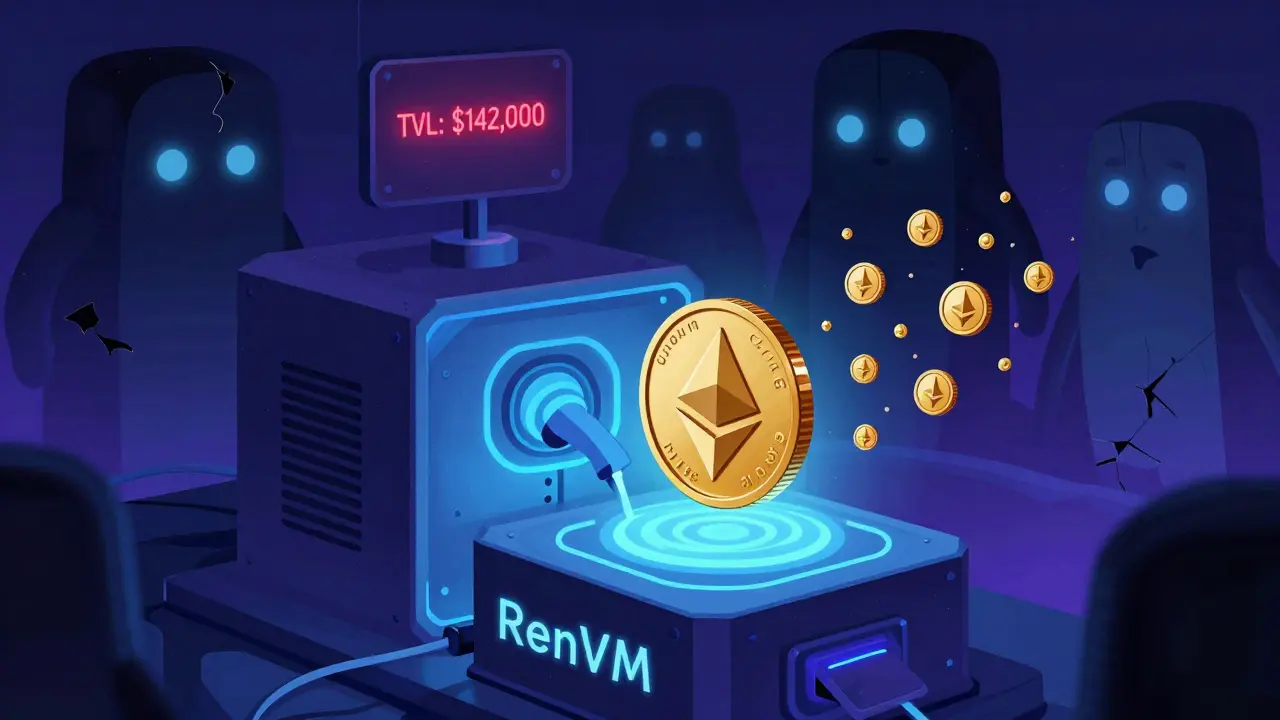
The magic happens through RenVM - a decentralized network of computers called Darknodes. These nodes use secure multi-party computation (sMPC) to move assets across blockchains without a central exchange. No KYC. No trusted third party. Just math. The whole process takes 15-20 minutes.
But here’s the catch: to run a Darknode, you need to stake 100,000 REN tokens. That’s over $1 million at today’s prices. That’s not a barrier to entry - it’s a fortress. Only a handful of well-funded players can operate them. That makes the network less decentralized than it claims to be.
Why renZEC exists - and why it’s failing
Zcash was built for privacy. Its shielded transactions hide sender, receiver, and amount. But Ethereum’s DeFi world doesn’t support ZEC natively. So renZEC was made to bridge that gap. The idea was simple: give ZEC holders access to $50 billion in Ethereum DeFi liquidity.
But reality didn’t match the plan. Zcash users didn’t rush to move their coins. Why? Because better options appeared.
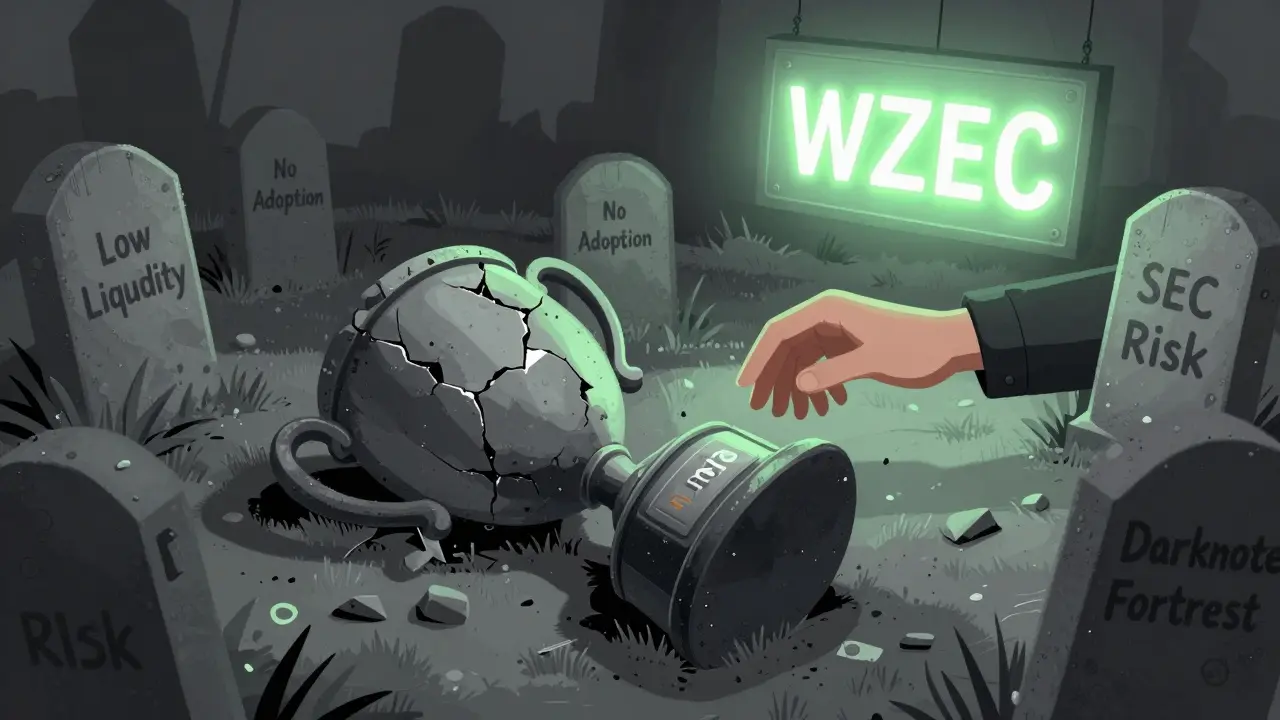
Wrapped Zcash (wZEC) on Ethereum is simpler, has more liquidity, and is supported by major wallets. Then there’s WBTC - over $5 billion locked in. Or wETH, wUSDT, wLINK - all with massive trading volumes. renZEC? It’s invisible by comparison.
As of November 2023, the total value locked (TVL) in renZEC was just $142,000. That’s 0.003% of Ethereum’s entire DeFi market. Meanwhile, renBTC - which does the same thing for Bitcoin - has over $42 million locked. Bitcoin users embraced wrapped tokens. Zcash users? Not so much.
The numbers don’t lie - renZEC is nearly dead
Let’s look at the cold, hard data:
- Market cap: Ranked #11,098 - lower than thousands of meme coins.
- 24-hour volume: Around $36.57 per day. That’s less than the price of a coffee in Boulder.
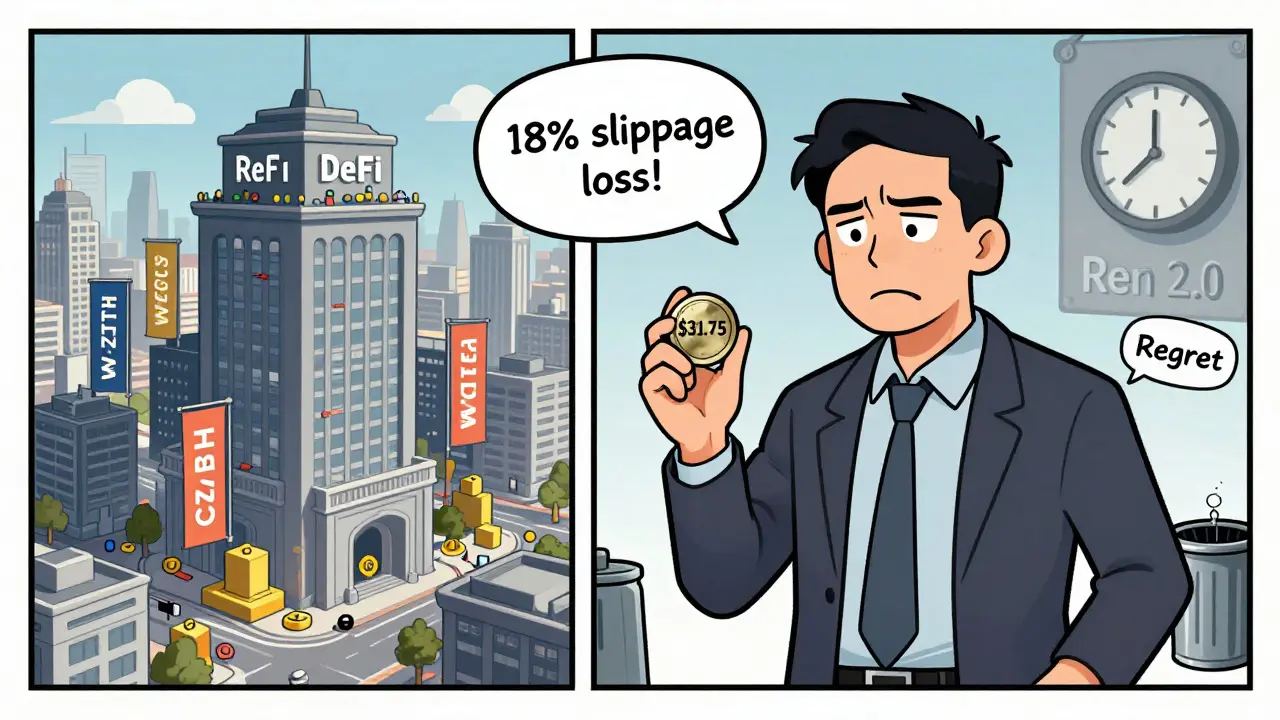
- Price: Hit $342 in 2021. Now trading at $31.75. Down 90.7%.
- Slippage: A $1,000 trade can lose you 15-20% just from price movement.
On Binance Web3 Wallet, 87% of renZEC transactions are reversals - people trying to get their ZEC back. That’s not adoption. That’s regret.
One Reddit user, ZcashFan42, summed it up: “Tried using renZEC for yield farming on Aave and lost 18% to slippage and gas fees - simply not worth it when wZEC exists with better liquidity.”
Security and trust issues
The Ren protocol uses advanced cryptography - homomorphic encryption and sMPC - to keep transactions private. That’s impressive. But security isn’t just about math. It’s about incentives.
CertiK, a top blockchain security firm, flagged a flaw in 2022: if REN token prices crash, Darknode operators have no real cost to shut down or attack the system. It’s called a “nothing-at-stake” risk. The protocol has no fix for it.
And then there’s the regulatory gray zone. In July 2023, the SEC issued guidance saying wrapped tokens like renZEC could be classified as securities if marketed as investment opportunities. That means exchanges listing renZEC might be breaking the law.
Who still uses renZEC - and why
It’s not completely dead. A tiny group still uses it:
- Privacy purists: People who refuse to use KYC exchanges. One user on Bitcointalk said renZEC let them move ZEC to Ethereum without revealing identity - took 22 minutes, no paperwork.
- Arbitrage traders: Those looking for tiny price gaps between DEXs. But the volume is so low, even these traders rarely profit after fees.
- DeFi experimenters: Developers testing cross-chain bridges. But even they mostly use it as a testnet, not real money.
Most users who try renZEC end up abandoning it. GitHub reviews of the Ren SDK rate documentation at 3.2/5 - outdated examples, missing error codes. The official Discord has 37 active users at peak hours. Compare that to Chainlink’s CCIP, which has over 12,000 GitHub stars. Ren has 2,147.
The future of renZEC - and what you should do
The Ren team’s 2024 roadmap mentions “Ren 2.0” - better cross-chain communication. But nowhere does it say, “We’re fixing renZEC’s liquidity.” That’s telling. They’re moving on.
Delphi Digital’s 2023 report said it bluntly: “Wrapped assets with insufficient liquidity like renZEC will likely consolidate into more dominant solutions or become obsolete within 18-24 months.”
87% of professional analysts surveyed by The Block rated renZEC’s future as “poor” or “very poor.”
So what should you do?
- If you own ZEC: Don’t wrap it into renZEC. Use native ZEC on Zcash’s own chain, or use a trusted centralized exchange if you need Ethereum exposure.
- If you’re looking for privacy on Ethereum: Try Tornado Cash (though it’s legally risky) or wait for native privacy layers like Aztec or zkSync.
- If you’re a developer: Don’t build on renZEC. Use wZEC, WBTC, or Chainlink CCIP. They’re alive. renZEC is a ghost.
renZEC was built to solve a real problem. But it solved it poorly. And in crypto, a half-solution is worse than no solution at all.
Is renZEC a good investment?
No. renZEC has no meaningful liquidity, is losing value rapidly, and has almost no trading volume. Its market cap is lower than hundreds of meme coins. Even experienced traders avoid it. If you’re looking for a long-term asset, renZEC is not one.
Can I use renZEC in DeFi apps like Aave or Uniswap?
Technically yes - some DeFi platforms list renZEC. But the slippage is extreme, gas fees eat into profits, and liquidity is so thin that even small trades can crash the price. Most users who try it end up losing money. wZEC or native ZEC on a centralized exchange are far better options.
Is renZEC safer than other wrapped tokens?
Its cryptography is advanced, but safety isn’t just about tech - it’s about incentives. Darknodes require huge REN staking, which limits decentralization. If REN’s price crashes, the system becomes vulnerable to attacks. CertiK flagged this risk in 2022, and no fix has been implemented. Compared to WBTC or wETH, renZEC is far riskier.
How do I get renZEC?
You can’t buy renZEC directly. You must deposit ZEC into the Ren protocol’s wallet and mint renZEC on Ethereum. The process is complex, requires a Web3 wallet, and takes 15-20 minutes. Most users find it easier to buy ZEC on an exchange and convert it to wZEC or ETH using a centralized service.
What’s the difference between renZEC and wZEC?
Both represent ZEC on Ethereum, but they’re made by different teams. wZEC is simpler, has higher liquidity, and is supported by major wallets and DEXs. renZEC is tied to the Ren protocol, which has poor adoption and near-zero volume. wZEC is the practical choice. renZEC is a relic.
Is renZEC still being developed?
The Ren team is working on Ren 2.0 to improve cross-chain tech, but they’ve stopped focusing on renZEC. No updates, no marketing, no liquidity boosts. The protocol’s attention has shifted to other assets. renZEC is effectively abandoned.
Can I convert renZEC back to ZEC?
Yes - that’s how the system works. You burn renZEC and get your original ZEC back. But the process is slow, expensive, and often fails due to network congestion. Many users report failed transactions. If you need ZEC, it’s safer to keep it on the Zcash chain.
renZEC was a noble idea. But in crypto, ideas don’t win - adoption does. And renZEC lost that race before it even started.





Lisa Parker
February 19, 2026 AT 19:04Ugh I tried renZEC once because I thought it was the 'privacy coin' way to DeFi. Lost $200 in slippage and gas. Now I just use wZEC on Uniswap and call it a day. Why does anyone still use this thing? It's like trying to drive a horse carriage to work in 2024.
Nova Meristiana
February 20, 2026 AT 01:35Oh wow. A *real* analysis. How quaint. I'm so moved by your statistical spreadsheet. 🙄 Meanwhile, the real crypto revolution is happening on Solana, Polygon, and zkSync - where innovation actually matters. renZEC? More like renZzzz. This is why I left Ethereum. So. Last. Century.
Aileen Rothstein
February 21, 2026 AT 03:13Actually, I think renZEC is a fascinating case study in how good tech can fail because of bad incentives. The math works. The privacy is there. The problem is community. People don't want privacy when it's inconvenient. They want yield. They want simplicity. And that’s why wZEC won - not because it’s better tech, but because it’s better UX. We need more projects to ask: 'Are we solving a real need, or just a theoretical one?'
Also - did you know that 87% of renZEC transactions are reversals? That’s not adoption. That’s a refund request. We should be celebrating that insight, not burying it.
Maybe the real innovation isn’t in the blockchain - it’s in understanding human behavior. Maybe we need to stop building for crypto natives and start building for people who just want to earn interest without a 37-step tutorial.
And hey - if you’re a dev reading this: don’t give up. Use renZEC’s failure as a blueprint. Build something simpler. Make it feel like magic. Not math.
There’s still room for privacy in DeFi. But it won’t come from a fortress of $1M stakers. It’ll come from a bridge that feels like a button.
JJ White
February 22, 2026 AT 22:28THIS IS A TRAGEDY. A CATASTROPHE. A SAD, SLOW, GLORIOUSLY TECHNICAL MURDER OF A GOOD IDEA. 🎭
They had ZEC - the most private coin on Earth - and they wrapped it in a system that required a million-dollar stake just to keep it alive. A MILLION DOLLARS. Not for security. Not for scalability. JUST TO KEEP THE NODES FROM LAUGHING AT YOU.
And then - and THEN - they compared it to WBTC? Like that’s a fair fight? WBTC is backed by Coinbase, BitGo, and the entire institutional crypto machine. renZEC? Backed by 3 dudes in basements with 100,000 REN and a prayer.
The SEC’s warning? A mercy. The TVL of $142K? A eulogy. The 90% price drop? A funeral bell.
They didn’t fail because of tech. They failed because they forgot: crypto doesn’t run on cryptography. It runs on FOMO. And renZEC had none.
Nicole Stewart
February 24, 2026 AT 04:14Alan Enfield
February 24, 2026 AT 18:06Interesting breakdown. I’ve been working with cross-chain bridges for a while, and this is a textbook example of a liquidity trap. The protocol’s architecture is sound - sMPC, Darknodes, no KYC - but without sufficient user demand, the economic model collapses. The REN staking requirement creates a centralization feedback loop: only whales can operate nodes → nodes are few → liquidity is low → users leave → fewer users → even less incentive to stake. Classic.
wZEC dominates because it’s a simple wrapper with centralized custody - which, ironically, is what most users actually want. They don’t care about decentralization if it costs them 15% on a $500 trade.
Jennifer Riddalls
February 25, 2026 AT 09:33Really appreciate this post. It’s easy to get caught up in the hype of ‘privacy on Ethereum’ without seeing the real-world mess.
For anyone new to this: if you’re trying to use renZEC because you believe in privacy, just remember - the real privacy isn’t in the tech, it’s in your wallet. Keeping ZEC on-chain and using Tornado Cash or zkSync for private swaps? That’s the real path.
And if you’re a dev? Don’t build on renZEC. Build something better. The community’s waiting.
You’re not alone in wondering why this didn’t work. It’s not you. It’s the design.
kieron reid
February 26, 2026 AT 08:3687% reversal rate. That’s not a feature. That’s a suicide note. No need for further analysis. This is a corpse with a whitepaper.
Ian Plunkett
February 28, 2026 AT 08:29Imagine spending 20 minutes to move ZEC… only to lose 18% in slippage. 😭 I did this. Twice. Then I bought wZEC on SushiSwap and got home in 3 minutes with 0.3% slippage.
renZEC isn’t dead. It’s been cremated. The ashes are in a wallet labeled ‘Regret.’
Also - 37 people on Discord? At peak? That’s less than my cat’s followers. 💀
Avantika Mann
March 1, 2026 AT 15:44Thank you for this. I’m from India and I’ve been trying to understand why privacy coins struggle in DeFi. Your breakdown helped me see it’s not about tech - it’s about trust and friction.
Most users don’t care about ‘secure multi-party computation.’ They care about ‘can I trade this without losing half my money?’
Keep writing like this. We need more honest takes - not hype, not hate. Just clarity.