
YokaiSwap isn’t another Uniswap clone. It doesn’t have millions in daily volume, hundreds of trading pairs, or a bustling Reddit community. But it does have something rare: it’s the only decentralized exchange built natively on the Nervos Network. If you’re already deep into Nervos, this might be your only game in town. If you’re not? You’ll need to ask yourself if it’s worth the hassle.
What Exactly Is YokaiSwap?
YokaiSwap launched in 2021 as the first Automated Market Maker (AMM) on the Nervos Network. It’s not just a side project-it’s a core piece of DeFi infrastructure backed by inNervation, a fund formed by CMB International and the Nervos team. That institutional backing gives it credibility, but not liquidity. Right now, you’re looking at a platform with just five tokens and six trading pairs. The most active one? YOK/WCKB. It accounts for over 93% of all trading volume-$490 out of the $527 total in the last 24 hours. That’s not a typo. The entire exchange moves less than $600 a day. Compare that to Uniswap, which handles billions. YokaiSwap’s trading volume sits in the 31st percentile among all tracked exchanges. That’s not just small-it’s microscopic.The YOK Token: Supply, Price, and Reality
The native token, YOK, has a max supply of 1 billion. About 450 million are in circulation, meaning nearly half the tokens are still locked up. As of October 2025, YOK trades at $0.0002. That’s not a typo either. You’d need over 5,000 YOK tokens to make $1. The price is low, but so is the demand. There’s no major exchange listing YOK. Phemex, one of the bigger centralized platforms, explicitly says you can’t buy it there. That means you’re stuck using YokaiSwap itself or niche wallets that support Nervos. The token’s purpose? It’s used for governance and yield farming. But with so few users, farming rewards are minimal. Staking YOK might earn you a few cents a week. Not enough to justify the gas fees unless you’re a believer in Nervos’s long-term vision.How Does It Work? (And Why It’s Hard to Use)
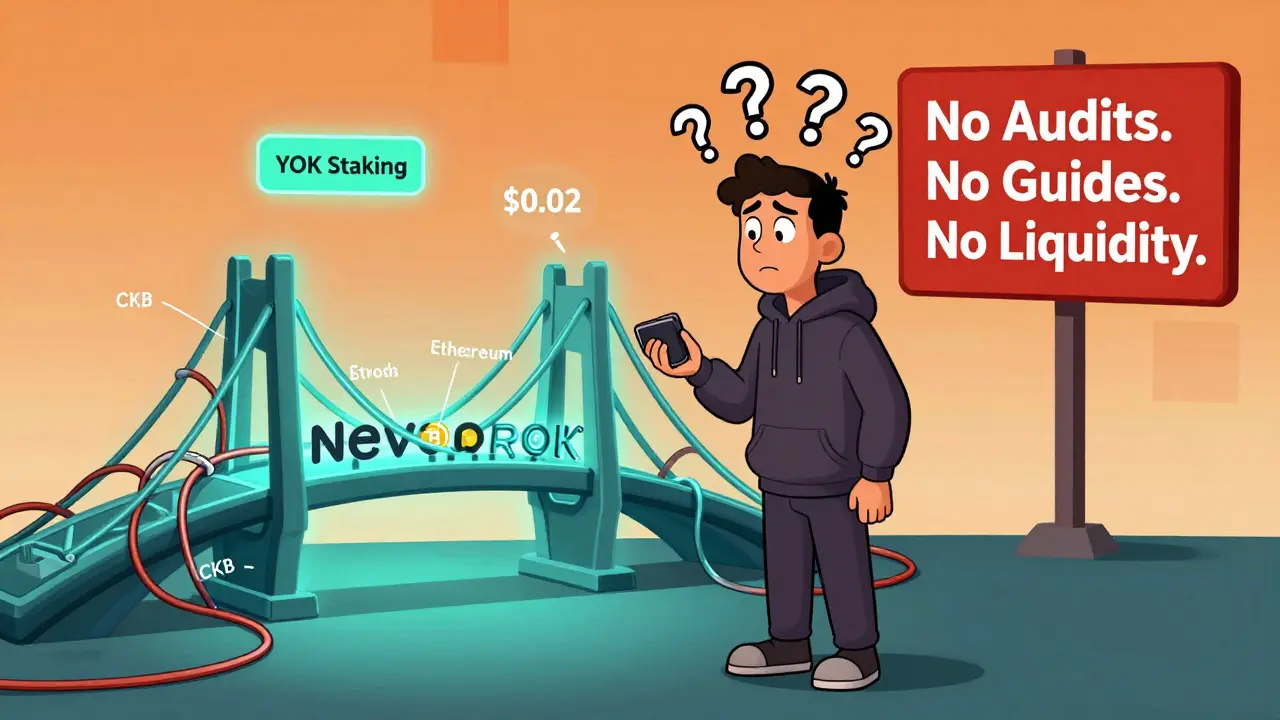
Using YokaiSwap isn’t plug-and-play like MetaMask on Ethereum. You need to interact with the Nervos Network directly. That means:- Setting up a Nervos-compatible wallet (like CKB Wallet or Nervos DAO)
- Bridging assets from Ethereum, Bitcoin, or other chains into the Nervos CKB blockchain
- Understanding how to swap using AMM pools with very thin liquidity
Security, Audits, and Transparency
No public security audit reports exist for YokaiSwap’s smart contracts. No third-party firm like CertiK or Trail of Bits has reviewed them. That’s a red flag. In crypto, if a project doesn’t publish audits, it’s either too small to afford one-or they’re avoiding scrutiny. Given that YokaiSwap is backed by institutional money, you’d expect more transparency. You don’t get it. CoinMarketCap lists YokaiSwap as a “preview” project. That means it hasn’t met their minimum criteria for full listing-usually around trading volume, team transparency, or community size. CoinGecko tracks it, but only as a basic entry. No analyst reports. No deep dives. No press coverage from major crypto outlets.What’s Next? The Roadmap and Realistic Prospects
YokaiSwap’s roadmap says it’s planning to support Cardano and Ethereum. That’s ambitious. If they pull off cross-chain liquidity bridges, it could open the door to millions of new users. But that’s a huge technical challenge. Most cross-chain projects fail to deliver on promises. And with current trading volume this low, there’s no real incentive for developers to build on top of it. Right now, YokaiSwap exists because the Nervos Network exists. If Nervos gains traction, YokaiSwap could grow. If Nervos fades into obscurity, so will YokaiSwap. There’s no independent momentum here. It’s entirely dependent on a blockchain that hasn’t cracked the top 20 by market cap or user base.
Who Is This For? (And Who Should Stay Away)
Use YokaiSwap if:- You already hold Nervos CKB or other Nervos-native tokens
- You’re testing DeFi on a non-Ethereum chain
- You believe in Nervos’s long-term potential and want to support its ecosystem
- You’re comfortable with low liquidity and high slippage
- You want to trade popular tokens like ETH, SOL, or BTC
- You need high liquidity or tight spreads
- You’re new to crypto and don’t know how to use wallets or bridges
- You’re looking for yield farming rewards that actually pay off
The Bottom Line: A Niche Tool, Not a Mainstream Option
YokaiSwap isn’t broken. It’s just small. It’s not a scam. But it’s not a solution either. It’s a tool for a very specific audience: Nervos believers who want to trade within their own ecosystem. If you’re not part of that group, you’re better off using Uniswap, PancakeSwap, or even a centralized exchange like Kraken. The fact that YokaiSwap exists at all is interesting. It shows that even the smallest blockchains are trying to build DeFi. But size matters in crypto. Liquidity matters. Community matters. And right now, YokaiSwap has none of those in meaningful amounts. If you’re curious, try it with $5. See how the experience feels. But don’t expect to make money. Don’t expect fast trades. Don’t expect support. You’re entering a quiet corner of crypto-and it’s not going to shout back.Can I buy YOK on Binance or Coinbase?
No, YOK is not listed on any major centralized exchanges like Binance, Coinbase, or Kraken. You can only trade it on YokaiSwap or through niche decentralized wallets that support the Nervos Network. To get YOK, you’ll need to first acquire CKB (Nervos’s native token), bridge it to YokaiSwap, and then swap it for YOK.
Is YokaiSwap safe to use?
There’s no public security audit for YokaiSwap’s smart contracts. While it’s backed by institutional partners, the lack of third-party verification means you’re trusting code that hasn’t been independently tested. Always use only funds you’re willing to lose. Never connect your main wallet-use a separate one with minimal balance.
What’s the trading volume on YokaiSwap?
As of October 2025, YokaiSwap’s 24-hour trading volume is around $527.75. The vast majority-over 90%-comes from just one trading pair: YOK/WCKB. This indicates extremely low liquidity and makes large trades risky due to high slippage.
Does YokaiSwap have yield farming or staking?
Yes, YokaiSwap offers yield farming and staking for the YOK token. But with only a few hundred active users and minimal liquidity, rewards are negligible-often less than a few cents per week. It’s not a viable income source, but rather a way to participate in the ecosystem if you’re already invested in Nervos.
Why hasn’t YokaiSwap grown like Uniswap or PancakeSwap?
Because it’s tied to the Nervos Network, which has far fewer users and developers than Ethereum or BSC. DeFi growth depends on user adoption, liquidity, and developer activity-all of which are minimal on Nervos. Without a large user base, there’s no flywheel effect. YokaiSwap can’t grow unless Nervos grows first, and Nervos hasn’t broken into mainstream adoption yet.
Can I use YokaiSwap without knowing how to bridge assets?
No. To use YokaiSwap, you need to get assets onto the Nervos CKB blockchain. That requires bridging from Ethereum, Bitcoin, or other chains using tools like the Nervos DAO or third-party bridges. If you don’t know how to do that, you won’t be able to trade. There are no easy on-ramps like MetaMask’s built-in swap feature.
Is YokaiSwap a good long-term investment?
Not as an investment vehicle. YOK’s value is tied to the success of the Nervos Network, which remains unproven at scale. If you believe Nervos will become a major Layer 1 blockchain in the next 5-10 years, then holding YOK could make sense. But that’s a high-risk, long-term bet-not a crypto investment strategy.


steven sun
January 24, 2026 AT 05:16yo this thing is literally a ghost town lmao i tried swapping 5 bucks and my transaction took 12 mins and cost me more in fees than i swapped. why is this even a thing?
tim ang
January 24, 2026 AT 10:10lol i love these tiny chains trying to be uniswap 😂 i’ve been holding ckb since 2022 just because i believed in the tech, but yokaiswap? its like bringing a spoon to a firehose. still, props for trying. if nervos ever blows up, this’ll be the OG dapp. 🙌
katie gibson
January 25, 2026 AT 19:15Okay but let’s be real - this isn’t DeFi, it’s a crypto art installation. A museum piece for people who think ‘decentralized’ means ‘no one cares’. I mean, $527 in volume? That’s less than my weekly coffee budget. And no audit? Honey, that’s not a risk, that’s a cry for help. 🫠
Ashok Sharma
January 27, 2026 AT 05:35This is a good example of how innovation needs community. Nervos has potential, but without users, no project can survive. Beginners should avoid this. Only experienced users who understand blockchain bridges should try it. Patience and caution are needed.
Margaret Roberts
January 27, 2026 AT 18:30institutional backing? yeah right. cmb international? that’s just a shell company for the nervos team to launder their own tokens. they’re not building a dex, they’re creating a pump-and-dump trap for true believers. you think this is niche? it’s a trap. they want you to buy yok while it’s worth nothing… then disappear when it hits 0.0005
Harshal Parmar
January 29, 2026 AT 16:49look i get it, most people see this and laugh. but i remember when ethereum had like 20 people trading and no one took it seriously. nervos is like that right now - quiet, slow, but the tech is solid. i’ve been farming yok for 6 months and made like 87 cents, but i’m not here for the money. i’m here because i think ckb is the future of layer 1 for smart contracts. if you believe in the vision, stick around. the real gains come to those who wait. 🌱
Darrell Cole
January 29, 2026 AT 17:04the fact that this is even being reviewed as a legitimate exchange is embarrassing. zero liquidity zero audits zero community zero credibility. calling it a dex is a stretch. it’s a demo. a prototype. a sandbox. if you’re not using it to test code, you’re wasting your time and your gas. also, who wrote this article? it’s too nice. they’re either paid or naive. neither is good
Matthew Kelly
January 31, 2026 AT 00:04just tried it with $3. it worked. kinda. took 8 mins, slippage was wild, but i got my yoks. no drama, no panic. just… quiet. it’s like using a library in 2003 - slow, no one’s there, but the books are real. i’ll keep a small wallet on it. for the long game. 🤝