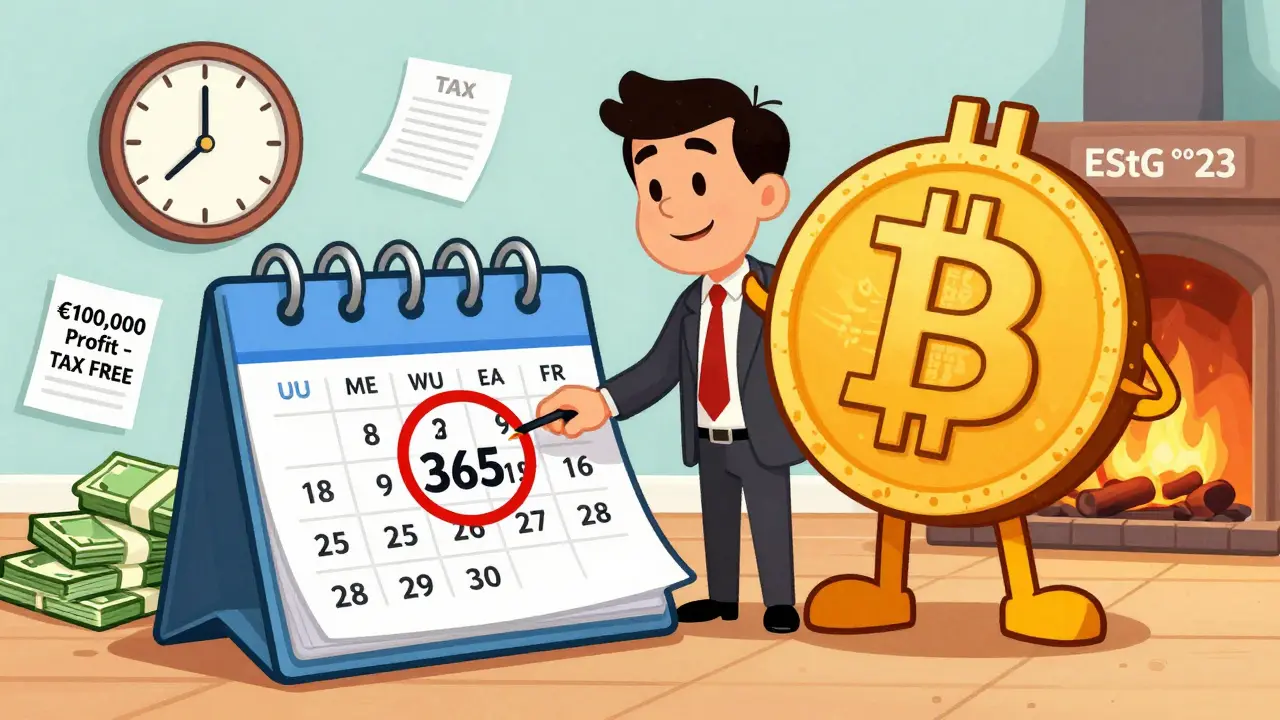
If you’ve held crypto for over a year in Germany, you might not owe a single euro in taxes - even if you made €100,000 in profit. That’s not a loophole. It’s the law. Since 2009, Germany has treated cryptocurrency like private assets, not securities. And if you wait just 12 months before selling, swapping, or spending your coins, your gains are completely tax-free. No caps. No limits. No hidden fees. This isn’t a rumor. It’s the official stance of the Bundeszentralamt für Steuern (Germany’s Federal Central Tax Office), backed by Section 23 of the Income Tax Act (EStG).
How the 12-Month Rule Actually Works
The rule is simple: buy crypto. Wait 365 days. Sell it. Pay zero tax. That’s it. The clock starts ticking the moment you acquire the asset - not when you move it to a wallet, not when you mine it, but the exact timestamp of your purchase. If you bought 0.5 BTC on January 15, 2024, at €35,000 per coin, and sold it on January 16, 2025, at €60,000, your €12,500 profit is tax-free. Even if you sold it for €200,000, still zero tax.
This applies to Bitcoin, Ethereum, Stablecoins, NFTs, and every other token traded on German exchanges. The Federal Ministry of Finance confirmed in 2024 that NFTs are treated exactly like cryptocurrencies under this rule. No distinction. No exceptions.
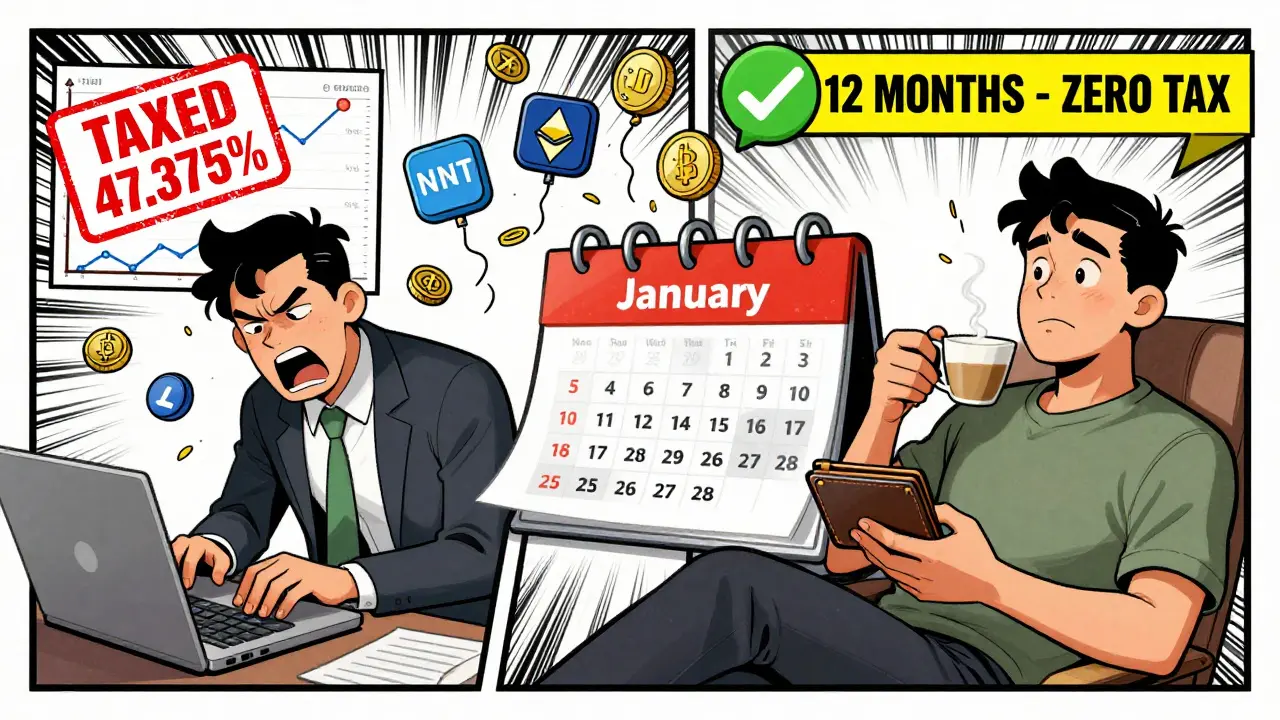
But here’s the catch: if you sell before the year is up, you’re taxed. Short-term gains are added to your income and taxed at your personal rate - between 14% and 45%, plus a 5.5% solidarity surcharge. That means the top rate can hit 47.375%. Luckily, there’s a buffer: you can make up to €1,000 in short-term profits each year without paying anything. That’s up from €600 in 2024. So if you’re trading small amounts, you’ve got a little breathing room.
Why Germany’s System Is Unique in Europe
Most of Europe taxes crypto like stocks. France? Flat 30% on every trade, no matter how long you hold. The UK? 10% to 20% capital gains tax, with only £3,000 free per year. Portugal used to be tax-free too, but now they’re cracking down on frequent traders and requiring proof of non-residency to qualify.
Germany stands apart. It’s the only EU country that offers a full, unconditional tax exemption for long-term crypto. Even Switzerland - often called a crypto haven - taxes crypto as part of your wealth, not just your gains. Singapore taxes crypto trading as business income if you trade too often. Germany doesn’t care how many times you trade - as long as each asset sits for a year, it’s tax-free.
That’s why Germany became Europe’s largest crypto market by transaction volume in 2024, according to Chainalysis. Over 30% of Germans now own some form of cryptocurrency. And a big reason? The tax policy gives people real incentive to hold, not flip.
What You Must Track - And Why
Just because it’s tax-free doesn’t mean you can ignore records. The German tax office doesn’t ask for reports unless they audit you. But if they do - and they do - you need to prove every transaction. That means:
- Exact date and time of every purchase
- Amount bought and price paid (in EUR)
- Wallet address or exchange used
- Transaction ID or hash
- Date and time of every sale, swap, or spend
- Value in EUR at time of disposal
It sounds like a headache - and it can be, especially if you use dollar-cost averaging. If you bought 0.1 BTC every month for a year, you now have 12 different purchase dates. Each one has its own 12-month clock. Sell one coin? You need to match it to the right purchase to calculate the holding period. Mixing them up could accidentally trigger a taxable event.
That’s why most serious investors use crypto tax software. Tools like Blockpit, Koinly, and CoinTracker have built-in German tax rules. They auto-import your exchange data, calculate holding periods, and flag any sales that might be taxable. Setup takes 2-4 hours. Most users say it’s worth it.
DeFi, Staking, and the Gray Areas
Here’s where things get messy. If you earn interest from lending crypto on a DeFi platform, or get staking rewards from Ethereum, those are treated as income. Not capital gains. That means you pay income tax on them - even if you hold them for 10 years.
The Bundeszentralamt für Steuern hasn’t issued clear rules on how to value these rewards. Do you tax them at the time you receive them? Or when you sell them? Most tax advisors recommend treating them as income on receipt, valued in EUR at that moment. Then, if you hold the earned tokens for over a year before selling, you can still avoid capital gains tax on the appreciation.
Same goes for airdrops. If you get free tokens, they’re taxable as income at their fair market value on the day you receive them. But again - if you hold them past 12 months, selling them later? Tax-free.
So the trick isn’t just holding your original buy. It’s holding everything you earn too. That’s why many German investors separate their wallets: one for long-term HODLing, one for active DeFi and staking. Keeps the books clean.
What Happens If You Get Audited?
Germany doesn’t audit everyone. But they audit enough. In 2024, over 12,000 crypto-related tax audits were launched. Most were triggered by data sharing between exchanges and tax authorities. Major German platforms like Bitpanda and Kraken now report user data to the BZSt under EU regulations.
If you’re audited and can’t prove your holding periods? Penalties can reach 40% of the unpaid tax, plus interest. That’s why keeping records isn’t optional. It’s your defense.
But here’s the good news: if you’ve held for over a year and you can prove it, you have nothing to fear. The BZSt has no legal basis to tax those gains. Courts have backed this interpretation multiple times. The law is clear. You just need to show you followed it.

How This Policy Shapes Investor Behavior
German Reddit communities like r/Finanzen and r/CryptoCurrency are full of stories. One user bought 2 ETH in early 2021 for €1,200 each. Sold them in 2025 for €4,800 each. Profit: €7,200. Tax: €0. Another bought Dogecoin in 2022 for €0.05, sold in 2025 for €0.18. Made €9,000. Paid nothing. These aren’t outliers. They’re standard.
The policy has changed how people think. Instead of chasing daily price swings, most German investors now focus on long-term growth. The tax system literally rewards patience. That’s why institutions - from family offices to small crypto funds - are setting up shop in Germany. They know the rules won’t change overnight.
Even if the EU pushes for harmonized crypto taxes under MiCA, Germany’s economic weight gives it leverage. Most experts believe the 12-month rule will survive until at least 2027. Any attempt to remove it would trigger a massive exodus of investors and blockchain companies.
What’s Next? Keep Holding
If you’re in Germany and you own crypto, the message is simple: hold. Don’t panic sell. Don’t chase quick flips. Let the calendar turn. Wait a year. Then cash out - tax-free. It’s not magic. It’s policy. And it’s one of the most powerful advantages any crypto investor has in the developed world.
Start tracking your buys. Use software if you need to. Talk to a German crypto accountant if you’re doing DeFi or have over 50 transactions. But don’t let complexity stop you. The reward - keeping every euro of profit - is worth the effort.
Do I pay tax if I swap one crypto for another after holding for a year?
No. Swapping crypto for crypto is considered a disposal under German tax law. But if you held the original asset for over 12 months, the swap triggers zero capital gains tax - even if the new asset increases in value later. The 12-month clock resets for the new asset, but the gain from the swap itself is tax-free.
What if I bought crypto on a foreign exchange like Binance?
It doesn’t matter where you bought it. German tax law applies to you as a resident, regardless of the exchange’s location. You must still track the purchase date, price, and disposal. Foreign exchanges may not report to German authorities, but that doesn’t mean you’re exempt from reporting - and audits can still happen.
Can I gift crypto to a family member to avoid tax?
Gifting crypto to family members is treated as a disposal by the tax office. If you’ve held it less than a year, you may owe tax on the gain at the time of the gift. If you’ve held it over a year, no tax is due. But the recipient inherits your original purchase date and cost basis. So if they sell it later, they’ll use your timeline to calculate their own 12-month period.
Is mining crypto tax-free after a year?
No. Mining rewards are taxed as income when you receive them, based on their EUR value at that moment. You pay income tax then. But if you hold those mined coins for over a year before selling them, the profit from the sale is tax-free. The tax is only on the initial receipt, not the later appreciation.
What happens if I lose access to my wallet and can’t prove my purchase date?
This is risky. Without proof of purchase date, the tax office may assume you bought the asset on the first day of the year. That could make your holding period shorter than it actually was, triggering unintended taxes. Always back up your transaction history. Use wallet exports, exchange statements, or blockchain explorers to document your earliest transactions. If you lose records, consult a tax professional - you may still be able to reconstruct them.





Rajappa Manohar
December 30, 2025 AT 00:02Wait, so if I hold for a year, I pay nothing? That’s wild. I’m sold.
Bianca Martins
December 30, 2025 AT 23:16This is actually one of the most rational crypto tax policies out there. Most countries treat crypto like gambling, but Germany gets that it’s money. Holding periods make sense - rewards patience, not speculation. I’ve been using Koinly since 2022 and it’s saved my sanity. Just export your transaction history once a year and forget about it until tax season. No drama.
Daniel Verreault
December 31, 2025 AT 08:20Bro this is the only reason i moved my crypto to Germany. I was trading on binance, got taxed 40% in the usa on a 6 month flip, then i heard about the 12 month rule and just said f*ck it i’m moving. Now i’m chillin’ in berlin with my btc stack, no stress, no taxes. Even my german landlady asked me how i’m so calm. I told her ‘i hold’ and she nodded like it made perfect sense. 🤷♂️
Alexandra Wright
December 31, 2025 AT 21:37Oh please. The ‘tax-free’ myth. You think the EU is gonna let this slide forever? MiCA is coming. Germany’s economy is too big to ignore, sure - but they’ll find a way to tax you. They always do. And let’s not pretend people aren’t gaming this. I know guys who buy 0.001 BTC every day to artificially stretch their holding periods. That’s not investing - that’s tax engineering. And it’s gonna backfire when the rules change.
dayna prest
January 2, 2026 AT 01:12Germany’s crypto tax law is basically the crypto world’s version of ‘sleeping giant’ - quiet, massive, and nobody dares poke it because if they do, the whole continent yawns and flips the table. Meanwhile, the UK’s still taxing your crypto like it’s a lottery ticket you bought at the corner store. It’s not even a contest. The only thing more ridiculous than the US tax code is the fact that people still think it’s fair.
Jacky Baltes
January 2, 2026 AT 14:02The real genius here isn’t the tax exemption - it’s the cultural shift it created. Germans aren’t flipping coins anymore. They’re building portfolios. They’re thinking decades, not days. That’s not luck. That’s policy design. When the state gives you space to think long-term, people stop acting like gamblers. This isn’t about money. It’s about maturity.
Antonio Snoddy
January 4, 2026 AT 03:34Let’s be real - this isn’t about tax law, it’s about identity. Crypto isn’t just an asset class anymore, it’s a philosophical stance. The 12-month rule forces you to sit with your decisions. To sit with uncertainty. To resist the dopamine rush of trading. It’s not about saving money - it’s about becoming the kind of person who doesn’t need to prove anything to the market. That’s the real win. The tax-free part? Just the cherry on top of an existential sundae.
alvin mislang
January 5, 2026 AT 02:59Wow. So you’re telling me I can make 100k and pay nothing? That’s literally theft from the public purse. This is why we have inflation. People are hoarding like it’s 1973 and the government’s printing money. And you call this ‘fair’? You’re not an investor - you’re a parasite. Tax the rich, not the poor. This isn’t freedom, it’s exploitation dressed up as policy.
Johnny Delirious
January 6, 2026 AT 07:18It is with profound respect for the principles of fiscal responsibility and individual sovereignty that I commend the German Federal Central Tax Office for its visionary adherence to the sanctity of long-term capital preservation. The implementation of Section 23 of the EStG constitutes a paradigmatic model of enlightened governance - one that aligns with the foundational tenets of economic liberty and prudent stewardship. I urge all jurisdictions to emulate this framework with urgency and solemnity.
nayan keshari
January 7, 2026 AT 18:05Wait, so if I buy on Jan 15, 2024, and sell on Jan 15, 2025, I pay nothing? What if I sell on Jan 14? Taxed. But Jan 15? Free. That’s not a law, that’s a glitch. The tax office should just say ‘if you hold it, you own it’ and be done with it. This 12-month thing is just bureaucracy with a stopwatch.